Tuesday, November 20, 2018

Germany: Drilling Almost Complete at Dorfen Geothermal District Heating Project

Geothermie-Bohrung nähert sich dem Ziel - Geothermal drilling approaches the target (Merkur.de)

Nur Noch Wenige Hundert Meter Bis Zum Grundwasser-Reservoir - Only A Few Hundred Meters To The Groundwater Reservoir

Location of the aquifers in the Alpine foothills (Courtesy Die Erdwärme Isar)

Icking – Die Erdwärme Isar ist zufrieden mit den Fortschritten, die die Geothermie-Bohrung in Attenhausen macht. „Es läuft sehr gut“, erklärt Pressesprecher Dr. Jochen Schneider. „Es gab keine Verzögerungen und keine Probleme.“ Seit der Meißelweihe Ende Juni habe man auf dem Weg in die Tiefe eine Strecke von gut 4000 Metern zurückgelegt, wobei in einer Tiefe von 3700 Metern eine Ablenkung in Richtung Höhenrain erfolgte – eine relativ anspruchsvolle Operation. Zuletzt habe man eine etwa 400 Meter dicke Erdschicht aus der Kreidezeit durchstoßen. Diese Kalk- und Sandsteine wurden vor etwa 100 Millionen Jahren während der späten Dinosaurierzeit abgelagert.

(From Google Translate) Icking - Geothermal Isar is pleased with the progress made by the geothermal well in Attenhausen. "It's going very well," said spokesman Dr. Jochen Schneider. "There were no delays and no problems." Since the drilling start at the end of June, a distance of over 4,000 meters has been covered on the way down , with a deflection at a depth of 3,700 meters towards the Höhenrain reservoir - a relatively demanding operation. Finally, the drilling will pierce a 400 -meter thick layer of Cretaceous rock. These limestone and sandstones were deposited about 100 million years ago during the late dinosaur era.

Weiterlesen                         Read More........

Monday, November 19, 2018

Geothermal Event - Call for Sessions for GRC Annual Meeting & Expo

GRC Annual Meeting & Expo - Call for Sessions


This is a “Call for Sessions” for the GRC Annual Meeting to be held in Palm Springs, California on September 15-18, 2019. We are inviting proposals for specific sessions at this year’s meeting. Sessions can be organized and led by up to three people, a session chair and two co-chairs. Successful session chairs will be expected to assist the technical chair to recruit authors and organize reviews. A session will include at least four papers.

The Session Proposal process is simple. Please email a Session Title and Description to Anh Lay at alay@geothermal.org by January 4, 2019.

Details on the requirements of the proposal:
Session Title: Session proposals must include an informative title (20-300 characters, not including spaces) and entered in title case.

Description: The session description is limited to 250 words. The description will be used during the review process. Session descriptions will be reviewed by the GRC Annual Meeting committee for possible inclusion in the meeting. Successful session proposals will be listed on the GRC website during the draft paper submission phase to assist authors in identifying an appropriate session to submit their draft paper.

Descriptions must adhere to the following criteria:
  • Concise definition of the scientific topic. Proposals must focus on scientific results and/or their applications.
  • Explain why the session is topical and relevant.
  • Session proposals focused on a specific development program, experiment, technology, or region of expansion are encouraged.
  • Sessions in tribute of a specific person will be considered, but appropriate justification must be provided.
  • Session proposals that are deemed to be primarily advertisements of commercial products and services will not be considered.
Optional: Please include the names of any specific people that you would recruit to author a paper for this session.

A separate “Call for Papers” will be released once sessions are reviewed and selected.

Science & Technology: An Innovative Closed-Loop Geothermal Power System from Canada

A clean, carbon-neutral, scalable, baseload power solution – Eavor-Loop™ (Eavor)

(Video 3:30 Minutes)

Eavor™ (pronounced “Ever”) is an Alberta (Canada)-based tech company led by a group of pioneers passionate about the pursuit of a cleaner energy future.

We power discovery through new innovative technologies. Our vision is to provide humanity with the power to grow, create, invent & evolve.

We’ve created the world’s first clean, carbon-neutral, scalable, baseload power solution – Eavor-Loop™.

Read More.........

Japan: Opportunity for Low-Temperature Geothermal Energy Companies to Work in Tandem with Hot Spring Owners to Produce Electricity

Changing the mix (Frost & Sullivan)

Utham Ganesh, Frost & Sullivan Energy & Environment Research Analyst, looks at the potential role of low-temperature geothermal power and other initiatives in Japan’s energy mix.


Low-temperature geothermal plants represent an ideal energy solution as a low- carbon power supply to local communities. This market, however, is expected to be primarily driven by low-temperature geothermal energy companies that can work in tandem with hot spring owners to produce electricity as well as additional value-adding services, drastically increasing the attractiveness and adoption of such projects.

As the market matures, the demonstration of low-temperature geothermal technologies, operating at below 120°C, represents a potential game-changer in the exploitation of the country’s geothermal potential to contribute to stable, low-emission power generation in Japan.

Download the Report (PDF)..........

Science & Technology: Water, Energy and Waste Carbon Dioxide from Svartsengi Geothermal Power Station Used to Make Methanol

Waste CO2 to be turned into ingredients for fuel, plastics and even food (Horizon)

CRI’s George Olah Renewable Methanol Plant in
Svartsengi, near Grindavik, Iceland began
production in late 2011 and was completed in 2012.
Scientists are ramping up efforts to turn waste CO2 from industry into chemicals such as methanol in a bid to reduce emissions and provide a new source of raw materials for use in fuel, cement and food production.

It's part of a strategy to halt global warming by cutting down the amount of CO2 we vent into the air and then re-using it—a technique known as carbon capture and utilisation (CCU).

At a facility run by Carbon Recycling International (CRI) beside the picturesque Blue Lagoon in southwest Iceland, water, energy and waste carbon dioxide from a nearby geothermal power station [Svartsengi] are being used to make methanol, which can be blended with petrol to power cars or turned into a range of chemicals.

‘We take CO2 originally dissolved in the steam coming from underground and we re-use some of it as a raw material in our process,’ said Ómar Freyr Sigurbjörnsson, former research director and now head of sales and marketing at CRI.


France: 3D Seismic Survey for Geothermal Resources Carried out in North Alsace

Géothermie : ÉS réalise une cartographie 3D dans le Nord de l'Alsace - Geothermal energy: ÉS performs 3D mapping in Northern Alsace (News Release)

ES a réalisé une cartographie 3D sur un périmètre de près de 200 km2 et 3000 m de profondeur dans le nord de l'Alsace : une première en France dans ce domaine.

Les objectifs de cette cartographie sont multiples :
  • Fixer les meilleures zones potentielles pour développer de nouveaux projets de géothermie profonde, à l'image des 2 centrales qui sont en exploitation depuis plus de 2 années maintenant.
  • Réaliser de nouveaux projets, et apporter au territoire une énergie vertueuse, décarbonnée et compétitive permettant l'implantation de nouveaux process industriels appuyés sur cette ressource et assurant un nouveau développement économique du territoire.
(From Google Translate) ES has carried out 3D mapping on a perimeter of nearly 200 km2 and 3000 m deep in the north of Alsace: a first in France in this area.

The objectives of this mapping are multiple:
  • Fix the best potential areas to develop new deep geothermal projects, like the 2 plants that have been in operation for more than 2 years now.
  • Realize new projects, and bring to the territory a virtuous, decarbonized and competitive energy enabling the implementation of new industrial processes supported by this resource and ensuring a new economic development of the territory.
Lire la suite.........                         Read More........
France: Spotlight on Clichy Batignolles Geothermal District Heating Project

L'éco quartier Clichy Batignolles, entièrement chauffé par la géothermie - The Clichy Batignolles eco-district, entirely heated by geothermal energy (La Tribune)


Un processus qui consiste à prélever des calories dans une nappe d'eau, ici la nappe de l'Albien, pour ensuite les transformer en chauffage. En construction, ce quartier innovant sera doté de 400 logements, 140 000 m² de bureaux, d'un nouveau palais de justice et d'un commissariat. Le chantier sera terminé en 2020.

A process that consists of taking calories from a water table, here the Albian water table, and then turning them into heating. Under construction, this innovative neighborhood will have 400 housing units, 140,000 m² of offices, a new courthouse and a police station. The project will be completed in 2020.

Lire la suite.........                         Read More........

From the Global Geothermal News archives:

Netherlands: French Company Participates in Large-Scale Study of Ultra-Deep Geothermal Energy

Engie werkt mee aan onderzoek ultradiepe geothermie - Engie contributes to ultra-geothermal research (duurzaambedrijfsleven.nl)

Zes consortia uit heel Nederland werken mee aan een grootschalig onderzoek naar ultradiepe geothermie. De techniek kan mogelijk als duurzame energiebron functioneren, maar daarvoor is nog wel onderzoek nodig. In de regio Utrecht doet energieleverancier Engie mee.

(From Google Translate) Six consortia from all over the Netherlands are participating in a large-scale study of ultra-deep geothermal energy. The technology may possibly function as a sustainable energy source, but research is still needed for this. Energy supplier Engie is participating in the Utrecht region.

Lees verder.........                        Read More........

From the Global Geothermal News archives:

Kenya: Approval for Cyrq Energy 75 MW Suswa Geothermal Power Project Requested

Kenya to receive US $300m for Suswa geothermal project (News Release)

Kenya is set to receive US $300m from Cyrq Energy, an American company specializing in renewable energy production, for the construction 330 MW geothermal power plant in Suswa, Narok County, in south-western Kenya.

Nicholas Goodman, President and CEO of Cyrq Energy, confirmed the reports and said that a feasibility study has already been carried out on the site and regulatory approval request has been sent to the competent authorities.

“The first phase of the project will be financed internally, with a mix of equity and debt, while long-term debt will be guaranteed for the other phases of the project,” said Nicholas Goodman.

The CEO further added that the company plans to start producing 75 MW within two years of the Kenyan authorities’ approval. The overall project is set to take an average of 3 to 4 years before completion after which electricity is first sold to the utility firm -Kenya Power under a long-term 25-year power purchase agreement.

Read More.........

From the Global Geothermal News archives:

Kenya: New Geothermal Wellhead Plants Helps KenGen Reduce Tax Costs

KenGen profit drop 12% to KSH 7.8 billion on tough environment (The Exchange)

Kenya’s electricity generator- Kenya Electricity Generating Company (KenGen) has recorded a 12.4 per cent drop on its profit for the financial year ended June 30, weighed down by increased expenses amid a drought that hit the country.

The Nairobi Securities Exchange (NSE) listed company closed the year with a Ksh7.89 billion profit, down from Ksh9.01 billion recorded last year.

According to the firm, the prior year’s tax expense was lower “largely due to the effect of tax incentive (investment deduction) granted on commissioning of the new geothermal wellhead plants.”

During the year, the leading power generator recorded increased costs on steam which went up to Ksh3.5 billion from Ksh2.8 billion. Steam revenues however soared to Ksh6.2 billion.

Geothermal guaranteed a dependable energy supply given the electricity revenue’s increase to Kshs17.1 billion. In their next business year, KenGen has set a delivery target of 165.4 MW from their already advanced geothermal project.

The implementation of 83.3 MW Olkaria I Unit 6 geothermal project has also commenced with planned commissioning in early 2021.

Read More..........

Saturday, November 17, 2018

Vote for New Members of the Geothermal Resources Council Board of Directors

GRC Board 2019-2020 Term of Office - Ballot Now Open!

The Geothermal Resources Council (GRC) Board of Directors consists of 28 elected members, plus the President, Past President and the President Elect. Every year, half of the Board’s elected members (13) are chosen by GRC members for a 2-year term.

The GRC 2018 Nominations Committee and GRC Board of Directors have approved 20 candidates for the 2019-2020 term of office.

Members of the GRC can now vote for no more than 13 candidates. All ballots must be "Submitted" and "Confirmed" by 11:55 p.m. on November 30, 2018. All GRC members should have received an invitation to vote online or, in the next few days by mail.

Board of Directors Candidate Statements (PDF).........

Friday, November 16, 2018

Geothermal Energy News from Around the World

Global Geothermal News - Weekly Update (Geothermal Resources Council)


A round-up of this week's international geothermal energy news.......

Click on the links below
to view the whole story and other news on Global Geothermal News.

USA, California: Presentations from Workshop on Lithium Recovery from Geothermal Brine

Lead Commissioner Workshop on Lithium Recovery from Geothermal Brine - Presentations (CEC)


The Lead Commissioner for Renewable Energy of the California Energy Commission (CEC), David Hochschild, conducted a workshop facilitating a conversation about lithium recovery from geothermal brine on Thursday, November 15, 2018. Two presentations from the workshop have been made available:

Canada: Additional Funding Needed for Geothermal Exploration in Nunavut

QEC needs more money to further geothermal studies (Nunavut News)

Geothermal prospects in Nunavut are generally not well understood due to a lack of drilling data and, based on what little is currently known, the potential is generally low.

Qulliq Energy Corporation is seeking federal funding to continue geothermal studies in Nunavut, says QEC president and CEO Bruno Pereira.

Those are two repeated findings in a $98,685, 32-page feasibility study prepared for Qulliq Energy Corporation (QEC) by RESPEC Consulting of Saskatoon, Tuya Terra Geo Corp. of Burnaby, B.C., and Qikiqtaaluk Business Development Corporation.

The report identifies a few areas of “potentially moderate development potential.” Among them is Resolute Bay, which hosts a sedimentary basin “with high enough temperatures for power generation and direct heating at 3-km depth,” the study states. However, certainty can only be established via further study of existing drilling logs, geophysical data and an exploration well, the report indicates.

The study’s authors also recommended drilling wells to ascertain underground temperatures at various depths in Iqaluit and Baker Lake.

Netherlands: Overview of an Oil & Gas and Geothermal Cooperation Conference

System Integration: Gas Meets Geothermal at Shell Technology Center Amsterdam (Well Engineering Partners)

District heating is one of the options in which hot water infrastructures within the building can be maintained, sourced by residual heating of nearby industries and/or from geothermal sources. There’s a great potential for geothermal in the Netherlands: much of the subsurface is already known in detail from oil and gas exploration. What needs to be done to unlock this potential successfully and what are the challenges to overcome? How will business develop this opportunity and create a new industry?
  • TNO gave a presentation of the Technology roadmap Geothermal Energy: The subsurface areas that outside the oil and gas exploration regions are unknown. There is a SCAN project started to scan the subsurface in those also called ‘white spots’ areas.
  • ECW showcased the development of heat networks and geothermal energy: it was great to hear the success story of one of the most, if not the most, successful geothermal energy operator in The Netherlands and to see our client thrive.
  • During the Geothermal  Energy workshop, Rabobank and DAGO shared their experiences and vision related to geothermal energy finances and legislation. Siemens presented an innovative basic concept of a CO2 based geothermal power generation cycle.
  • EBN presented the Dutch Masterplan Geothermal Energy: focused especially on the synergy within both sectors (geothermal and oil&gas) and the challenges we face together as a sector. Redefining the business case for dual-play concepts and further develop re-use and repurpose concepts for oil & gas wells, harmonizing mining law, acknowledge practical and operational industry standards.
  • Vermillion shared their intentions and initial steps into the geothermal market with a Gas to Geothermal (G2G) case at Middenmeer to convert 2 depleted gas wells to a geothermal doublet.
  • Halliburton presented their strategy to cooperate with the geothermal production challenge by obtained experiences of Electric Submersible Pumps (ESP) in the geothermal industry standardizing their ESP from 30 different versions to only 3.
  • It was an informative event and positive to see the involvement of petroleum operators and service companies in the geothermal energy sector.

Sweden: Geothermal Heat Power Investment Company to Announce Green Bond

Baseload Capital – Mandate Announcement and Publication of Green Bond Framework (News Release)

Baseload Capital AB, based in Stockholm, Sweden, will be investigating the opportunity to issue a SEK denominated senior secured bond issue under its newly established green bond framework. Norwegian investment bank DNB Markets has been mandated to arrange a series of fixed income investor meetings in the Nordics expected to commence the first week of December followed by a capital markets transaction, subject to market conditions.

Baseload has designed a green bond framework together with DNB Markets. The framework has been reviewed by Sustainalytics. The Green Bond Framework and the Second Opinion are published on www.baseloadcap.com/investors. The investments financed by the contemplated green bond issue will be presented in annual reports published on the company website. 

Baseload Capital is a specialized investment entity investing in geothermal heat power. Baseload was established by three Swedish based family offices, and Climeon AB (publ), in order to facilitate the build out of renewable geothermal heat power projects globally. 

United Kingdom: "Companies can encourage the renewable energy market by securing low carbon renewable energy supplies"

Arup supports UK’s first deep geothermal electricity plant (News Release)

United Downs Geothermal Project Site in Cornwall, England.
Arup, a multinational professional services firm headquartered in London which provides engineering, design, planning, project management and consulting services for all aspects of the built environment, has signed a commitment to purchase Renewable Guarantee of Origin (REGO) certificates  from the UK’s first deep geothermal electricity plant when it starts producing electricity.

The plant operator Geothermal Engineering Ltd (GEL) this week announced drilling has started at the United Downs Industrial Estate in Cornwall. The project is aimed at demonstrating the potential of geothermal resource in the UK to produce electricity and renewable heat. 

Arup has committed to purchasing 9000 MWh/year allowing Arup to supply zero carbon electricity to all 15 of its offices across the UK, based on the firm’s current energy usage. 

Discussing the project, Nigel Tonks, Arup’s UKIMEA Sustainable Development Director, said, “As well as taking responsibility for reducing their carbon emissions, companies can encourage the renewable energy market by securing low carbon renewable energy supplies. We believe geothermal energy has huge potential to contribute to the UK’s renewable energy sources and that’s why we’ve been investing in geothermal technologies since 2013. This agreement contributes significantly to our efforts to reduce the carbon footprint of our UK operations. We believe this project will stimulate the growth of geothermal plants in the UK.”

Latin America: Sign Up for Third Call Geothermal Development Facility - Expression of Interest

Geothermal Development Facility - Expression of Interest Sign-Up (GDF Latin America)


Third Call will begin on December 3, 2018. Sign up now to be considered! Don’t wait!

Dear Developer, do you have a geothermal project for Surface Studies or Confirmation Drilling in one of these countries?

The GDF will open its third call to Expressions of Interest at the beginning of December 2018. We are interested in knowing your project. It can be the beginning of great opportunities for your project and the development of Latin America.

Go ahead and be part of the change!​​​​​​​ Register Now.........

Thursday, November 15, 2018

Canada: "Direct Use of Geothermal Heat: A Mature and Deployable Solution for Canada" - Report

CanGEA Releases "Direct Use of Geothermal Heat: A Mature and Deployable Solution for Canada" (News Release)

The Canadian Geothermal Energy Association (CanGEA) has published a document about direct use of geothermal heat. It includes the basics of direct use, global case studies and the relevant takeaways for the Canadian geothermal industry, job creation impacts, and applications in Canada.

Geothermal energy, or heat from subsurface, is a clean and renewable form of energy that is being developed and utilized in 82 countries around the world. Canada, despite being among the global leaders for actions taken to mitigate climate change, has yet to harness its geothermal energy potential in a meaningful way. Though Canada does have geothermal resources that offer the
potential for geothermal electricity production, the potential applications for the direct use of geothermal heat are endless and should be further explored by the Canadian government and developers. 

Greece: Government Plans for Nearly 2000 GWh of Geothermal Energy by 2040

Ραγδαίες αλλαγές στην ηλεκτροπαραγωγή - Rapid changes in power generation (capital.gr)

The Greek Ministry of Energy is planning for 1971 GWh of geothermal (Γεωθερμιa) energy by 2040


Οι υψηλές εκπομπές ρύπων των λιγνιτικών μονάδων και η μείωση του κόστους των μονάδων ΑΠΕ αναδεικνύονται ως οι καθοριστικότεροι παράγοντες που θα αλλάξουν τη μορφή του ενεργειακού συστήματος της χώρας από το 2020 έως το 2030, όπως επισημαίνει ο εθνικός ενεργειακός στρατηγικός σχεδιασμός που τέθηκε σε διαβούλευση από το υπουργείο ενέργειας. 

(From Google Translate) The high emissions of lignite units and the reduction of the cost of RES units are emerging as the most important factors that will change the shape of the country's energy system from 2020 to 2030, as highlighted by the National Energy Strategic Plan, which was consulted by the Ministry of Energy. 

Turkey, Kenya: Talks Held on Cooperation in Geothermal Energy Development

Kenya Enerji Bakanı, Türk Jeotermal Şirketlerini Davet Etti - Minister of Energy of Kenya Invites Turkish Geothermal Companies (Jeotermal Haber)

JESDER Chairman Ali Kindap (right) and the
Kenyan Minister of Energy, Joseph Njoroge.
Jeotermalde büyük potansiyeli bulunan ve önümüzdeki dönemde 5.000 MW’lik enerji yatırımı planlayan Kenya’dan Türk şirketlerine davet var… Jeotermal Elektrik Santral Yatırımcıları Derneği (JESDER) Yönetim Kurulu Başkanı Ali Kindap’ın, Kenya Enerji Bakanı Joseph Njoroge ile gerçekleştirdiği görüşmede, iki ülke arasındaki işbirliği imkanları masaya yatırıldı.

(From Google Translate) There is an invitation for Turkish companies from Kenya, which has a great potential in geothermal and plans to invest in 5,000 MW of energy in the near future. Cooperation opportunities were discussed.

Jeotermal Elektrik Santral Yatırımcıları Derneği (JESDER) Yönetim Kurulu Başkanı Ali Kindap, Kenya’nın başkenti Nairobi’de, Kenya Enerji Bakanı Kenya Enerji Bakanı Joseph Njoroge’yi ziyaret ederek bir görüşme gerçekleştirdi. Kındap ile Njoroge’nin görüşmesinde, iki ülke arasında jeotermalde işbirliği imkanları değerlendirildi. Jeotermalde büyük potansiyeli bulunan Kenya, önümüzdeki dönemde geniş ölçekli enerji yatırımları yapmayı planlıyor. 

Geothermal Power Plant Investors Association (JESDER) Chairman Ali Kindap visited the Kenyan Minister of Energy,  Joseph Njoroge, in Kenya's capital, Nairobi. At the meeting of Kındap and Njoroge, opportunities for cooperation between the two countries in geothermal energy were evaluated. Having huge potential in geothermal, Kenya plans to make large-scale energy investments in the near future.

Daha fazla oku.........                           Read More.........

Portugal: Feature on Pico Alto Geothermal ORC Power Plant

Green islands, green energy (eniday)

How do you build a geothermal power plant on a volcano, in a natural reserve, in the middle of the Atlantic Ocean? That’s exactly what Exergy, CME, and EDA Renováveis have done in the Azores…

Pico Alto geothermal plant in the Azores Islands (Exergy-orc.com)

A technology which has increased the efficiency of geothermal power plants is the so-called binary cycle, employed in the recently inaugurated 4 MW geothermal power plant of Pico Alto, on Terceira Island in the Azores, located on a 2650-foot (808 meters) high volcano, 1500 kilometers away from the coast of Portugal in the Atlantic Ocean.

Binary cycle power plants use the heat from the underground geothermal reservoirs to heat up a fluid (in this case, cyclopenthane) with a lower boiling point than water, thus producing steam at lower temperatures than those needed in traditional geothermal power plants, which use water vapor. The steam is then driven into a turbine connected to a generator.

The great advantage of binary cycle power plants is that they work with lower water temperatures than those necessary in dry steam or flash power plants. In fact, while the latter need temperatures upwards of 347 °F (175 °C) to produce electricity, binary cycle power plants work with water temperatures as little as 185–194 °F (85-90 °C).

The Pico Alto power plant, built by Italian Exergy and Portuguese CME for the local energy provider EDA Renováveis, uses Radial Outflow Turbine technology to increase conversion efficiency, which has reached the highest possible level of 4.9 MW, with an average of 4.6 MW produced to supply the 56,000 island inhabitants, according to Exergy.

New Zealand: Wairakei Geothermal Power Station is 60 Years Old Today!

60 Years on And Wairakei Still a Thermal Success (News Release)

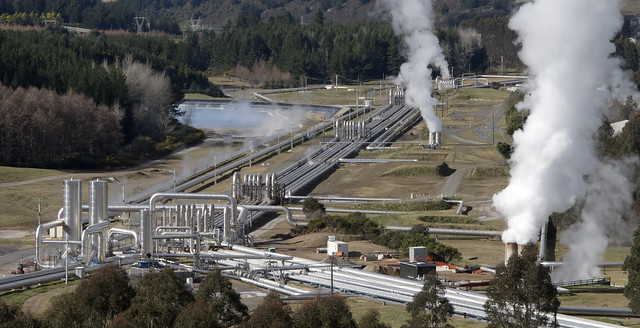
Wairakei in winter. By Duncan Foley. Pipe to Powerplant at Wairakei outlook taken July 27, 2012. GRC Photo Contest 2012.
Contact Energy is proud of the historic role the Wairakei Geothermal Power Station has played in pioneering geothermal generation, Contact’s CEO Dennis Barnes says.

In acknowledging the 60th anniversary of the station this week (Thursday 15 November 2018), Mr Barnes said Wairakei was a success story when it came to renewable energy. Geothermal generation is a core and growing part of Contact’s operations.

Wairakei, which was opened in 1958, is the world’s second oldest geothermal power station and the first to use wet steam technology. It has contributed renewable electricity to the national grid, and made a substantial contribution to the local economy and surrounding communities.

Read More........

From the Global Geothermal News archives:

Indonesia: 35 Kamojang-5 Geothermal Power Project Wins Major Engineering Award

PT Rekayasa Industri (Rekind) Won the ASEAN Outstanding Engineering Achievement Award 2018 (News Release)

The Geothermal Power Plant Project (PLTP)
Kamojang 5 Project (Courtesy PT. Rekayasa Industri)

President Director of Rekind, Yanuar Budinorman asserts that the company won the award for the EPCC Project - Total Geothermal Project of Kamojang-5 1x35 MW (KMJ5).

This project, which is situated in the same location as PLTP Kamojang-4, applies the method of gantry crane installation technology and sliding method for the installation of the main equipment of heavy lift category, as it had to be installed in the power house building that had been finished as per the schedule. Meanwhile, for the stage of the Fluid Collection and Reinjection System (FCRS) steam pipe testing, the method of Initial Service Test (IST) was chosen as the alternative Hydraulic Test at the FCRS pipeline to reduce cost and time. By means of IST method, the pipe testing stage could be finished within one day, much faster than the Hydraulic Test method that might last for one month.

United Kingdom: Geothermal Spa Project Reaches 30 Degree Celsius Water at 410 Meters

Jubilee Pool geothermal spa to have even hotter water than expected (Cornwall Live)

It was like striking gold for the team behind the hot rocks bonanza in Penzance


The Jubilee Pool geothermal spa will be hotter than expected and that means the water will reach temperatures of up to 30 degrees C.

Geothermal Engineering Ltd (GEL), the company which has been drilling holes into the earth below the famous Jubilee Pool to tap into the earth's natural heat, said it found a warm water 'geothermal vein' 410 metres deep into the rock below Penzance's iconic sea water open air Lido.

The company, which is also involved in building the UK's first ever geothermal power plant at United Downs near Redruth, where it is drilling two 4.5 km deep holes into the earth's crust as part of a £18m EU-funded project with the potential to power 3,000 homes, said the hot water will now be tapped up to heat a section Jubilee Pool all year round.

GEL managing director Ryan Law said hitting the warmer than expected hot water vein was like 'striking gold'.

He said: "We are delighted that we have hit the hot water vein," said. "It is warmer than expected and capable of yielding much more geothermal energy than planned.

Read More..........

USA, California: Workshop on Lithium Recovery from Geothermal Brine

Geothermal Grant and Loan Program Workshops (California Energy Commission)


Lead Commissioner Workshop on Lithium Recovery from Geothermal Brine

Thursday, November 15, 2018, 1-5 p.m., California Energy Commission, Sacramento, California 95814-5512

Also Remote Access by Computer or Phone via WebEx™

Lead Commissioner David Hochschild and California Energy Commission staff will seek input from stakeholders including developers of lithium recovery technologies, lithium marketers, geothermal facility operators, investors, local governments, and state and federal agencies involved in lithium recovery from geothermal brine.

The workshop will include presentations and panel discussions on the following topics:
  • Demand for Development - discussion on the demand for lithium and the additional benefits development of lithium extraction can bring to the geothermal community, local municipalities, battery manufacturers, and the state.
  • Barriers and Opportunities - discussion on the current state of lithium recovery and production in California, the barriers that need to be overcome to expand production, and the opportunities lithium recovery offers for stakeholders and government agencies.
  • Policy and Funding Priorities - discussion of the needs and opportunities for policy and financial support of the entire lithium production process and what may be needed to mitigate risks for citizens, investors, developers and the state.  

Wednesday, November 14, 2018

Canada: MGX Minerals Patent Combines Geothermal Steam and Electricity Production with Wastewater Treatment and Mineral Extraction Technologies

MGX Minerals Announces Patent Acceptance For Low Cost Combined Heat And Power Cogeneration (News Release)


MGX Minerals of Vancouver, BC, Canada, has announced patent acceptance for low cost combined heat and power cogeneration (CHP) for heavy oil and oilsands producers; combines steam and electricity production, with wastewater treatment and mineral extraction technologies.

MGX Minerals Inc. and engineering subsidiary PurLucid Treatment Solutions Inc. are pleased to announce they have received notice of publication of its patent for a new method to produce boiler feed water using low energy water treatment. The technology will facilitate using poor quality water to tri-generate electricity, pure water and minerals.

The system was designed within a consortium, including MGX, PurLucid and David Bromley Engineering Ltd for the generation of electricity and excess steam for thermal oil recovery and extraction of lithium, vanadium and other minerals. The design, utilizing highly charged Replaceable Skin Layer (RSL™) membranes as a replacement for softening and ultrafiltration, substantively reduced cost and energy requirements while providing electricity for sale or internal use.

Read More..........

From the Global Geothermal News archives:

Indonesia: PT Pertamina Geothermal Energy Looking at Developing 70 MW Resource in West Java

Pertamina Geothermal Energy (PGE) Targeting Gunung Guntur Geothermal Energy Garut regency, West Java Province (Asean Power)

PT Pertamina Geothermal Energi (PGE), a subsidiary of PT Pertamina (Persero), geothermal manager of the Kamojang Area, West Java, eyeing the Gunung Masigit hotspot in the Gunung Guntur area, Tarogong Kaler District, Garut Regency. This geothermal area is next to the Kamojang Area. According to data from the Garut Regency Government, the geothermal energy in Gunung Masigit has a potential of around 70 MW.

PT PGE’s Managing Director, Ali Mundakir, said that PGE is planning to expand the geothermal utilization area in the Garut region, including planning to manage the geothermal on Mount Masigit in the Guntur Mountain area. For this reason, PGE is taking care of changing zone status so that it enters the Geothermal Working Area (WKP) of Kamojang Darajat.

Read More........

Indonesia: Geothermal Preliminary and Exploration Survey Area Up for Auction in West Sumatra

Ministry of Energy and Mineral Resources (ESDM) Auction for Geothermal Areas in West Sumatra (Asean Power)

The Ministry of Energy and Mineral Resources (ESDM) through the Directorate General of Renewable Energy and Energy Concertation (EBTKE) again auctioned geothermal Preliminary and Exploration (WPSPE) Survey Areas.

The WPSPE offered is WPSPE Bonjol, located in Pasaman Regency, West Sumatra Province. The potential capacity is estimated at 200 megawatts (MW) with a land area of ​​7,441 hectares.

ESDM Director General of Geothermal Energy, Ministry of Energy and Mineral Resources Ida Nuryatin Finahari said the implementation of the offer will last for 1 month. The auction document must be submitted no later than the interested business entity on November 21, 2018.

The business entity designated as the winner will conduct a Pre Transaction Agreement (PTA) with PT PLN (Persero) after exploration is complete and a Geothermal Permit is issued. The reference price of electricity in the PTA referred to follows the provisions of the legislation.

Read More..........

USA, Pennsylvania: Mining Engineer Believes State Should Utilize Mine Water Geothermal Resources

Opinion - Leadership Opportunity: Pennsylvania Should Make Mine Water Geothermal A Key Part Of Its Clean Energy Transformation (PA Environment Blog)

By Michael C. Korb, P.E., Senior Mining Engineer, Tetra Tech, Inc.

One of Pennsylvania’s potential sources of water for geothermal systems is mine-water pools. Heating and cooling buildings with mine-water makes use of what was previously thought of as a dirty problem. 

Application of this technology is also proven for almost 40 years. 

Mine-water geothermal can give many areas of the Commonwealth a rather remarkable source of heating/cooling which is perhaps the most economical, energy-efficient, low carbon footprint scheme. 

There are currently mine-water geothermal operating systems in Nova Scotia, Scotland, Netherlands, Missouri; and Scranton, Pennsylvania. 

Mines that are flooded with water - mine pools - are essentially almost unlimited aquifers.  Mine-water geothermal projects are feasible when there is a mine pool located nearby. 

Pennsylvania should recognize that mine pools are underutilized energy sources, should be considered community assets, and should encourage their use for future sustainable energy projects.  

District heating and cooling utilizing mine-water geothermal could be a “community-based approach focused on long-term economic diversification and recovery of communities formerly dependent on coal.” 

Iceland: First Electricity at Climeon Geothermal "Heatpower" Plant in Fludir

Electricity Generated at Fludir Geothermal Power Plant (LinkedIn)

Christopher Engman, CRO/CMO of Climeon, has announced that electricity has been produced at Varmaorka's geothermal heatpower plant in Fludir in Iceland. Christopher says this is the first step to the first 29 MW. Watch the Video.......

From the Global Geothermal News archives:

Finance: Over USD 50 Million Available for Renewable Energy Projects in Developing Countries

Abu Dhabi Fund for Development Loans Worth over US$50 Million Available (News Release)

Seventh funding cycle of IRENA/ADFD Project Facility now open for applications from government-backed projects in developing countries

Abu Dhabi Fund for Development (ADFD) and The International Renewable Energy Agency (IRENA) are inviting applications for more than US$50 million in funding through the IRENA/ADFD Project Facility. The ADFD-financed initiative is available to government-guaranteed renewable energy projects in developing countries that seek to increase energy access, improve livelihoods and advance sustainable development.

ADFD has committed US$350 million (AED1.285 billion) in concessionary loans over seven annual funding cycles to renewable energy projects recommended by IRENA.

The facility welcomes proposals for projects – especially those submitted by ministries, public utility entities and rural electrification agencies – that are able to obtain a government guarantee for the ADFD loan.

The projects selected for the sixth funding cycle will be announced in January 2019. Summary applications for the seventh cycle will be accepted until 17:00 GST on 14 February 2019.

Finance: Cryptocurrency Fund Focuses on Geothermal Research and Development

Interview with Jason “Bitbender” Brink, Project Director, Vulcano (bitcoinwarrior.net)

Vulcano is a Proof-of-Stake and Masternode-based cryptocurrency with a focus on geothermal research and development. Named after the Vulcano island in the Tyrrhenian Sea, a geothermally active area, Vulcano strives to use blockchain and distributed consensus to help contribute to raising funds for the advancement of earth-science based technologies such as geothermal power. With a heavy focus on community, Vulcano strives to become a strong community-based effort to advance scientific research.

Why did you decide to pivot the coin away from being “high-staking” into a focus on geothermal energy research?

Geothermal, on top of being a personal passion of mine, was chosen somewhat by the name of the project. What else can you do with something called “Vulcano”? It wasn’t even “volcano.” Given this, I knew I needed to find something that would work for the project, wasn’t already a red-ocean market in terms of crypto use cases and would enable us to stabilize the project and grow. Geothermal stood out early on because its an area of science that could use more help in terms of research, but has never been explored in terms of crypto projects. We could move into that area, apply our skills, and have a tangible positive impact on research. Just this week we funded our first project and will be announcing that to the community shortly.  Volcano Whitepaper.........

Education: Free Course on Geothermal Energy

Free course - Energy resources: Geothermal energy (The Open University)
  • Free statement of participation on completion
  • 4 hours study
  • Download for use offline 
  • Free!!
This course considers geothermal energy derived from the interior heat of the Earth. It looks at the most favourable areas for geothermal exploitation, heat production, geothermal power plants and the pros, cons and future of geothermal energy.
  1. Geothermal energy
  2. High- to medium-enthalpy steam fields
  3. Hot dry rock (HDR) fields
  4. Locating high-enthalpy geothermal fields
  5. Geothermal power plants
  6. Direct heating using geothermal energy
  7. The pros and cons, and future of geothermal energy
The Open University is a public distance learning and research university, and the biggest university in the UK for undergraduate education.


Download this course for use offline or for other devices:

Kazakhstan: Central Asian Republic Looks to Geothermal Energy for Power and Heat

Kazakhstan eyes to use underground hot water to obtain light and heat (Trend News Agency)

(Courtesy CIA.gov)

Almost 40 percent of Kazakhstan's territory is rich with geothermal hot water. The experience of its use is applied in many states, including Iceland, the US, Canada, and Turkey. In the near future, the first geothermal power station works on which have already started, will appear in Kazakhstan, bnews.kz reported.

Underground resources will generate electricity and heat.

A geothermal power station has a unique distinction which is its operation irrespective of a solar cycle, wind and other weather changes, important for Kazakhstan with an extreme continental climate. The station's efficiency is 96 percent, by 5 times higher than that of solar panels.

Meanwhile, following the preliminary data, the country has a sufficient amount of resources so to provide at least 1/4 of the territory with hot water.

Read More.........

Europe: EU Clean Energy Package Sets 32% Binding Target for Renewables in 2030

Renewable, Energy Efficiency and Governance Directives voted by the European Parliament allow development of geothermal energy beyond 2020 (EGEC)

Framework allows for the accelerated development of geothermal energy - EGEC

The European Geothermal Energy Council (EGEC) welcomes the adoption of the Renewable Energy Directive, the Energy Efficiency Directive and the Governance Regulation by the European Parliament today. The new legislations will be the basis for the European climate and energy regulatory framework after 2020. While they do not quite point to the right level of ambition, they lay out a framework that allows the accelerated development of geothermal energy.

The EU Clean Energy Package sets a 32% binding target for renewables in 2030, and a – regrettably indicative – target of 32.5% energy efficiency improvements.

EGEC was among the few organisations openly advocating for binding ambitious targets for renewable energy and energy efficiency, an attestation of their complementarity.

The new set of legislations also includes a sectorial obligation to increase by 1.3 percentage point the share of renewables in heating and cooling at the national level annually.

Philippe Dumas, EGEC Secretary General commented “The introduction of a sectorial obligation to increase the penetration of renewable heating and cooling is a positive signal for geothermal and lets us expect that strong policies will be implemented to decarbonise a sector which represents nearly half of the EU’s energy demand”.

Read More.........

Antarctica: Geothermal Anomaly Discovered Under Ice Sheet

Discovery of high geothermal heat at South Pole (Phys.Org)

Scientists have discovered an area near the South Pole where the base of the Antarctic Ice Sheet is melting unexpectedly quickly. Using radar to look through three km of ice, the team found that some of the ice – covering an area that's twice the size of Greater London – appeared to be missing. The results are published this week in the journal Scientific Reports.

This new study explains how an unusual amount of geothermal heat has melted, and continues to melt, the base of the ice, resulting in the ice sheet layers above sagging downwards.

The team believes the heat source is a combination of unusually radioactive rocks, and hot water coming from deep under the ground. This heat melts the base of the ice sheet, producing melt-water which drains away beneath the ice sheet filling subglacial lakes downstream. The presence of this extra water may help lubricate the fast flowing ice in this area.


Tuesday, November 13, 2018

Spain: Plan to Source 70 Percent of Electricity from Renewables by 2030

Spain sets out plan for 100% renewable electricity by 2050 (The Independent)

(Courtesy CIA.gov)
Spain has set out plans to switch entirely to renewable electricity by 2050, with goals that go further than current European Union plans.

Under the new strategy, greenhouse gas emissions from Spain would be cut by 90 per cent compared to 1990 levels by the middle of the century.

The nation intends to invest massively in wind and solar power over the next decade, while banning new licences for fossil fuel drilling and fracking wells.

It is also planning to source 70 percent of electricity from renewables by 2030, and 100 percent by 2050. In 2017 Spain got roughly a third of its power from renewable sources such as sunlight, wind, rain, tides, waves, and geothermal heat.

Finance: IEA Forecasts Biggest Geothermal Capacity Additions in Indonesia, Kenya, Philippines and Turkey

World Energy Outlook 2018 examines future patterns of global energy system at a time of increasing uncertainties (IEA)

Global geothermal power capacity is expected to rise to just over 17 GW by 2023

Major transformations are underway for the global energy sector, from growing electrification to the expansion of renewables, upheavals in oil production and globalization of natural gas markets. Across all regions and fuels, policy choices made by governments will determine the shape of the energy system of the future.

At a time when geopolitical factors are exerting new and complex influences on energy markets, underscoring the critical importance of energy security, World Energy Outlook 2018, the International Energy Agency’s flagship publication, details global energy trends and what possible impact they will have on supply and demand, carbon emissions, air pollution, and energy access.   

In the Renewables 2018 forecasts, the share of renewables in meeting global energy demand is expected to grow by one-fifth in the next five years to reach 12.4% in 2023.

Renewables will have the fastest growth in the electricity sector, providing almost 30% of power demand in 2023, up from 24% in 2017. During this period, renewables are forecast to meet more than 70% of global electricity generation growth, led by solar PV and followed by wind, hydropower, and bioenergy.

In 2017, global geothermal power generation stood at an estimated 84.8 TWh, while the cumulative capacity reached 14 GW. Global geothermal power capacity is expected to rise to just over 17 GW by 2023, with the biggest capacity additions expected in Indonesia, Kenya, Philippines and Turkey.

New Zealand, Canada: Subsurface Geoscience and Modeling Software Companies Merge

Seequent Acquires Geosoft: Merger of Leapfrog and Geosoft Brands Creates Subsurface Geoscience and Modelling Powerhouse (News Release)

Seequent of Christchurch, New Zealand, today announced it has signed an agreement to acquire Geosoft, a Canadian geoscience software company headquartered in Toronto with offices around the world.

The acquisition brings together Seequent’s Leapfrog 3D geological modelling software suite with Geosoft’s subsurface geoscience and exploration dataset technology – to create an unparalleled subsurface offering for the mining, civil engineering, energy and environmental sectors.

Seequent is known worldwide for its Leapfrog 3D geological modelling solutions. First introduced to the mining and minerals industry close to 15 years ago, Leapfrog helps uncover valuable insights from geological data and enables geologists and executives alike to confidently make critical time-sensitive investment and environmental decisions. The company has since launched Leapfrog versions for the geothermal and energy industries and civil engineering and environmental industries, as well as other visualisation and collaboration technologies.

Geosoft’s Oasis montaj® technology platform is an industry standard within the geosciences, supporting advanced analysis and understanding of the Earth’s subsurface and subsea environments. The company’s Target for ArcGIS software is the market-leading geological application for Esri, delivering essential workflows for geoscience and GIS professionals working on the ArcGIS platform. With its release of VOXI Earth Modelling, Geosoft pioneered the use of high performance geocomputing and 3D geophysical inversion modelling in the cloud.

Read More.........

USA: Geothermal Expert is New Director of National Energy Technology Laboratory

Scientist Brian Anderson Named Director of National Energy Technology Laboratory (Executive Gov)

Brian Anderson
GRC Member Brian Anderson, former director of West Virginia University (WVU)'s Energy Institute, has joined the Department of Energy (DOE) as director of the National Energy Technology Laboratory (NETL).

He succeeds Sean Plasynski, who now serves as NETL's deputy director and chief operating officer, the DOE said Friday.

The appointment continues Anderson's previous involvement with NETL, where he coordinated a study on methane hydrate reservoir.

Anderson founded the WVU's Energy Institute in 2014 to foster collaborative research and development of new technologies.

Read More.........

From the Global Geothermal News archives: