Tuesday, February 18, 2020

Indonesia: 80 MW Muara Laboh Geothermal Power Plant Inaugurated

Supreme Energy Memulai Operasi Komersial PLTP Muara Labuh - Supreme Energy Begins Commercial Operation of Muara Labuh PLTP (Republika.co.id)

PT Supreme Energy Muara Laboh (SEML) yang merupakan perusahaan patungan PT Supreme Energy, ENGIE dan Sumitomo Corporation hari ini, Senin (17/2) meresmikan pengoperasian Pembangkit Listrik Tenaga Panas Bumi (PLTP) Muara Labuh untuk tahap I secara komersial. Founder & Chairman PT Supreme Energy Supramu Santosa mengatakan, kapasitas PLTP Muara Labuh ini sebesar 85 megaWatt.

(From Google Translate) PT Supreme Energy Muara Laboh (SEML), a joint venture of PT Supreme Energy, ENGIE and Sumitomo Corporation, today, Monday (17/2) inaugurated the commercial operation of stage I of the Muara Geothermal Power Plant (PLTP). PT Supreme Energy's Founder & Chairman Supramu Santosa said the capacity of the Muara Labuh PLTP was 85 megaWatts. 

Baca lebih lajut.........                         Read More.........

From the Global Geothermal News archives:

USA, California: "Geothermal is set to Become a Major Player in Renewable Energy"

California Ramping Up Its Reliance on Geothermal (AltEnergyMag)

California, spurred by concerns about the relationship between carbon emissions and climate change, is on track to transition to fully renewable energy production by 2045. Some of the biggest beneficiaries of the pivot to renewables have been wind and solar. Now, however, other renewables are starting to see significant growth.

After years of being overshadowed by solar and wind,  geothermal is set to become a major player in California's renewable energy. Here is how geothermal is growing in California right now, plus why experts believe the energy source is becoming popular.

Read More..........

Climate Change: World's Richest Man Unveils $10 Billion Fund to Address Climate Crisis

Jeff Bezos Commits $10 Billion to Address Climate Change (The New York Times)

The world’s richest man unveiled a fund to help climate scientists and activists, an escalation of his philanthropic efforts.

Public Domain - Wikipedia
Jeff Bezos, Amazon’s chief executive and the world’s richest man, said on Monday that he was committing $10 billion to address the climate crisis in a new initiative he called the Bezos Earth Fund.

The effort will fund scientists, activists and nongovernmental organizations, he said in a post on Instagram. Mr. Bezos, who has been pushed by Amazon employees on climate issues, said he expected to start issuing grants this summer.

“Climate change is the biggest threat to our planet,” he wrote. “I want to work alongside others both to amplify known ways and to explore new ways of fighting the devastating impact of climate change on this planet we all share.”

Read More..........

Global: Geothermal Photo Contest Announced

The Geothermal Resources Council Announces 2020 Photo Contest (News Release)


Winners will be announced at the GRC Annual Meeting in Reno, Nevada, USA. 
The Geothermal Resources Council (GRC) is pleased to announce this year’s Geothermal Photo Contest. The contest serves to showcase the talent of the geothermal community as well as the beauty and intrigue found in every aspect of the geothermal industry.

The winners will be announced and prominently displayed at the GRC Annual Meeting & Expo being held in Reno, Nevada, USA from October 18-21.

Geothermal provides our communities long-term jobs and economic benefits while supplying low-cost, low-impact energy with innovative technologies. For the 2020 photo contest, GRC is soliciting submissions in 3 categories that help raise awareness of the benefits of geothermal energy:
  • Jobs: Providing long-term, wage earning jobs
  • Low Impact: Providing low geographic impact, water use & emissions
  • Innovation: Showcasing research & development of new technologies
Awards will be presented to the winners at the GRC Annual Meeting. Winners of each category will receive $100. The award checks will be drawn from a U.S. bank.

More information on the GRC Geothermal Photo Contest, including a Submission Form, can be found on the GRC Annual Meeting & Expo website. The deadline for submissions is July 31, 2020.

Friday, February 14, 2020

Geothermal Energy News from Around the World

Global Geothermal News - Weekly Update (Geothermal Resources Council)


A round-up of this week's international geothermal energy news.......

Click on the links below
to view the whole story and other news on Global Geothermal News.

Netherlands: Employment Opportunity as Experimental Engineer in Geothermal Energy

Vacancy - Experimental engineer for execution of large-scale experiments for geo-energy (TNO)

Location: Rijswijk, Netherlands
Deadline: March 10

As an experimental engineer at TNO Applied Geosciences (AGS) you will focus on the execution of large-scale experiments for a variety of subsurface energy domains (such as geothermal, carbon storage, storage and oil and gas), particularly around well issues. The experiments are simulating the subsurface conditions, implying experimental conditions at different temperature and (high) pressure regimes.

More Information..........                          Apply.........

Science & Technology: Flow Control Devices Helps in Mitigating Against Thermal Breakthrough in Geothermal Reservoirs

From Oil & Gas to Geothermal: flow control devices (Phoenix RDS)

Flow control devices (FCDs) or inflow control devices (ICDs) have been utilized for many years in well completions in the oil and gas industry. They are down hole tools or equipment designed to promote uniform flow in or out of a well by inducing pressure drop. Devices utilized in injection wells have been referred to as outflow control devices (OCDs) while those in production wells are referred to as inflow control devices (ICDs). FCDs have been successfully utilized in improving oil and gas production through secondary and tertiary recovery methods. They have been used in preventing water/gas breakthroughs. More recently they have been applied to Steam Assisted Gravity Drainage (SAGD) improving recovery in these reservoirs.

(A1) No Flow control –
inefficient zonal heat extraction
(A2) Flow control –
controlled, efficient zonal heat extraction
Reservoirs of hot water that exist at varying temperatures and depths below the Earth’s surface. These conventional systems are often referred to as hydrothermal systems and they naturally possesses all major components (heat >150C; fluid; and permeability) of geothermal systems. In these systems heat is transferred by convection. In these high temperature systems, injection flow control is an effective tool for reservoir management mitigating against thermal breakthrough and to increase productivity. Examples include a number of power plants throughout the Philippines including Gunung Salak, Mindanao, and Palinpinon. The application of FCD’s here can contribute greatly towards reservoir management increasing the longevity of the resource (See A1 & A2 above).

Read More..........

Science & Technology: Researchers Determine Potential for Occurrence of M > 2.0 Seismicity for Geothermal Operations in Sandstone Target Formations in the Netherlands is Low

Review of induced seismicity in geothermal systems worldwide and implications for geothermal systems in the Netherlands (Cambridge Core)


Here we review the occurrence (or the lack) of felt seismic events in geothermal systems worldwide and identify key factors influencing the occurrence and magnitude of these events. 

Based on this review, we project the findings for seismicity in geothermal systems to typical geothermal formations and future geothermal developments in the Netherlands. 

The case study review shows that doublets that circulate fluids through relatively shallow, porous, sedimentary aquifers far from the crystalline basement are unlikely to generate felt seismic events. On the other hand, stimulations or circulations in or near competent, fractured, basement rocks and production and reinjection operations in high-temperature geothermal fields are more prone to induce felt events, occasionally with magnitudes of M > 5.0. 

Many of these operations are situated in tectonically active areas, and stress and temperature changes may be large. The presence of large, optimally oriented and critically stressed faults increases the potential for induced seismicity. 

The insights from the case study review suggest that the potential for the occurrence of M > 2.0 seismicity for geothermal operations in several of the sandstone target formations in the Netherlands is low, especially if faults can be avoided. The potential for induced seismicity may be moderate for operations in faulted carbonate rocks. 

Induced seismicity always remains a complex and site-specific process with large unknowns, and can never be excluded entirely. However, assessing the potential for inducing felt seismic events can be improved by considering the relevant (site-specific) geological and operational key factors discussed in this article.

Read More..........

Review of induced seismicity in geothermal systems worldwide and implications for geothermal systems in the Netherlands by Loes Buijze, Lonneke van Bijsterveldt, Holger Cremer, Bob Paap, Hans Veldkamp, Brecht B.T. Wassing, Jan-Diederik van Wees, Guido C.N. van Yperen, Jan H. ter Heege. Part of: Netherlands Journal of Geosciences, Volume 98 - Geothermal Energy. Published online by Cambridge University Press: 12 February 2020, e13.

From the Global Geothermal News archives:

USA, California: Register For The GRC/SPE High-Temperature Well Cementing and Integrity Workshop

Don't Forget To Register For The GRC/SPE High-Temperature Well Cementing and Integrity Workshop (News Release)

Early Bird Rates Expire March 1, 2020


The workshop will highlight cement formulae and slurry blends, placement methods, remedial procedures and result evaluations. Case studies will be discussed and analyzed.

All drilling personnel, both geothermal and oil & gas drilling and production engineers, well-site supervisors, cementing engineers and interested personnel are encouraged to Register........

Sponsorships Available!

Be part of advancing technology while maximizing your company’s exposure to both the geothermal & oil and gas industries. Become A Sponsor..........

Thank you to our Workshop Sponsors!


Peru: Geothermal Potential of More than 3,000 MW - EDC Manager

Potencial geotérmico peruano equivale al 50% de la electricidad que producimos - Peruvian geothermal potential equals 50% of the electricity we produce (Rumbo Minero)

EDC Peru plans to invest more than US $ 1 billion to build two geothermal plants in Arequipa and Moquegua that will initially produce 200 MW.

(Courtesy CIA.gov)
“El Perú cuenta con un potencial geotérmico de más de 3,000 MW, que equivalen al 50% de la electricidad que se produce hoy en todo el país, gracias a nuestra estratégica ubicación sobre el Cinturón de Fuego del Pacífico”, sostuvo Franklin Acevedo, gerente general de Energy Development Corporation Perú (EDC Perú), empresa especializada en geotermia que viene desarrollando proyectos en el sur del país.

(From Google Translate) "Peru has a geothermal potential of more than 3,000 MW, equivalent to 50% of the electricity produced today throughout the country, thanks to our strategic location on the Pacific Ring of Fire," said Franklin Acevedo, manager General of Energy Development Corporation Peru (EDC Peru), a geothermal company that has been developing projects in the south of the country.

Lee mas.........                               Read More.........

Thursday, February 13, 2020

USA: 2020 Promises to be an Exceptional Year for Geothermal “on the Hill”

Excerpt from the Geothermal Magazine

2020 Promises to be an Exceptional Year for Geothermal “on the Hill”

Volume 49, No. 1 of the internationally-renowned geothermal energy magazine is now available - for GRC Members only.

Here is a free excerpt from the Executive Director of the GRC.

Science & Technology: Geothermal Drilling in Search of Supercritical Fluids - Looking for the Eureka Moment

Want Unlimited Clean Energy? Just Drill the World's Hottest Well (Wired)

Geothermal Sunset, by Fabio Sartori. GRC Photo Contest 2019.
Nuova Monterotondo geothermal power plant, Italy.
An engineering team bored 2 miles into hot rock without causing major earthquakes—a good sign for harnessing the Earth's heat as a power source.

There’s treasure buried deep beneath the viridescent foothills of Tuscany’s Apennine Mountains, where the stark metal trusses of the Venelle-2 drilling tower mark its location like an X on a map. This geothermal well reaches nearly two miles beneath the surface to a region where temperatures and pressures are so high that rock begins to bend.

Here, conditions are ripe for supercritical geothermal fluids, mineral-rich water that exhibits characteristics of both a liquid and a gas. It’s not exactly gold, but if Venelle-2 could tap into a reservoir of supercritical fluids and use them to spin a turbine on the surface, it would be one of the most energy-dense forms of renewable power in the world.

Drilling at Venelle-2 stopped just shy of the K horizon when temperatures at the bottom of the well overwhelmed the equipment. Sensors at the bottom of the well indicated temperatures had breached 1,000 degrees Fahrenheit and pressures 300 times greater than at the surface. Nevertheless, Venelle-2 is the hottest borehole ever created, and it demonstrated that it's possible to drill at the extreme end of supercritical conditions.

Read More.........

Riccardo Minetto, Domenico Montanari, Thomas Planès, Marco Bonini, Chiara Del Ventisette, Verónica Antunes, Matteo Lupi. Tectonic and Anthropogenic Microseismic Activity While Drilling Toward Supercritical Conditions in the Larderello‐Travale Geothermal Field, Italy. Journal of Geophysical Research: Solid Earth, 2020; 125 (2) DOI: 10.1029/2019JB018618

Kenya: Using Simulators for Virtual Training in Drilling Geothermal Steam Wells

Kenya’s Geothermal Agency Turns to Virtual Training of Staff (Africa Sustainability Matters)

The specialized simulator provides a detailed experience of drilling operations on a virtual rig illustrating processes such as pipe-handling, tripping in, tripping out, mud system operation, cementing operations & well control training.
Geothermal Development Company (GDC) has installed simulators at its training complex for virtual training of its technicians on drilling steam wells.

GDC, which is fully owned by the government, is running the simulation training at its Geothermal Centre of Excellence in Nakuru, in Kenya’s Rift.

“By simulating actual drilling conditions and procedures, our rig operators gain more experience in handling different drilling conditions,” the company said in an update.

“Our specialised simulator provides a detailed experience of drilling operations on a virtual rig illustrating processes such as pipe-handling, tripping in, tripping out, mud system operation, cementing operations and well control training.”

Philippines: Bringing the 60 MW Mahanagdong B Geothermal Power Plant Back Online after Earthquake

Reinstating Vital Power Infrastructure in the Philippines Under Challenging Conditions (Jacobs)

Image courtesy of Energy Development Corporation
Jacobs’ rectification work to reinstate the Mahanagdong B power plant in Leyte following earthquake delivers strong safety and sustainability outcomes, winning two prestigious awards.

When an earthquake measuring 6.5 on the Richter scale struck the island of Leyte in the Eastern Visayas region of the Philippines in mid-2017, it caused multiple fatalities, injuries and significant damage to critical local infrastructure. The Mahanagdong B 60 MW geothermal power plant sustained severe damage, and power supply to the whole of the Eastern Visayas region and nearby Bohol island was interrupted.

USA, California: Opportunities for Geothermal - Lithium Coproduction

The California Lithium Supply Chain Opportunity

Alexander Grant, CEO & Principal, Jade Cove Partners

Presented at the California’s Lithium Recovery Initiative symposium hosted by the California Energy Commission, Wednesday, 12 February, 2020.


France: Geothermal Resource Council Scholarship Application to be Announced Soon

Omar Rodriguez Villarreal, doctorant en Génie Civil, remporte un prix international de géothermie - Le prix « Marcelo Lippmann » - Omar Rodriguez Villarreal, doctoral student in Civil Engineering, wins an international geothermal energy prize - The “Marcelo Lippmann” Award (Université de Pau et des Pays de l'Adour )

Etudiant en Doctorat de Génie Civil, Omar Rodriguez Villarreal a remporté le prix « Marcelo Lippmann », décerné chaque année, par le « Geothermal Resources Council » (Conseil des ressources géothermiques) en novembre 2019.

(From Google Translate) Doctor of Civil Engineering student, Omar Rodriguez Villarreal won the "Marcelo Lippmann" prize, awarded each year by the "Geothermal Resources Council" in November 2019.

Lee mas..........                                    Read More..........

An announcement on this year's GRC Scholarship awards, including the Marcelo Lippmann Graduate Scholarship Award, will be made shortly - More Information.........

Kenya: Kengen Extends Tender Deadline to Build 140 MW Geothermal Power Plant at Olkaria

Tender to Build, Own, Operate, Transfer 140 MW Olkaria PPP Geothermal Power Plant (News Release)

Request for Qualifications of Bidders for the Financing, Design, Supply, Construction, Commissioning, Operation and Maintenance of the 140MW Olkaria PPP Geothermal Power Project Located at Olkaria, Nakuru County on a Build, Own, Operate, Transfer (BOOT) Basis
  • Date Tender Closes : February 21 (Extended from Feb 5)
Aerial View of Olkaria PPP Project Location
To achieve its capacity expansion plans, KenGen is working in close collaboration with the National Treasury to develop a 140 MW greenfield geothermal power plant through a Public Private Partnership (PPP). Kenya approved a framework for developing and implementing infrastructure PPPs under the PPP Act of 2013 which led to the promulgation of PPP regulations in 2014.

The Olkaria geothermal field is in Naivasha, approximately 120 km northwest of Nairobi. The Project area is in the northeastern sector of the Olkaria geothermal field. The power plant location is next to the existing Olkaria II power station and will interconnect to the grid at the Olkaria I AU switchyard. The site is within an area leased by KenGen from the Kenya Wildlife Service.

The Project will consist of a geothermal power generating facility and associated interconnection facilities with a capacity of approximately 140 MW at site reference conditions, to be specified in detail within the RFP.

More Information.........

Spain: Can Geothermal be a Bridge to the Renewable Energy World for Oil & Gas Companies - Submit an Abstract

American Association of Petroleum Geologists (AAPG) - International Conference and Exhibition


28 September - 1 October, Madrid, Spain

Call for Abstracts (Oral Presentations or Posters) Open — Submit Now!
Submission Deadline: 20 February 2020

The American Association of Petroleum Geologists (AAPG), in conjunction with the Association of Spanish Geologists and Geophysicists of Petroleum (AGGEP), is proud to host the 2020 International Conference and Exhibition (ICE) at IFEMA – Feria de Madrid in Madrid, Spain, 28 September–1 October 2020. Now is the time to share your knowledge, insights, and research to help guide our geosciences community to expand frontiers and unlock resources for future generations.

The Technical Program Committee invites you to submit abstracts for oral presentations or posters, including the  theme/subthemes listed below, that have direct application to the industry. In particular, abstracts that deal with the hottest, most relevant play areas, both domestic and international, are most desirable. The committee also encourages case studies that illustrate the successful implementation of new techniques and technologies. In addition, student participation is a priority — AAPG ICE is an invaluable opportunity to showcase graduate research that advances the industry.

Theme 7: Energy Transition
Subthemes:
  • CO2 CCS
  • Gas Storage
  • Geothermal - “Can geothermal be a bridge to the renewable energy world for oil & gas companies?
Malcolm I Ross is the co-chair of the Energy Transition theme, trying to get technical sessions (oral and posters) as well as a panel organized. Contact him at malcolm.ross@shell.com if you have any questions.

Submit Abstract.........                           More Information..........

Taiwan: Potential for 32 GW of Geothermal Capacity

Taiwan’s Alternative Energy Options (Taiwan Business Topics)

The small Chingshuei geothermal power plant
 in Yilan County. Photo: Wikipedia
A geothermal power plant operates similarly to a nuclear or coal-fired steam generator but with magma buried deep beneath the earth’s surface as its heat source. Unlike intermittent wind or solar resources, geothermal power can operate continuously and serve as baseload power. However, geothermal reservoirs are accessible from only a small portion of the earth’s surface.

Located along the seismically active Pacific Ring of Fire and replete with hot springs, Taiwan would seem a likely candidate for geothermal power development. The island has a long history of exploring geothermal power, having first considered its potential in the 1970s during the two international oil crises. But while such other countries as New Zealand and the Philippines took firm measures to develop the sector, Taiwan opted for nuclear power instead, largely abandoning geothermal.

Geologic surveys conducted by the government over the years have found that the geothermal potential in Taiwan could be as high as 32 gigawatts (GW) of installed capacity, which would be sufficient to supply most of Taiwan’s power needs. The administration’s goal for geothermal is modest, though. It plans to have only 200 megawatts (MW) of capacity in place by 2025 – less than 1% of the total renewable power target.

USA: No Major U.S. Geothermal Plant was Commissioned in 2019 - Factbook

2010s Deliver Decade of Clean Energy (BCSE)

An era of economic growth, reduced CO2 emissions and sharply falling energy costs for consumers

Over the past 10 extraordinary years, the United States has fundamentally overhauled how it produces, delivers and consumes energy. The 2020 edition of the Sustainable Energy in America Factbook – produced for the Business Council for Sustainable Energy by BloombergNEF, looks at the U.S. energy transformation of the past decade (2010 – 2019) and provides the annual update on the progress of energy efficiency, natural gas and renewable energy sectors in 2019 in America.
  • No major U.S. geothermal plant was commissioned in 2019. Unlike other renewable resources, geothermal projects have long project completion periods of 4-7 years. In addition, the technology lacks strong policy support and faces high development costs. These factors contributed to the low build volumes.
  • One geothermal plant currently sits in the EIA build queue. The 25 MW summer capacity Dixie Valley Power Partnership is currently slated to come online in Nevada in 2020. The plant is owned by AES and the company intends to sell power from the project into the California market.
  • The 2.9 MW of the Soda Lake Geothermal project in Churchill, Nevada was retired in 2019.
Download the Factbook........

Wednesday, February 12, 2020

Geothermal Event! Call for Papers - Deadline is May 27, 2020

GRC Annual Meeting 2020 - Call for Papers (News Release)


Geothermal Resources Council Annual Meeting will be held in Reno, Nevada, USA

The Geothermal Resources Council (GRC) has issued a call for papers for the world’s biggest annual geothermal energy conference taking place October 18-21, 2020, at the Peppermill Resort Spa & Casino, Reno, Nevada, USA.

The GRC Annual Meeting & Expo is the industry’s largest annual gathering of leading geothermal energy scientists, producers, renewable energy industry stakeholders, regulators, utilities, and key associated business leaders. The four-day event will offer technical, policy, and market conference sessions, educational seminars, tours of local geothermal and renewable energy projects, and numerous networking opportunities.

Nearly 1,000 attendees came to the 2019 GRC Annual Meeting and Expo from just under 40 different countries, highlighting the GRC’s role in connecting the global geothermal energy community. With increasing interest in geothermal as a reliable source of renewable energy providing both flexible and baseload power production around the world, the GRC is looking ahead to an even stronger international attendance in 2020. 

Commonwealth of Dominica: More Funding Sought for 7 MW Geothermal Power Project

Government Seeking Approval for $46.4m for Geothermal Risk Mitigation Project (Dominica Vibes)


Government is requesting approval to accept a $46.4 million dollar loan to further the geothermal energy project.

The request was tabled by Hon Minister for Blue and Green Economy, Fidel Grant tabled the request for authorization for credit facility from the International Development Agency for funding of the Geothermal Risk Mitigation Project.

In his contribution to the debate, Honorable Minister for Trade, Ian Douglas said, “In a couple of years- maybe even before 2030- when we have to begin repaying the loan, we would have developed the plant and started generating revenue from it. We are speaking about the small plant now which will give us a cheaper, more reliable source of energy than we have now.

He further disclosed that the necessary stakeholders have agreed to partner on this undertaking.


From the Global Geothermal News archives:

Sweden: Geothermal Heat Power Module Manufacturer Provides an Update

Climeon - Year-end report 2019 (News Release)

Net sales amounted to SEK 35.1 million (37.7) in the fourth quarter and increased significantly for the full year to SEK 116.8 million (58.9). The fourth quarter was eventful with a first order for power plants based on reciprocating engines, a strategic partnership to open up a new part of the geothermal market and Sea Trials with Virgin Voyages. Operating profit amounted to SEK -36.0 million (-32.7) in the quarter. The profit was affected by the planned increase in expenses and investments related to continued build-up of the organization. The order backlog totaled SEK 729.7 million (818.6) at the end of the quarter.

"It is now clear that the large roll-out of the Icelandic order will take longer than previously estimated, but we continue to believe in the Icelandic market and the need for a distributed baseload power. Both in Iceland and in Japan, our teams are working hard together with our customers to bring up a total of four power plants in the first half of 2020. Step by step, we continue to work towards our vision of delivering fossil-free heat power and becoming the world’s number one climate solver."

Read More.........

United Kingdom: Webinar on Geothermal Heat from Abandoned Coal Mines in Scotland

Webinar - Climate change solutions: Geothermal energy opportunities in Scotland (Scottish Enterprise)

Our webinar looks at how geothermal energy from minewater could help reduce carbon emissions and how your business could get involved. The following speakers are confirmed:
  • Andy McDonald, Head of Low Carbon at Scottish Enterprise
  • Professor Zoe Shipton, Professor of Geological Engineering at the University of Strathclyde
  • Dr Alison Monaghan, Geologist at the British Geological Survey

United Kingdom: United Downs Deep Geothermal Power Project Gets Investment Boost

Thrive Renewables to invest up to GBP 6.5M in the UK’s first geothermal electricity power plant being developed by Geothermal Engineering Limited (News Release)

Funding will enable final testing and power plant construction

Renewable energy investment company, Thrive Renewables, based in Bristol, England, today announces plans to invest up to £6.5 million in the UK’s first geothermal power plant being developed by Geothermal Engineering Ltd. The plant, which is on the United Downs Industrial Estate in Cornwall, aims to supply circa 3 MWe (Mega Watt electrical) of baseload electricity to the National Grid and up to 12 MWth of renewable heat for local use. 

So far, two wells have been successfully drilled, one of which is the deepest onshore well in the UK at 5.1km vertical depth, almost four times the height of Ben Nevis.  The wells are also the hottest in the UK with an expected temperature of over 190°C.  Initial flow tests show that the project will be capable of producing the UK’s first geothermal electricity. The project is now in its final testing phase.

Thrive Renewables is investing funds to complete the final rounds of testing and to build the geothermal power plant.  Radial turbines, powered by the energy from water heated deep in the earth, will generate enough renewable electricity to power approximately 6,500 UK homes and will be available 24 hours a day. There are also early stage plans to use the residual heat energy from the project to provide renewable heat locally.

Read More.........

USA, Washington D.C.: Hearing on Advanced Geothermal Research and Development Act

Full Committee Markup of H.R. 5374 The Advanced Geothermal Research and Development Act (House Science, Space, and Technology Committee)

Comments on H.R. 5374 starts at minute 53:59 and ends at 1:07:09
Both amendments passed by voice vote.


H.R. 5374, the Advanced Geothermal Research and Development Act, authorizes enhanced early-stage geothermal research programs at the Department of Energy (DOE). H.R. 5374 prioritizes the fundamental research needed to develop and test advanced technologies to better capture and utilize geothermal energy.

H.R. 5374 The Advanced Geothermal Research and Development Act.........

From the Global Geothermal News archives:

Tuesday, February 11, 2020

Global: Free Article from the GRC Bulletin - The Vikings and Geothermal Iceland

The Latest Geothermal News from the Geothermal Resources Council (GRC)

Free article from the GRC Bulletin - Volume 49, No. 1 - January/February 2020

The Vikings & Geothermal Iceland

The Geothermal Resources Council (GRC) has made available the latest GRC Bulletin, the voice of the global geothermal energy industry, published continuously since 1972. For over 47 years this magazine has provided the essential news and information for the international geothermal community.

The Bulletin is free with GRC Membership or subscribe (PDF) to six issues a year for $120.

The GRC has generously provided 10 pages from the latest issue for free! However, the full issue is 62 pages and available to download for GRC Members only.

This brand new article looks at why and when did the Vikings come to Iceland—the land of fumaroles, geysers, thermal waters, and volcanic eruptions. And what happened next? It’s quite a story. This is our gift for anyone going to the World Geothermal Congress 2020 in Reykjavík. Enjoy!

The GRC Bulletin is only available online to GRC members. To make sure of your copy join the GRC today!

Central Europe: Great Untapped Geothermal Potential of the Dráva Basin

New methods of geothermal potential assessment in the Pannonian basin (Cambridge Core)

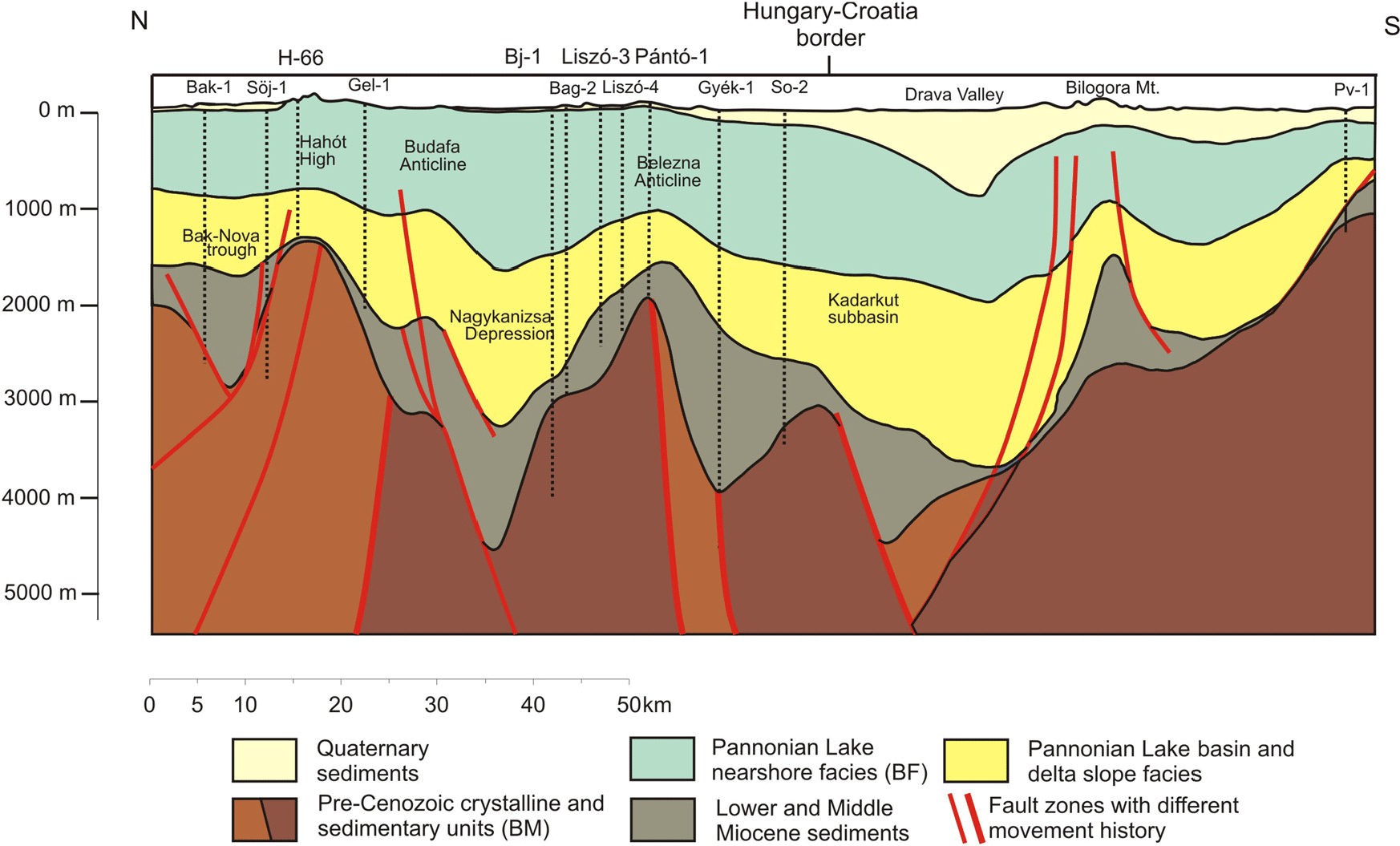
Geological cross section of the Dráva basin (Rotár-Szalkai et al., 2018).
The Pannonian basin in Central Europe is well known for its rich geothermal resources. Although geothermal energy has been utilised, mainly for direct use purposes, for a long time, there are still a lot of untapped resources.

This paper presents novel methods for outlining and assessing the theoretical and technical potential of partly still unknown geothermal reservoirs, based on a case study from the Dráva basin, one of the sub-basins of the Pannonian basin along the Hungarian–Croatian border.

The presented methods include reservoir delineation based on combining geological bounding surfaces of the Upper Pannonian basin-fill units with a set of isotherms deriving from a conductive geothermal model.

The geothermal potential of each identified reservoir was calculated by a Monte Carlo method, which was considered as being represented by the heat content of the fluids stored in the effective pore space (‘moveable fluid’).

The results underline the great untapped geothermal potential of the Dráva basin, especially that of the reservoir storing thermal water of 50–75°C, which has the largest volume and the greatest stored heat content.

Read More...........

New methods of geothermal potential assessment in the Pannonian basin by Annamária Nádor, László Sebess-Zilahi, Ágnes Rotár-Szalkai, Ágnes Gulyás, Tamara Markovic. Part of: Netherlands Journal of Geosciences, Volume 98 - Geothermal Energy. Published online by Cambridge University Press: 05 February 2020, e10.

Iceland: 90 MW Theistareykir Geothermal Power Plant Steam Supply System Explained

Steam Supply System for 90 MW Theistareykir Geothermal Power Plant - Design, Operation and Experience (Mannvit)

Theistareykir Geothermal Power Plant (Courtesy Mannvit)
The steam supply for Theistareykir Geothermal Power Plant is a single flash cycle providing steam for 2x45 MWe turbine units whereas the separated water is mixed with steam condensate from the units and reinjected. The steam supply has been in operation from end of 2016.

The paper “Theistareykir Geothermal Power Plant, description of the steam supply system: Design, operation and experience gained” describes the design and layout of the steam supply, the characteristics of the steam wells, operation and control strategy of the steam supply and its ability to cope with variable load.  More information on the geothermal project as a whole.

The steam supply system comprised of the steam wells, steam pipelines, steam gathering pipelines, steam separators, main steam pipelines, steam control valves, mist eliminators, reinjection pipeline, condensate mixing system and reinjection wells. The steam wells are located on five drilling areas from where most of the wells are directionally drilled. The average length of the wells is 2 500 m and their vertical depth ranges from 1 800 – 2 400 meters, each well producing steam in the range equivalent to 5-21 MWe of electrical power. In the operation of the wells, some of the wells have been shown to have fluctuation in the output and some decline has been noted.

Science & Technology: Geothermal Resource at 46 Degrees Celsius from Abandoned Coal Mines

Mine water heat under the PhD spotlight (Coal Authority)

Better understanding of a potential new energy resource for coalfield areas is being researched by a PhD student in conjunction with the Coal Authority.

University of Edinburgh student Mylène Receveur is being partly-sponsored by the Coal Authority to expand our understanding of the geothermal warming of mine waters.

Mylène’s thesis - Investigating geothermal heat resources of legacy mine workings, why are some mine waters hotter than others? - will explore the key controls that create differences between different sites.

When mines are abandoned and the pumps which kept them dry are switched off, the roadways, galleries and fractures fill with groundwater, which is heated by geothermal energy from the earth’s core to temperatures of 11 to 20°C close to the surface and up to 46°C in deeper coal seams.

Read More.........

USA, Alaska: State Senate Considers Geothermal Exploration Bill

Committee discusses geothermal exploration, hemp (Mat-Su Valley Frontiersman)

A bill that would resurrect a state leasing program for geothermal leasing was up for its first hearing in the Senate Resources Committee, Feb. 10.

In Senate Bill 161 geothermal exploration be licensed similar to the way oil and gas exploration licensing is done, with the license converted to conventional leases if a commercial-scale discovery is made.

The geothermal bill, SB 161, is likely to be amended to give added protection to surface landowners who use small-scale geothermal resources for local use, such as home heating, according to comments made during the hearing Monday on the bill. Alaska had an active geothermal leasing and exploration program several years ago when a Nevada company was interested in tapping high temperature hot water near Mount Spurr, an active volcano west of Anchorage. The exploration did not result a commercial development and the project was abandoned. The state program subsequently lapsed.

The bill would give the Department of Natural Resources more flexibility for geothermal leasing, extending the lease term from three to five years to allow an explorer more time for research, securing of surface permits and to do field work needed to prove up a resource. The bill also doubles the amount of acreage that can be held for exploration from 51,200 acres to 100,000 acres because underground geothermal resources tend to be dispersed over large areas.


From the Global Geothermal News archives:

USA, Utah: Video of Soda Lake Geothermal Power Plant

Geothermal Energy Now Helps Power University of Utah Campus (University of Utah)

(Video 0:50 Minutes)

As of Nov. 1, 2019—through a partnership with Utah-based Cyrq Energy and Rocky Mountain Power—a geothermal plant in Nevada now supplies campus with 20 megawatts of geothermal energy and will do so the next 25 years. This is the first time in its history the University of Utah will receive over half of its electricity from clean renewable sources. Total carbon emissions will be reduced by 23%.

From the Global Geothermal News archives:

USA, Utah: Soda Lake Geothermal Power Plant to Power University of Utah

Most of the University of Utah’s electricity will now be fueled by renewable energy (The Salt Lake Tribune)

Cyrq Energy to provide 20 MW over 25 years from the Soda Lake geothermal power plant

In a landmark energy deal, the U. has agreed to buy some of its power from a geothermal plant. And with it, the school will now get more than 50% of its electricity through renewable sources.

Negotiations on the much-anticipated agreement began in 2017 and were finalized this November. Under the partnership, the university will get 20 megawatts of geothermal power from a plant in Nevada. It’s such a massive buy that the U.’s electricity will now be fueled 53.7% by renewable energy. Before the contract, it was only 4.6%.
The U.’s contract for the power, made with the Utah-based company Cyrq Energy, which owns the geothermal plant in Nevada known as the Soda Lake Field, will include a fixed rate for 25 years. The university declined to disclose the price per unit, but said it’s comparable to what it currently pays for electricity.

Read More.........

From the Global Geothermal News archives:

Climate Change: Carbon Dioxide Emissions Stopped Growing in 2019, Thanks to Renewable Energy - IEA

Defying expectations of a rise, global carbon dioxide emissions flatlined in 2019 (IEA)

Despite widespread expectations of another increase, global energy-related carbon dioxide emissions stopped growing in 2019, according to IEA data released today.

After two years of growth, global emissions were unchanged at 33 gigatonnes in 2019 even as the world economy expanded by 2.9%. This was primarily due to declining emissions from electricity generation in advanced economies, thanks to the expanding role of renewable sources (mainly wind and solar), fuel switching from coal to natural gas, and higher nuclear power generation. Other factors included milder weather in several countries, and slower economic growth in some emerging markets.

Across advanced economies, emissions from the power sector declined to levels last seen in the late 1980s, when electricity demand was one-third lower than today. Coal-fired power generation in advanced economies declined by nearly 15% as a result of growth in renewables, coal-to-gas switching, a rise in nuclear power and weaker electricity demand.

Read More..........

USA, South Dakota: GRC Member Researches Using DNA Tracers to Track Geothermal Flows

Microbial community could help map the subsurface (Sanford Underground Research Facility)

Researchers ask microorganisms for directions through the subterranean networks they colonize

GRC member Yuran Zhang, a doctoral student at Stanford University and member of EGS Collab, works at the testbed at the 4850 Level of Sanford Lab. Photo courtesy Yuran Zhang.
Beneath our feet, rivers trickle, swell, then gush through natural fractures in the Earth’s crust. Studied extensively by geologists and reservoir engineers, these complex subterranean networks sidestep direct measurements, preferring to flow mysteriously through opaque passageways.

At a testbed on the 4850 Level of Sanford Underground Research Facility (Sanford Lab), researchers walk drifts adjacent to these pathways. Just inches from dribbling underground streams, researchers with Enhanced Geothermal Systems Collab (EGS Collab) are trying to find better ways to extract heat from the earth’s hot rocks for the Department of Energy’s FORGE project (Frontier Observatory for Research in Geothermal Energy). If the project is successful in extracting natural heat, it could one day act as an enormous, domestic, clean energy resource.

Traditionally, researchers use environmentally friendly chemical tracers to follow water traveling through the earth. By injecting a trackable chemical into the reservoir then taking samples at outlet locations downstream, researchers can get a sense of where and how quickly the water is flowing.

Due to the inflexibility of chemical tracers, researchers have begun developing tracers tagged with synthetic DNA. Unlike chemical tracers, DNA tracers have inexhaustible configurations, allowing them to be used for more complex reservoirs. Still, these injected tracers are only useful once researchers have established flow circulations between wells.

Read More.........

Iceland: Invitation to a Hackathon After World Geothermal Congress

Geothermal Hackathon 2020 (Agile)

Subsurface machine learning

Sat, May 2, 2020. 8 am. - Sun, May 3, 2020. 6 pm.
IÐNÓ, Vonarstræti 3, Reykjavík, Iceland

This is the inaugural event — be part of something new! Help us figure out how social coding events can help explore new technology in geothermal.

The theme is machine learning. We hope this is broad enough to let you take it where you want, from open data benchmarks to model for predicting fractures, or maybe you have some data for a predictive maintenance project, or want to look for trends in production time series. We will spend the first hour or so of the event defining projects and forming teams, so come ready to brainstorm!

You can put project ideas on the Ideas tab (above) when you sign up. And please join in the discussion on the Software Underground slack group; look for the #geothermal channel.

More Information...........

USA, Washington D.C.: Hearing on Advanced Geothermal Research and Development Act

Full Committee Markup of H.R. 5374 The Advanced Geothermal Research and Development Act (House Science, Space, and Technology Committee)

Wednesday, February 12, 2020 7:00 AM-11:00 AM
2318 Rayburn House Office Building, Washington D.C., USA

H.R. 5374, the Advanced Geothermal Research and Development Act, authorizes enhanced early-stage geothermal research programs at the Department of Energy (DOE). H.R. 5374 prioritizes the fundamental research needed to develop and test advanced technologies to better capture and utilize geothermal energy.

Check back for live video of this hearing.

H.R. 5374 The Advanced Geothermal Research and Development Act.........

From the Global Geothermal News archives:

USA, California: Symposium on Lithium Recovery from Geothermal Brine in the Golden State

California’s Lithium Recovery Initiative - Symposium (California Energy Commission)

Wednesday, February 12, 1-5 pm. 
Stanford University, California, USA

The California Energy Commission (CEC) and the Governor’s Office of Business and Economic Development (GO-Biz), will jointly host a symposium facilitating presentations and panel discussions on lithium recovery from geothermal brine in California.

The theme for this symposium is introducing California’s “Lithium Valley” vision of establishing a world-class lithium industry in the state. A focus is advancing California’s unique opportunity to recover lithium from geothermal brine in support of California’s clean energy future. The symposium will feature developers, policymakers, stakeholders, and customers involved from all aspects of the lithium supply chain.

More Information and Register..........

Monday, February 10, 2020

New Zealand: Employment Opportunity as Geothermal Planning Coordinator at Mercury

Vacancy - Geothermal Planning Coordinator - Mercury

Location: Rotorua, Taupo, Whakatane, New Zealand
Applications close Monday, 24th February at 5:00pm 


We are a high performing and innovative team of Maintenance professionals focused on delivering professional shutdowns at our five geothermal stations in the Bay of Plenty and Waikato areas.  As part of our Team, you will contribute to our team purpose, to optimise shutdowns of generation assets, while managing safety and risk. We currently work closely with the Geothermal Generation sites across the South Waikato and Eastern Bay of Plenty regions, resulting in a good variety of work and a mix of site and office-based.

More Information and Apply.........

USA, California: GreenFire Presents Update on Coso Closed-Loop Geothermal Demonstration Project

GreenFire Energy Inc. Presents Closed-Loop Paper at the Stanford Geothermal Workshop (News Release)

Photo of the demonstration equipment just 
after the well was opened with CO2 being 
pumped into the closed-loop system.
Tuesday 11th February, 10:45 AM

GreenFire Energy Inc. today announced that Joseph Scherer, CEO, and Alvaro Amaya, Ph.D., Chief Modeling Engineer, will be presenting their recent paper on “Closed-Loop Demonstration Project at Coso Geothermal Field Using Supercritical CO2” at the Stanford Geothermal Workshop, February 10-12, 2020.

GreenFire Energy developed a geothermal power cycle that uses a closed-loop design with different working fluids. An experimental demonstration of this system was performed at the Coso Geothermal Field with supercritical carbon dioxide (sCO2) recirculated in a downhole closed-loop heat exchanger installed into an existing well. In this demonstration, sCO2 was circulated and the well co-produced steam at different flow rates and flow settings. The primary goal of this demonstration was to verify GreenFire Energy’s supercritical CO2 process modeling assumptions and to illustrate the heat and power production potential of closed-loop geothermal technology under various operational conditions.

Read More.........

USA, California: Register For The GRC/SPE High-Temperature Well Cementing and Integrity Workshop

Don't Forget To Register For The GRC/SPE High-Temperature Well Cementing and Integrity Workshop (News Release)

Early Bird Rates Expire March 1, 2020

The workshop will highlight cement formulae and slurry blends, placement methods, remedial procedures and result evaluations. Case studies will be discussed and analyzed.

All drilling personnel, both geothermal and oil & gas drilling and production engineers, well-site supervisors, cementing engineers and interested personnel are encouraged to Register........

Sponsorships Available!

Be part of advancing technology while maximizing your company’s exposure to both the geothermal & oil and gas industries. Become A Sponsor..........

Thank you to our Workshop Sponsors!

New Zealand: Drilling of First Four Wells at Tauhara Geothermal Project Scheduled to Continue until April

Contact Energy: 2020 Interim financial statements

Giving customers choice, certainty and control in a volatile period.
Decarbonisation opportunities accelerate.


A highlight of the results is investment in geothermal appraisal wells and strong competitive interest from construction partners, in advance of a final investment decision for Tauhara.

Contact CEO Dennis Barnes said New Zealand was undergoing “a transformation” from reliance on fossil fuels to renewable electricity. “The transformational shift has impacted Contact’s near-term profitability as thermal costs rise, but over the longer term we are well-positioned to connect our customers with renewable energy.

“We expect to drive reductions in costs and deliver strong returns to shareholders at the same time as we develop our large-scale consented geothermal development at Tauhara. This will help reduce the nation’s carbon emissions, backed by our world-class geothermal capability and strong balance sheet.”

He said the company remained focussed on delivering on its transformation programme to reduce controllable costs, and capture value from scale efficiencies through geothermal development and leveraging its customer systems and lean operating model.

Read More.........