Thursday, May 4, 2017

Canada: How Geothermal Energy Can Power the Arctic

Best Practices of Geothermal in the Arctic – Infographic (The Arctic Institute)

In March 2017, The Arctic Institute in partnership with Yukon College, the Pacific Northwest Economic Region (PNWER), and Indigenous and Northern Affairs Canada, with support from the U.S. Mission to Canada held a two-day workshop in Whitehorse, Yukon on the future of Arctic entrepreneurship. Bringing together dozens of interested stakeholders, the workshop featured roundtable discussions, based around the foundational dimensions that make a successful renewable energy project, namely, (1) How to overcome technical challenges to develop a project; (2) How stakeholders ensure Indigenous and community engagement; (3) How to ensure the financial commitment necessary for a project; and (4) How policy is either changed or enhanced to promote small-scale renewable energy projects.

Working with experts, academics, government officials, Indigenous leaders, and energy practitioners, the symposium between Canadian and American participants facilitated a much-needed best practice sharing of how to move the Arctic towards a green, innovative economy. The infographic below and available for download highlights basic information and takeaways from one of the four roundtable discussions on Geothermal Energy.


Wednesday, May 3, 2017

Mexico: Opportunities for U.S. Geothermal Energy Developers

Mexico’s Geothermal Market Assessment Report (NREL)

This report is intended to help U.S. companies in the geothermal sector understand potential business opportunities created by recent changes in the Mexican energy market and regulatory environment.

Currently, there are a variety of avenues for private renewable energy companies to sell electricity into the Mexican market. In addition to securing long term PPAs with the federal government, companies can secure PPAs with local corporate or municipal customers, build turnkey projects for locally active companies, or sell directly into the wholesale electricity market.

U.S. companies can also provide a variety of technology products and services for export into the Mexican market.

This report will help U.S. companies identify the many public and private sector stakeholders in the United States and Mexico, which can help U.S. companies
navigate the new regulatory and permitting environment, build new partnerships, and identify vehicles for financial assistance and risk mitigation.

Mexico's Geothermal Market Assessment Report (PDF).........

GRC Annual Meeting & GEA GeoExpo+

Less than Five Months to the Geothermal Energy Event of the Year!


More information on the GRC Annual Meeting & GEA GeoExpo+.......

Germany: Four Wells of 4,000 Meter Depth to be Drilled for Geothermal Reserves Under Munich

Daldrup & Söhne AG receives major order for four geothermal drillings from Stadtwerke München (News Release)

The drilling technology and geothermics specialist Daldrup & Söhne AG has received a major order from Munich-based energy provider Stadtwerke München GmbH (SWM) to drill two geothermal doublers (four deep drillings) for the production of geothermal energy. 

The drillings will go into a depth of more than 4,000 meters with work to start later this year. 

The drillings are part of SWM's vision for district heating, which calls for Munich to be Germany's first major city whose district heating will be generated entirely through renewable energies by 2040. Geothermal energy from hot thermal water is key to the production of this heating: Munich is located on top of vast supplies of this environmentally friendly energy, which is contained in easily permeable layers of limestone that are part of the geological layers underneath the city.

Science & Technology: Corrosion Testing in H2S Abatement System at Hellisheidi Geothermal Power Plant

Testing Materials for Corrosion in an Icelandic Geothermal Environment (Materials Performance)

The gas separation system with the absorption tower.
Photo courtesy of Sigrún Nanna Karlsdóttir.
In Iceland, geothermal power is the country’s single largest source of energy. Geothermal steam, however, contains noncondensable gases (gases that are not easily condensed by cooling), such as carbon dioxide (CO2), hydrogen sulfide (H2S), hydrogen (H2), nitrogen (N2), methane (CH4), and argon (Ar), that are considered to be either greenhouse, corrosive, or toxic gases. A recent Icelandic regulation with a stricter guideline on atmospheric concentration of H2S, which took effect in 2014, has compelled the country’s geothermal industry to take actions that will reduce H2S emissions into the air.

To evaluate the corrosion resistance of the absorption tower, which is in contact with high concentrations of H2S, Sigrún Nanna Karlsdóttir, associate professor in the Industrial Engineering, Mechanical Engineering, and Computer Science Department at the University of Iceland and her colleagues at the University of Iceland and the Innovation Center Iceland conducted a study on the corrosion behavior of UNS S31603 while being exposed to the H2S cleaning process in the absorption tower.

More information on the study can be found in the CORROSION 2016 paper, “Corrosion Testing in H2S Abatement System at Hellisheidi Geothermal Power Plant in Iceland,” by S.N. Karlsdóttir, S.M. Hjaltason, and K.R. Ragnarsdottir.

Kenya: Nairobi to Naivasha Rail Line will Link to Olkaria Geothermal Resources

Kenya Govt Secures Sh 155 Billion Funding for SGR Phase Two (Kenyan Wall Street)


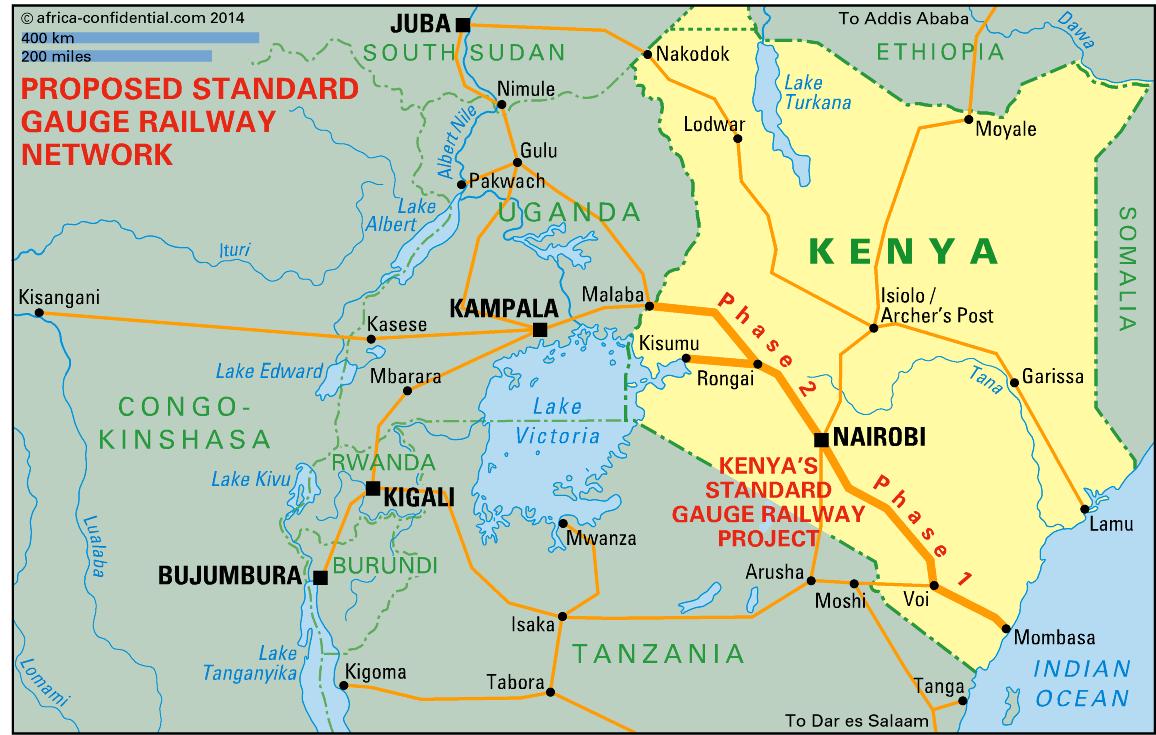
The  Kenyan Government has secured Sh 155 Billion Funding from the Exim Bank of China for the construction of Phase Two of the 490Km Standard Gauge Railway (SGR).

The project will be constructed by the China Road & Bridge Construction Company and will traverse Naivasha, Narok, Bomet, Nyamira, Kisumu, Yala, Mumias to Malaba. The line will also be linked to Olkaria Geothermal and the Government’s planned Special Economic Zone in Naivasha.

Feasibility studies have already been completed and construction starts in July 2017.

USA, Idaho: Boise has the Largest City-Operated Geothermal System in the US

Interest in geothermal energy grows, additional well added (KTVB)

Boise has the largest city-operated geothermal system in the United States, according to Boise Public Works.

They say just over 5 million square feet of downtown building space is heated with geothermal water using two city-operated wells, and now they want to add a third to keep up with demand.

"We're getting to a place where the amount of space downtown that we're heating we felt it was the right time to bring on the third well to ensure that we have redundancy, in case something happens during the winter months, during our peak season so we have some back up for the customers on geothermal heating,” Colin Hickman, a spokesman for Public Works, said.

Read More........

Rwanda: Surface Exploration for Geothermal Energy Reserves is Complete

Rwanda to Release New Results on Geothermal Energy Potential (KT Press)

Rwanda is concluding a four year research that will lead to exploration of new kind of energy in efforts to meet 70% energy rollout target by 2018.

Two feasibility studies that were launched in 2013 at a cost of $ 300,000 each are expected to lead to drilling of geothermal energy in Western province.

Speaking to KT Press last week, Uwera Rutagarama, geothermal development manager at Energy Development Corporation Limited (EDCL), said “We have undertaken surface exploration studies of Bugarama and Gisenyi sites in Western Province.”

The surface exploration consists of studying geology, hot springs and geophysics to indicate whether there is hot water underneath that can be drilled for power generation purposes.

USA, California: 100 Percent of Electricity Could Come from Renewable Energy by 2045

Green California may become even greener (Sacramento Bee)


Kevin de León wants to make environmentally friendly California even greener.

A day after unveiling a plan to upend California’s cap-and-trade program, Democrats in the Senate are introducing a proposal Tuesday that calls for 100 percent of the retail electricity sold in the state to come from renewable energy sources by the end of 2045.

SB 100 also shortens the timeline to hit interim targets along the way that became law under Senate Bill 350 in 2015. Current law dictates that 50 percent of California electricity must come from renewable sources by the end of 2030, which the proposal bumps up five years to the end of 2025.

Tuesday, May 2, 2017

GRC Annual Meeting & GEA GeoExpo+: Exhibit at the Geothermal Energy Event of the Year

Exhibitors at the GRC Annual Meeting & GEA GeoExpo+


As of today, 53 Exhibitors have signed up to present their products and services at the geothermal energy event of the year.

3JTech
AMSA, Inc.
Boart Longyear
BS&B Safety Systems, LLC
C-FER Technologies
Cooling Tower Depot, Inc.
Dewhurst Group
DOSECC Exploration Services (DES)
EthosEnergy
Exergy SpA
Expro
Fuji Electric Co., Ltd.
Gardner Denver Nash
Gefco
Geothermal Energy Association (GEA)
Geothermal Resources Council (GRC)
Geothermal Resource Group, Inc. (GRG)
GeothermEx
Horizon Well Logging
Hudson Products Corporation
Indar Electric, S.L.
International Cooling Tower USA, Inc.
John M Phillips
KMS Technologies
Mill Man Steel
Mitsubishi Hitachi Power Systems
Nalco Company

Nevada Division of Minerals
Ormat Technologies, Inc.
Phoenix Geophysics
Pioneer Petrotech Services, Inc.
PM International Suppliers, LLC
POWER Engineers, Inc.
REED Electric & Field Service
PowerChem Technology
Quantec Geosciences, Ltd.
REXA
Rotork Controls Inc.
Sandia National Labs
Schlumberger Limited
Scientific Drilling International
Sinclair Well Products
SPX Cooling Technologies, Inc.
Thermochem, Inc.
TIMET
TIX-IKS
TNG Energy Services
Toshiba
Turboden
Veizades & Associates, Inc.
Vooner FloGard Corporation
Wieland Thermal Solutions
WWT International 
For more information about the GEA GeoExpo+ please visit the GEA website.

Exhibitors register for the trade show..........

USA, Washington D.C.: New Head of Office of Energy Efficiency and Renewable Energy

Trump appoints critic of renewable subsidies as acting head of DOE renewable energy office (The Washington Post)


President Trump has appointed Daniel Simmons, a conservative scholar who sharply questioned the value of promoting renewable energy sources and curbs on greenhouse gas emissions, to oversee the Energy Department’s Office of Energy Efficiency and Renewable Energy (EERE), according to an email distributed to department employees.

Global: Calendar of Geothermal Energy Events

Geothermal Energy Calendar

Geothermal Energy (Resource Technology, and Economy) - One Day Course
12 May, Kelowna, BC, Canada
www.apeg.bc.ca/Events/Events/2017/17MAYGER

Euroheat & Power Congress 
14-17 May, Glasgow, United Kingdom
www.ehpcongress.org/

Taiwan Start to Steam - Acid Volcanic Geothermal Systems and the Challenges for Power Development
15-17 May, Taipei, Taiwan
www.taiwan-start2steam.tw/

Geothermal Reservoir Engineering Short Course (IGA)
15-19 May, Bochum, Germany
www.geothermal-energy.org/iga_academy/courses.html

1st EFG EuroWorkshop: Geothermal - the Energy of the Future (EFG/AGG)
18-19 May, Santorini, Greece
http://eurogeologists.eu/santorini-2017

GeoEnergi 2017
22-23 May, Bergen, Norway
http://cger.no/index.cfm?id=433924

IGC Turkey 2017 
22-24 May, Izmir, Turkey
http://igc-turkey.com

National Geothermal Academy - Module 1: Geothermal drilling engineering 
19-23 June, Reno, Nevada, USA
www.gbcge.org/education-NGA.php

13th International Mine Water Association Congress – “Mine Water & Circular Economy – A Green Congress”
25-30 June, Rauha, Laappenranta, Finland
www.imwa2017.info/

National Geothermal Academy - Module 2: Geothermal reservoir engineering
26-30 June, Reno, Nevada, USA
www.gbcge.org/education-NGA.php

Indonesia International Geothermal Convention & Exhibition 2017
2-4 August, Jakarta, Indonesia
www.iigce.com/

Clean Power for the South Pacific Conference 2017 
7-11 August, Vanua Levu, Fiji
www.geothermalcities.com/en/

CAS Deep Geothermal Systems - Certificate of Advanced Studies
Module 1: Geothermics and Geophysics

11-15 September, Neuchâtel, Switzerland
www.unine.ch/cas-deegeosys

Praxisforum Geothermie
11-12 September, Munich, Germany
www.praxisforum-geothermie.bayern/en

DGK 2017 - Der Geothermiekongress 2017
12-14 September, Munich, Germany
www.geothermie.de

41st GRC Annual Meeting & GEA GeoExpo+
1-4 October, Salt Lake City, Utah, USA
https://geothermal.org/meet-new.html

5th European Geothermal Workshop 
12-13 October, Karlsruhe, Germany
www.agw.kit.edu/EGW2017.php

IGC Invest Geothermal
8-10 November, Frankfurt am Main, Germany
www.investgeothermal.com/

Renewable Iran 2017 - Incorporating Iran Geothermal Expo
13-14 November, Tehran, Iran
www.greenworldconferences.com/ri2017/

CAS Deep Geothermal Systems - Certificate of Advanced Studies
Module 2: Geochemistry and Hydrochemistry 

13-17 November, Neuchâtel, Switzerland
www.unine.ch/cas-deegeosys

SMU Power Plays Conference (SMU Geothermal Lab)
10-11 January, 2018 , SMU Campus, Dallas, Texas, USA
www.smu.edu/Dedman/Academics/Programs/GeothermalLab/Conference

CAS Deep Geothermal Systems - Certificate of Advanced Studies
Module 3: Drilling and Logging

15-19 January, 2018, Neuchâtel, Switzerland
www.unine.ch/cas-deegeosys

GeoTHERM – Expo & Congress
1-2 March, 2018, Offenburg, Germany
www.geotherm-germany.com/

CAS Deep Geothermal Systems - Certificate of Advanced Studies
Module 4: Reservoir Evaluation and Production

12-16 March, 2018, Neuchâtel, Switzerland
www.unine.ch/cas-deegeosys

Iceland: Expanding Iceland’s Vast Geothermal Energy Infrastructure

See how the Volvo FH16 is helping to build Iceland’s geothermal energy infrastructure – one pipe at a time (Volvo Trucks)


Performing special tasks is an everyday thing for Jon and Margeir, a highly successful, father and sons trucking business. For Margeir Jonsson, it’s all about solving problems for his clients. Perhaps this explains why he has been driving Volvo trucks since 1974. Today, their specialised fleet includes a Volvo FH16 650, fitted with a very powerful, 38-metres long crane. It has proven ideal for a range of unique tasks – like transporting and positioning concrete sections for a bridge construction to offloading huge commercial fishing nets from difficult-to-access vessels. It’s also often hard at work expanding Iceland’s vast geothermal energy infrastructure – one pipe at a time. 

Canada: Overview of Renewable Energy Mentions Lack of Geothermal Power Plants

NEB releases report on Canada's Adoption of Renewable Power Sources (News Release)

Canada generates a larger share of its electricity from renewable sources than most other developed economies in the world, primarily due to its hydro production, according to a new report released by the National Energy Board (NEB).

The report, titled Canada's Adoption of Renewable Power Sources, provides direct comparisons of how Canada ranks internationally for renewable power adoption. It also covers factors that affect the uptake of each renewable source, including financial costs, reliability and environmental impacts.

Large scale geothermal energy may be possible on Canada’s west coast by harnessing the “Ring of Fire” around the Pacific Ocean. Geothermal projects are also being considered in isolated northern communities, which would benefit from combined heat and power.

Although the technology to generate power from geothermal energy has existed for over 100 years, no geothermal power plants operate in Canada.

All of Canada has geothermal energy. However the principal areas showing the most promise are B.C., Alberta, the Yukon, the Northwest Territories, and Saskatchewan.  Canada’s west coast, on the eastern periphery of the Ring of Fire around the Pacific Ocean, is suited for larger-scale commercial power production. Isolated northern communities are exploring synergies between geothermal heat and power, even at smaller scales, in order to displace comparatively high energy costs for electricity and heat.

Canada's Adoption of Renewable Power Sources (PDF)

Read More........

Monday, May 1, 2017

USA: Employment Opportunity Includes Geothermal Energy Component

Senior Subsurface Energy Analyst (KeyLogic)

Location: Pittsburgh, PA, USA

The candidate will apply sound principles and analytical leadership to the area of energy-related subsurface analysis.  The analyst work with the Pittsburgh-based Subsurface Analyst Team and support the development of technologies related to geologic carbon storage, enhanced oil recovery, oil and gas operations, produced water production and management, and geothermal energy.

The team works across a range of subsurface-related topics, technologies, and operations supporting a variety of clients.  The candidate is expected to quickly learn all the tools and procedures currently in use, and be able to lead and direct work initiatives.  The candidate must have flexibility to work independently or in a team setting, depending on the particular work initiative.  The candidate is expected to add significant value to client tasks, especially to the interpretation and communication of complex subsurface results and data, as well as add new capability to the Subsurface Analysis Team.

More Information........

Iceland: Electricity from New Geothermal Energy Resource Looks for the Best Market

Seabed Geothermal Electric Would be Sold Straight to UK (IcelandReview)

If geothermal power stations on the seabed become a reality in Iceland, the plan is to sell the power straight to Europe through an undersea cable.

This direct sale, bypassing Iceland’s terrestrial electricity grid, would generate the best price possible for the electricity without forcing electric prices up in Iceland, it is hoped.

North Tech Energy has been granted a research license to explore the seabed for suitable geothermal sites off Reykjanes and North Iceland, from which the company hopes it can generate electricity, as reported last week.

Another way to get more money is to use the electricity generated in the production of hydrogen—as there has already been interest from Japan to buy hydrogen produced in Iceland; so hydrogen is another avenue North Tech Energy will be looking into. Hydrogen is seeing expanded usage options around the world, not only for powering vehicles, but also for powering homes, industry and more, RÚV reports.

Science & Technology: Molten Carbonate Reservoir is 217 Miles Beneath the Surface of the Earth

A Massive Lake Of Molten Carbon The Size Of Mexico Was Just Discovered Under The US (Forbes)

A recent scientific discovery has drastically changed our view of the global carbon cycle and identified a new significant risk. Researchers have discovered a giant lake or reservoir made up of molten carbon sitting below the western US.

The molten carbon (primarily in the form of carbonate) reservoir could drastically and immediately change the global climate for over a decade if it were to be released. Thankfully there is little risk in the near future of this happening. The carbon sits 217 miles beneath the surface of the Earth in the upper mantle and has no immediate pathway to the surface. In total the lake covers approximately 700,000 square miles, approximately the size of Mexico. This has redefined how much carbon scientists believe sits locked away in the Earth's mantle and its interaction with surface and atmospheric carbon.

Pervasive upper mantle melting beneath the western US, Saswata Hier-Majumdera and Benoit Tauzinb. https://doi.org/10.1016/j.epsl.2016.12.041

Read More........

USA: Western Imbalance Market Continues to Grow

Salt River Project will join western Energy Imbalance Market (News Release)

The California Independent System Operator (ISO) and Salt River Project (SRP) signed an agreement today (April 27, 2017) for the Phoenix-based municipal utility to participate in the western Energy Imbalance Market (EIM) beginning in April 2020.

The western EIM’s advanced market systems automatically find the lowest-cost energy to serve real-time consumer demands of participating utilities.  This market enables utilities to buy and sell power more efficiently in the hour before the energy is needed, with five-minute plant dispatching, which result in improved efficiencies and cost savings.

Current western EIM participants have realized savings totaling nearly $142 million since the wholesale market was launched in November 2014.

Utilities now active in the western EIM include Oregon-based PacifiCorp; NV Energy of Las Vegas, NV; Puget Sound Energy of Washington state; and Arizona Public Service of Phoenix, Ariz.  Other utilities that have formally agreed to join the EIM include Portland General Electric on October 1, 2017, Idaho Power on April 1, 2018, and Seattle City Light and Balancing Area of Northern California/Sacramento Municipal Utility District on April 1, 2019.  The western EIM serves utility consumers in Arizona, California, Idaho, Nevada, Oregon, Utah, Washington, and Wyoming. 

Friday, April 28, 2017

USA, California: 25 Years of the Shrinking Salton Sea

Salton Sea Recession: September 1992-March 2017

Complied by Ron DiPippo Using Google Earth


This shows the area around the Salton Sea Units 1-5 (Units 1-2 lie on the west side of the light square in middle). Left-1992: The plant site is very nearly surrounded by the sea on the north and west sides. Right-2017: On the north side, the sea has receded almost to the NW corner and has crept up the west side. The promontory to the north has been filled in on the west side and the small bay at the upper right has begun to fill in.


This shows a close-in view of the power plant sites. On the north side the sea has receded about 1000 lateral feet over the period from 1992 to 2017.


This view is about 3.7 miles northeast of the Salton Sea power plants and shows the mouth of the Alamo River. Left-1992: The small white piece of land at the upper center is Mullet Island; the larger body of land just south of the river is Red Hill, essentially an island connected to the mainland by a narrow causeway in 1992. Right-2017: The receding sea has left a sizeable new land mass on the south side of the river that completely surrounds Red Hill making it an actual part of the mainland. On the north, Mullet Island is now part of that same landmass that is divided by the Alamo River; the new land now defines a cove (center) with a very narrow outlet to the sea on its north side. The John L. Featherstone power plant can be seen at the right-center of the 2017 image.


This is an area about 3.5 miles southwest of the Salton Sea power plants and shows the New River delta. The recession of the sea has greatly enlarged the land area on both sides of the river.

Dr. Ron DiPippo is a world authority and consultant on Geothermal Power Plants. He is Chancellor Professor Emeritus of Mechanical Engineering, former Associate Dean of Engineering at the University of Massachusetts Dartmouth (UMD), a visiting Research Professor and Visiting Lecturer at Brown University in Providence, Massachusetts Institute of Technology (MIT), as well as a visiting lecturer at the School for Renewable Energy Science at the University of Akureyri, Iceland.

USA: Geothermal Energy Favors Well in Federal Energy Study

Levelized Cost and Levelized Avoided Cost of New Generation Resources in the Annual Energy Outlook 2017 (EIA)

This paper presents average values of levelized costs and levelized avoided costs for generating technologies entering service in 2019, 2022, and 2040 as represented in the National Energy Modeling System (NEMS) for the Annual Energy Outlook 2017 (AEO2017) Reference case.


The average net differences shown in the table above are for plants coming online in 2022. The weighted average net difference is above zero for geothermal, suggesting that the technology is being built in regions where it is economically viable. Indeed, it has the greatest average net difference suggesting it is the most economically viable energy technology.

As the best, least-cost resources are exploited, development will be forced into less favorable areas, potentially resulting in higher development costs, higher costs to access transmission, or access to lower-performing resources. Changes in the value of generation are a function of load growth.

However, renewables such as wind and solar that may show strong daily or seasonal generation patterns may see significant reductions in the value of their generation as these specific generation periods become more saturated with generation and new generation must compete with lower-cost options on the dispatch merit order.

Read the full paper........

Russia: Record Snowfall at Mutnovskaya Geothermal Power Station

Fire and Ice in the Russian Far East (Twitter)

Europe: Geothermal News from EGEC

The EGEC Newsletter April 2017 - The Voice of Geothermal in Europe

The April issue of the EGEC Newsletter is now available.
Click here to download it. In this issue:

Editorial
  • A word from the EGEC President
Policy
  • Energy labelling legislation: towards a new set of energy efficiency classes
  • New documentation available for EGEC members
News
  • GEOTHERMICA launches its Call for Actions
  • DEEPEGS drilled the world’s hottest well
  • New State Aid Scheme in Romania to encourage production of energy from biomass, biogas and geothermal resources
  • 5th Global District Energy Climate Awards

Kenya: Construction Starts for 158 MW Olkaria V Geothermal Power Project

Uhuru breaks ground for 158 MW for Olkaria V power project (Capital FM)

The President also commissioned 14 geothermal wellhead units producing a total of 75 MW of electricity

The President at the same time commissioned 14 wellhead units producing a total of 75MW of electricity/PSCU
President Uhuru Kenyatta Friday broke ground for the construction of the Olkaria V power project which will produce 158 MW of electricity.

The President at the same time commissioned 14 wellhead units producing a total of 75 MW of electricity.

The ‘wellhead unit’ is a unique technology developed by Kenyan engineers to harness geothermal power, which has reduced the duration between the first drilling of a well and installation of a geothermal plant from five years to two years.

President Uhuru Kenyatta said Kenya has one of the largest reserves of geothermal energy and more plants will be constructed to harness the power for the benefit of Kenyans.

“That this form of energy is not subject to the vagaries of the weather, and that it runs at a respectable rate more than 90pc of the time every year, means that we can bring reliable power to every Kenyan home,” said the President.

Armenia: Tender for Construction of 30 MW Geothermal Power Plant to be Issued Next Year

Armenian ministry to announce tender for construction of geothermal power plant (Arka News Agency)

The Armenian ministry of energy infrastructure and natural resources will announce in late 2018 a tender for the construction of a geothermal power plant with a capacity of 30 MW in southern Armenia near the town of Sisian, Deputy Minister Hayk Harutyunyan told journalists on Friday.

According to the deputy minister, exploratory drilling confirmed the availability of geothermal potential. "We drilled two wells -1,495 and 1,682 meters deep and we can talk about the availability of a geothermal resource, based on which we can build a station that will use underground hot springs," said Harutyunyan.

Read More........

USA: Chevron Gets $600 Million for Indonesia Geothermal Business

Chevron Reports First Quarter Net Income of $2.7 Billion (News Release)

Chevron Corporation today reported earnings of $2.7 billion ($1.41 per share – diluted) for first quarter 2017, compared with a loss of $725 million ($0.39 per share – diluted) in the 2016 first quarter. Included in the quarter was a gain of approximately $600 million from the sale of the Indonesia geothermal business. Foreign currency effects decreased earnings in first quarter 2017 by $241 million, compared with a decrease of $319 million a year earlier.

International upstream operations earned $1.4 billion in first quarter 2017, compared with a loss of $609 million a year earlier. The increase was due to higher crude oil realizations and a gain of approximately $600 million from the sale of the Indonesia geothermal business.

USA, Nevada: Cyrq Energy in Line to Buy Reno Geothermal District Heating Plant

Sustainable heat source will stay online after Reno utility company sells geothermal plant (KRNV)

Nevada geothermal has announced they will sell a district geothermal heat energy plant located in the shadow of the Peppermill Spa and Resort in Reno.

A letter to residents announced Cyrq Energy, headquartered in Salt Lake City, Utah, will take over the system. Company attorney Curt Ledford said Nevada Geothermal was looking for a buyer "that would propose a plan to keep the geothermal system operating. We think Cyrq has that capability."

Cyrq Energy is no stranger to the alternative energy industry. At a meeting on March 8, the company's Vice President of Operations and Safety spoke to residents about Cyrq's interest in buying the geothermal plant. Monte Morrison said, "we also have power plants in Utah and New Mexico."

The South Reno geothermal plant supplies just 104 homes, but it's actually the largest residential geothermal district in all of Nevada.

Thursday, April 27, 2017

Kenya: US Grant to Fund Study Into Increasing Geothermal Energy Efficiency and Power Production at Olkaria

USTDA Supports U.S. and Kenyan Business Partnerships in Power Sector (News Release)

Today, the U.S. Trade and Development Agency signed two grants that leverage U.S. technology solutions and investment to increase access to affordable, reliable electricity in Kenya.

USTDA signed a $500,000 grant with the Kenya Electricity Generating Company Limited (KenGen) for a study assessing the use of U.S. technology solutions to increase energy efficiency and power production. Nevada-based energy equipment manufacturer, Langson Energy, Inc., is conducting the study in partnership with KenGen.

KenGen’s cash will see it deploy equipment in Olkaria power plants on a pilot basis to tap more electricity from geothermal wells.

“The equipment will enable us tap the total flow of geothermal energy since it uses both steam and the liquid from wells,” said KenGen managing director Albert Mugo.

USA, California: Energy Commission to Address Flexible Geothermal Energy Generation Issues

Energy Commission Adopts Research Investment Plan (News Release)

The California Energy Commission (CEC) today adopted a three-year strategic investment plan for its clean energy research and development program.

The Electric Program Investment Charge (EPIC) 2018-2020 Triennial Investment Plan is a proposed strategy for administering research and development funds. The Energy Commission invests more than $120 million annually through EPIC for innovations and concepts that help California meet its energy and climate goals.

One funding initiative will lower the cost, improve the efficiency, and advance the potential for the flexible operation of geothermal in support of high penetration of renewable energy.

Initiative 4.3.2 Geothermal Energy Advancement for a Reliable Renewable Electricity System (Page 156 of the report)

Based on project findings and discussions with facility owners, operators prefer to operate geothermal as a baseload because of issues associated with flexible generation, such as the buildup of hydrochloric acid, hydrogen sulfide and other
corrosive and toxic materials. From an efficiency perspective, steam generation and the energy associated with distribution are generally wasted or lost during curtailment of production. This initiative will address flexible generation issues identified by exploring strategies such developing materials, designs and
operational techniques to mitigate corrosion issues and possibly integrating energy storage, a strategy that has not yet been demonstrated. The initiative will also support activities that explore the economic values of capturing the useful
elements from buildup of these condensates (such as solid sulfur for agriculture use or metals for industrial application).

The initiative will also support strategies that boost geothermal from existing facilities and wells that are declining or idle. The goal is to further position geothermal energy as a key player in attaining the RPS goal by backing up intermittent renewables and providing sustained and increased renewable
generation to the grid.

EPIC was established by the California Public Utilities Commission (CPUC) in 2011. The plan, which is the third since the program’s inception, will be submitted to the CPUC for adoption.

Read More........

USA, California: Reports from a Geothermal Energy Hotspot

Selected Speaker Presentations from the 10th Annual Imperial Valley Renewable Energy Summit  (IVEDC)

Jason Czapla (left), Controlled Thermal Resources and Dennis Kaspeneit, Geothermal Resources Council listen as Jim Turner (right), Controlled Thermal Resources, makes his Geothermal 101 presentation (Courtesy IVEDC)
The Imperial Valley Economic Development Corporation (IVEDC) held the tenth annual Imperial Valley Renewable Energy Summit March 15-17, 2017. The Geothermal Resources Council (GRC) attended representing the geothermal energy community. The following are some of the presentations from the conference, especially relating to the development of geothermal energy in the area.

Chile: Direct Use of Geothermal Energy to Dry Wood in Rural Area

En Aysén se utilizará geotermia para secado de leña e invernadero de cultivo agrícola - In Aysén will use geothermal for drying wood and greenhouse farming


El Centro de Energía (CE-FCFM), en conjunto con el Centro de Excelencia de Geotermia de los Andes (CEGA), de la Facultad de Ciencias Físicas y Matemáticas de la Universidad de Chile, han desarrollado un proyecto basado en la Estrategia Regional de Consumo y Producción Sostenibles (CPS) en zonas rurales de Chile. Esta iniciativa consiste en la construcción de un sistema de secado de leña y un invernadero que utilizará energía geotérmica de forma directa, permitiendo mejorar las condiciones de vida de una comunidad de manera sustentable.

The Energy Center (CE-FCFM), together with the Center of Excellence of Geothermal Energy of the Andes (CEGA), of the Faculty of Physical Sciences and Mathematics of the University of Chile, have developed a project based on The Regional Strategy for Consumption and Sustainable Production (SCP) in rural Chile. This initiative consists of the construction of a drying system of wood and a greenhouse that will use geothermal energy directly, allowing to improve the living conditions of a community in a sustainable way.

Read More (in Spanish).......

(Thanks to GRC Member Marcelo Lippmann, Staff Scientist (retired) at Lawrence Berkeley National Laboratory for the submission.)

USA: California: Problem With Too Much Variable Renewable Energy in Golden State?

Is the Duck Sinking? (Energy Institute at Haas)

by Catherine Wolfram, Cora Jane Flood Professor of Business Administration at the Haas School of Business, Co-Director of the Energy Institute at Haas, and a Faculty Director of The E2e Project


As of last spring, the projections in the duck curve were materializing on schedule, as Meredith’s blog post described. During 2016, however, utility-scale solar PV capacity in the state grew by another 50%. As a result, net load in the middle of the day on a recent Sunday (April 9) bottomed out at 10,000 MW (see the green line in the graph below), instead of the 14,000 MW projected for 2017 in the forecast duck (the dark orange line labeled “2017” in the graph above).

[For reference, on April 9 geothermal provided a constant, steady baseload supply of 22,473 MWh]

All the solar and hydropower have led to a new phenomenon – negative prices in the middle of the day. The blue line in the graph above depicts day-ahead prices for Sunday, April 9 in Southern California. For comparison purposes, the red line depicts day-ahead prices at the same location on the second Sunday in April 2012. Looks like another version of the duck, albeit drawn by a preschooler, and this time with price on the vertical axis.

Read More.........

New Zealand: Geothermal Energy is Big Contributor to Kiwi Economy

Wind and geothermal emerge as significant sources of energy (Statistics New Zealand)

Strong growth in wind and geothermal electricity generation has led to significant economic impacts, according to a Stats NZ report published today.

Geothermal’s contribution to New Zealand’s total renewable energy generation increased from 11 percent in 2007 to 21 percent in 2015. Over the same period, its value rose from $1.3 billion to $2.9 billion.

Statistical services manager Dan Oberhaus said. “The increased use of wind and geothermal energy resources is showing positive contributions to our economy.”

Geothermal increased from 3,210 gigawatt hours to 7,091 gigawatt hours (8 percent to 17 percent of net generation) over the period. 

Fiji: Innovative Geothermal Absorption Chilling Facility Improves Health on Island

Harnessing Fiji hot springs for refrigeration (University of New South Wales)


Two remote off-grid villages on the tiny Fijian island of Vanua Levu are looking forward to their first reliable source of refrigeration thanks to, rather ironically, their local hot spring.

The plan for this pilot project is to pipe the Waikatakata Hot Spring at Vusasivo, which is coming out of the ground at 70°C, into an absorption chilling facility at Natewa Bay.

This centralised cold storage facility will then be available for villagers to preserve their goods.

The geothermal freezer facility plans to service the traditional landowners of Vusasivo Village and adjoining Natewa Village in coordination with the Nambu Conservation Trust of Natewa.

Read More........

USA, Idaho: Flow Increased to Raft River Geothermal Plant

U.S. Geothermal Inc. Provides Update on Raft River Expansion Program (News Release)

Raft River Geothermal Plant, Idaho (Photo by Ian Crawford)
U.S. Geothermal Inc. has provided an update on its Raft River expansion project.

Phase II of the ongoing plan to increase the output at Raft River from its current generation level of 10 MWs, up to its contract maximum of 13 MWs, commenced in March with the successful installation of the pump in well RRG-5.

Production from RRG-5 started on March 21, 2017 and is currently operating at the rate of 1,100 gallons per minute.  The addition of this flow to the plant has increased net power production by approximately 0.71 MWs.

To date, the reservoir response has been significantly better than projected, with minimal drawdown in well RRG-5 and no impact to water level in the adjoining wells.  The well temperature is currently stable at over 247°F.   The next step to optimize output from the wellfield is to increase the capacity of the injection system. After an injection pump is upgraded, a further increase in fluid flow to the plant is expected, which will result in a corresponding increase in generation, plus allow for additional production well increases.

Philippines: Restoration Completed on MakBan Geothermal Power Plant Binary Unit

AboitizPower restores 6-MW binary plant (BusinessWorld Online Edition)

AP Renewables, Inc. (APRI), the renewable power unit of Aboitiz Power Corp., on Thursday launched the newly restored 6 MW binary plant at the Makiling-Banahaw (MakBan) geothermal project in Sto. Tomas, Batangas.

APRI completed the restoration of Binary Plant 1, which uses excess heat from spent brine to generate clean energy for the Luzon grid, in July 2016. The plant restoration cost P107 million, lower than the initial budget of P130.7 million.

The additional renewable capacity was added to the Luzon grid by the end of 2016. 

The plant is one of three binary cycle power plants in the MakBan Geothermal Project complex that the company had acquired in 2009, and the only one found fit for rehabilitation. 

At the same time, Mr. Moraza said there is potential to source 20 to 24 MW from their geothermal power plant located in Tiwi, Albay. 

“We’re actually doing the feasibility study now, we have the costing already... They’re developing now,” AboitizPower President and Chief Operating Officer Antonio R. Moraza said. 

Wednesday, April 26, 2017

USA, California: Opportunity for Geothermal Energy Sales to New Community Choice Aggregator

L.A. County creates a lower-cost alternative for Southern California Edison customers (L.A. Times)

New Community Choice Aggregator could offer geothermal energy from Coso and Imperial Valley

Southern California Edison customers in Los Angeles County soon will have an alternative way to get their electricity — from a new government-run utility promising lower bills and easier access to clean-energy options.

The county Board of Supervisors on Tuesday unanimously approved the public energy program, which they say will help reduce power bills by as much as 5% below what customers pay Edison. Residents and businesses will have the choice to stay with Edison or join the county’s utility.

In the last few years, more communities have been considering such community choice aggregation programs, also known as CCAs. Los Angeles County began studying the concept about two years ago, and its program has the potential to become the state’s largest.

The L.A. County utility, to be governed by the Los Angeles Community Choice Energy Authority, is expected to start providing electricity next year. Customers who switch to it will be able to choose whether they want power from solar, wind or another clean energy source (geothermal). Those decisions by customers will influence how much green energy — and what kind — the county invests in.


Community Choice Aggregation in California - An Opportunity for the Geothermal Industry [July/August 2016 GRC Bulletin] by Paul Brophy, Past-President, Geothermal Resources Council, and Vice-Chair, Business Operations Committee, Sonoma Clean Power.

USA, Oregon: Legislation Would Exempt Drilling Geothermal Wells from Hydraulic Fracturing Ban

Oregon House passes 10-year fracking ban (Statesman Journal)

It would exempt drilling required for geothermal wells

The Oregon House has passed a 10-year ban on hydraulic fracturing, or fracking. Industry officials say the practice has been used for more than 60 years and is safe.

“Hydraulic fracturing has been demonstrated, across multiple state and federal jurisdictions, to be a safe and effective technology that can be used to increase the recovery of hydrocarbons and deliver significant benefits, without adverse efforts, said Brian Doherty, a lobbyist for the Western States Petroleum Association during a hearing on the bill.

House Bill 2711 would put a 10-year moratorium on hydraulic fracturing for oil and gas exploration and production.

It would exempt drilling required for natural gas storage wells and geothermal wells, as well as for some unused coal bed methane extraction wells that currently exist near Coos Bay.

Thailand: Thai Company Buys a Share of 182 MW of Geothermal Power Plants in Indonesia

Thai-listed BCPG to pick 33.3% in Indonesia’s Star Energy (DealStreetAsia)

Thai listed renewable energy firm BCPG (ex. Bangckak Petroleum Public Company Limited) has secured the approval from the Board of Directors to acquire one-third stake in Indonesia-based Star Energy Group for not exceeding $357.5 million. Both companies expect to enter into the transaction in the second quarter of this year, according to BCPG’s filing on Wednesday.

Following the acquisition, BCPG will hold stakes in three geothermal power plants in Indonesia with a combined production capacity of 182 MW. The three projects are top geothermal power plants in Indonesia. The largest plant is located in Sukabumi City in West Java with the installed capacity of 377 MW. The other two include the 227 MW geothermal power plant at Wayang Windu and the 271 MW Darajat project in Garut and Bandung.

Read More..........

Mexico: Iceland to Help Develop Geothermal Energy Projects

Geothermal clusters of Iceland and Mexico sign cooperation agreement (ThinkGeoEnergy)

Official signing of a cooperation agreement
between the Iceland and Mexican geothermal
clusters (source: ThinkGeoEnergy)
In a ceremony today in conjunction with the Geothermal Conference for Latin America and the Caribbean, the representatives of the Iceland Geothermal Cluster, Vidar Helgason and Dr. Luis Alonso Gallardo, the Director of the Earth Science Division of Mexican El Centro de Investigación Científica y de Educación Superior de Ensenada (CICESE) signed a cooperation agreement.

The agreement aims to encourage the creation of scientific consortiums and the collaboration in various scientific, research, educational and exploration aspects of geothermal projects.

Read More.........

Tuesday, April 25, 2017

Spain: Galicia Could Host Geothermal District Heating Project

First Geothermal District Heating Network in Spain (News Release)


The first geothermal district heating network in Spain may be installed in Orense, the capital of the province of the same name and the third largest city of the Autonomous Community of Galicia.

News Release in Spanish (PDF).........

(Thanks to GRC Member Marcelo Lippmann, Staff Scientist (retired) at Lawrence Berkeley National Laboratory for the submission.)

Canada: One Day Course in Geothermal Energy in British Columbia

Geothermal Energy (Resource Technology, and Economy)

Friday, May 12, 2017, Kelowna, BC, Canada

Presented by Dr. Mory Ghomshei, P.Eng./P.Geo., British Columbia Institute of Technology

This one day professional training course will combine theory with practical guidance to improve and enhance your skills in geothermal system design and management.

Iran: Renewable Energy Conference in Tehran Includes Geothermal Presence

Renewable Iran 2017 (Green World Conferences)

13-14 November, 2017, Tehran, Iran

Renewable Iran 2017 is an umbrella name for an annual large-scale expo covering the following renewable energy sectors: solar, wind, hydro, geothermal, bioenergy/waste management.

Over 100 companies involved in the renewable energy deployment will showcase at the exhibition allowing you to meet the most relevant and experienced players within RE sector in Iran.

More Information.........

Education: $15,000 in Educational Awards for Students in the Global Geothermal Energy Community

2017 Geothermal Resources Council Scholarships - Deadline is May 26 (News Release)

Total of $15,000 in educational awards to be given to six students in the global geothermal energy community
Some of the winners of the GRC Scholarships in 2016. From left to right: Gudni Rosenkjaer, Jeff Cullen, Erin Camp, and Jon Golla
The Geothermal Resources Council (GRC), a non-profit educational association dedicated to the promotion of geothermal energy and associated technologies around the world, is pleased to announce the availability of the 2017 GRC Scholarship Awards.

To qualify for one of these awards a student must be a GRC member (student memberships are only $5 per year) as well as be a student in an accredited academic institution. Selection of recipients will be based upon a variety of factors, including the individual’s academic record, student activities, geothermal industry experience, and career goals.

The following awards are available:
  • Two (2) GRC Undergraduate Scholarship Awards of $1,500 – to be eligible for one of these awards, the candidate must be a third or fourth year undergraduate majoring in engineering or geosciences at the time of the award (Fall 2017). 
  • Three (3) GRC Graduate Scholarship Awards of $2,500 – to be eligible for one of these awards, the candidate must be enrolled in a graduate-level program in engineering or geosciences at the time of the award (Fall 2017). 
  • One (1) Student Geothermal Project Award of $4,500 – selection of recipient will be based primarily upon the creation and description of a geothermal-focused project, though other factors such as the individual’s academic record, student activities, geothermal industry experience, and career goals will factor into the determination as well. The project can represent a variety of academic subjects, including, but not limited to, geosciences, engineering, and economics. The primary requirement is that the project be focused on some aspect of geothermal power production, geothermal direct use applications or geothermal heat pumps. 
Applications must be received by May 26, 2017 to be considered.
For application instructions and other details see the announcement on the GRC website at: www.geothermal.org/students.html

Please direct questions regarding the scholarship awards to: Brian Schmidt, bschmidt@geothermal.org or 530-758-2360, ext. 107

Colombia: Geothermal Resources Council Student Chapter


The GRC Uniandes student chapter is one of 8 chapters established by the Geothermal Resources Council for the fellowship of students involved in geothermal energy around the world. The group based in Bogotá are especially active!


The chapter was set up within the Department of Geosciences at the Universidad de los Andes in Bogotá, Colombia.

The chapter has created a website to show-off their great work.

More information on services for students from the Geothermal Resources Council (GRC).......

Colombia: Two Day Geothermal Conference

National Geothermal Meeting (Asociación Colombiana De Estudiantes De Geociencias)

30 November-1 December, 2017 - Manizales, Colombia


Climate Change: Falling Costs of Renewables Make Cost-Effective, Clean Electricity Unstoppable

Halving global carbon emissions by 2040 is within our reach, but governments, investors and businesses must act now to accelerate energy transitions (News Release)

Leading industries, investors and climate advocates set out achievable pathways to limit global warming to well below 2˚C while stimulating economic development and social progress. 


Governments, investors and businesses must seize the opportunity to halve global carbon emissions by 2040 while ensuring economic development and energy access for all, but they must act now to accelerate clean electrification, decarbonization beyond power and energy productivity improvement, says the Energy Transitions Commission (ETC).

The ETC today launched its "Better energy, Greater prosperity" report which argues that it is technically and economically feasible to grow economies and provide affordable, reliable, clean energy for all while meeting the Paris objective of limiting global warming to well below 2°C.

Key conclusions of the report include:
  • Falling costs of renewables and batteries make cost-effective, clean electricity unstoppable and essential to the transition to a low-carbon, energy-abundant world. 
  • There is still untapped potential to improve energy productivity – i.e. the energy-intensity of GDP. Growth of 3% per annum could be achieved with the right policies effectively implemented. 
  • Rapid progress is now required on other technologies, including bioenergy, hydrogen and all forms of carbon capture and sequestration, to drive complete decarbonization. But even with large scale CCS deployment, which is currently not on track, fossil fuels use must fall 30% by 2040, with rapid decline of unabated coal.