The Geothermal News Report (GNR) is a weekly podcast wrapping up the top stories in the geothermal industry.
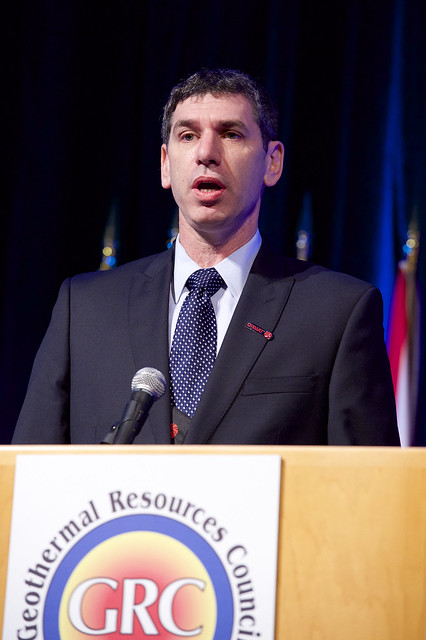
GNR interviews the Executive Director of the Geothermal Resources Council (GRC), Mr. Steve Ponder at the GRC Annual Meeting & GEA Expo 2015 in Reno, Nevada. The discussion covers everything from the international markets, to the new generation of geothermal students and professionals joining the industry.
DEADLINE TO SUBMIT PROPOSALS - November 23, 2015 by 3:00 p.m.
The California Energy Commission (CEC) is searching for an expert in geothermal resources to provide consultation services to the Energy R&D department at the CEC.
The work would involve occasional consultation with the CEC on R&D trends and needs, and evaluation of grant requests under the EPIC program. Below is the list of topics that the CEC includes in their request for qualifications for this contract.
Geothermal electric generation such as: vapor-and liquid-dominated electric generation technologies (including wellhead units), distributed generation geothermal technologies (e.g., less than 20 MW in capacity), and/or geothermal/oil and gas co-production; alternative thermodynamic cycles, efficiency improvements, well design, material science, corrosion and brine chemistry, pollution abatement, and environmental mitigation
Direct use applications
Geothermal heat pump technologies (GHP), including heat exchangers
Geothermal resources, including: assessment and exploration, production and injection wells, reservoir engineering, and modeling
Hot water and steam reservoirs, magma systems, geo-pressured systems, and hot dry rock
Regulation of geothermal development and use
Geothermal mapping/location techniques
Economic and technical barriers to geothermal development
Environmental impacts associated with geothermal development and production, and mitigation techniques to reduce impacts
By-products assessment – technical and economic feasibility
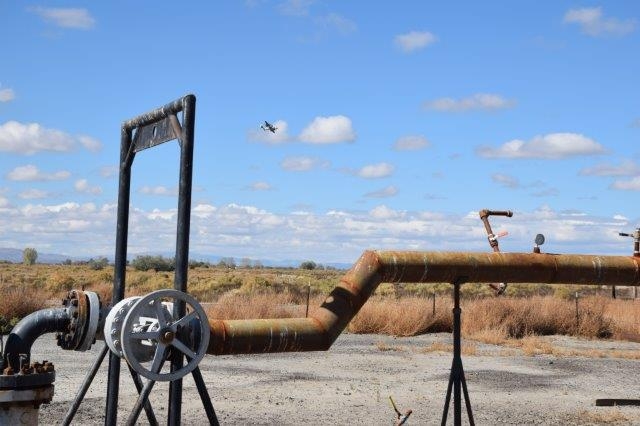
Inside Naval Air Station Fallon, Nevada (Courtesy GTO)
And they’re off! After more than a year since the announcement of available funding, the project teams selected for our Frontier Observatory for Research in Geothermal Energy (FORGE) each hosted our geothermal experts at their candidate sites this fall. We’re calling it our road trip through the geothermal frontier.
The Energy Department’s Geothermal Technologies Office (GTO) FORGE staff embarked on two road trips in early September and mid-October to visit the sites, meet with teams and stakeholders, learn more about the individual locations, and check in with the teams on the progress they are making.
Shortly after the whirlwind of site visits, the team made its way back to Washington, D.C. headquarters, where the five candidate site teams provided their first round of quarterly deliverables, including analysis of exiting site characteristic data and comprehensive team structures. The duration of Phase I will be focused on developing and drafting a multitude of plans and processes for the creation of the final field laboratory. These plans range from environmental, safety, and health protocols to the storing and handling of core samples. At the completion of Phase I, the five candidate sites will go through a down-select process to see which will move on to Phase II. No more than three teams will be selected for the next round of funding next year.
To stay updated about FORGE and the Phase I candidate teams visit Energy.gov/FORGE.
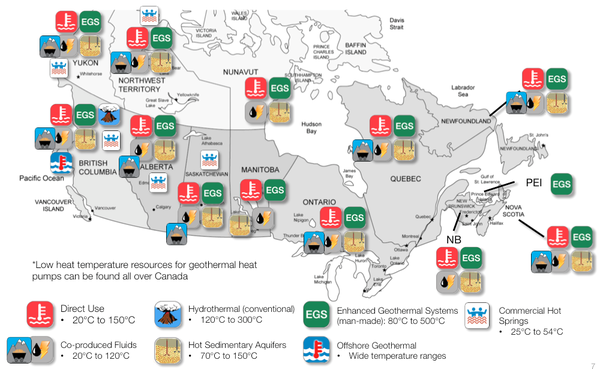
Canada possesses significant geothermal energy resources, primarily concentrated in the country’s western provinces and territories. Conventional geothermal resources, those often associated with volcanic activity, can be found throughout British Columbia and the Yukon. These are evidenced by the more than 150 known hot springs in Western Canada, which are surface manifestations of geothermal activity.
Our continental neighbors, the United States and Mexico, have harnessed these resources, producing the first and fourth largest amounts of geothermal power in the world, respectively. Yet no megawatts of geothermal power are currently being produced in Canada. This situation warrants question as geothermal power is internationally recognized as a renewable source of energy that operates 24/7, unlike wind and solar.
Headlines and features in this month’s edition include:
President’s Message – The Path to Recognition
Geo Industry Leaders Confident of Federal Tax Credit Renewal
GEO, NEGPA Team Up to Change New Hampshire Cost Calculator
USDA Grants $1.5M for Geothermal Projects – Applications Open
Permanent Rules for Oregon Residential Energy Tax Credits
GEO $1,000 Challenge! Kirk T. Mescher Scholarship Award Fund
PLUS More GEO News and Announcements
The Geothermal Exchange Organization, a 501(c)(6) non-profit trade association based in Springfield, Illinois, USA that advocates the environmental, energy efficiency and economic benefits of geothermal heat pump systems for heating and cooling applications in residential, commercial, and institutional buildings in the USA.
"We want intermittent generators to be responsible for pressures they add to system when wind doesn’t blow or sun doesn’t shine”.
U.K. energy secretary, Amber Rudd (Courtesy Nick Ansell/PA)
In a speech by the U.K. energy secretary, Amber Rudd on Wednesday it was indicated that the government is going to penalise intermittent renewables generation for its intermittency. She stated: “we also want intermittent generators to be responsible for pressures they add to system when wind doesn’t blow or sun doesn’t shine”.
It’s not clear yet what that means, but it could be some kind of a charge to renewable power producers to cover the costs of balancing supply.
The CCC said in its recent scenarios report that though “It is possible to ensure security of supply in a decarbonised system with high levels of intermittent and inflexible generation”, there are costs associated with variable output. They estimate this would represent around £10/MWh for both wind and solar for the deployment levels in its 2030 decarbonization scenarios.
Energy experts seem to agree that making renewable generators pay for intermittency would be inefficient and expensive – even though opinion differs on whether renewables or the system as a whole should compensate for intermittency.
The British government also announced plans to shutter all coal-fired power plants in the country by 2025, phasing them out with tighter restrictions two years before that.
The submission process will officially open on 23 November 2015 and close in January.
The India Innovation Lab for Green Finance is a public-private initiative to seek out and help implement novel solutions for unlocking and scaling up investment for green infrastructure in India. By addressing investors’ needs, it aims to drive new private investment for clean growth.
The India Innovation Lab for Green Finance seeks proposals to identify financial instruments that have potential to manage investment barriers and scale up attractive capital for green infrastructure in India. The submission process will officially open here on 23 November 2015 and close in January. Up to four winners will be announced in February, and will receive advice and endorsement from Lab Members to develop and implement the ideas over the course of the next year
Ideas should address investors’ needs, in order to unlock more private investment for green infrastructure, including for large-scale renewables, distributed renewables including off-grid electricity, energy efficiency, urbanization, and others. Examples might be credit enhancement of renewable energy projects to attract institutional investors, or tools to reduce the cost of currency hedging to attract more foreign investment.
IRETHERM Target Areas (Muller et al., 2012 & Goodman, 2004)
The Irish government has recently announced its Legislative Programme for the Autumn Session 2015. Government Chief Whip Paul Kehoe stated that the Programme includes a number of Bills which are central to the Government’s plans to secure Ireland’s ongoing economic recovery including a Geothermal Energy Development Bill that aims to provide a legislative framework for the vesting, licensing and regulation of the development of geothermal energy.
According to a paper "Geothermal Energy Utilisation - Ireland Country Update" by Riccardo Pasquali, Alistair Allen, John Burgess, Gareth Ll. Jones, Taly Hunter Williams, presented at the World geothermal Congress 2015, the Geothermal Development Bill would define geothermal energy in Ireland and vests ownership of geothermal energy in the State, giving practical effect to the assertion of ownership of natural resources in the Constitution. The Bill would cover the exploration and development of deep geothermal energy resources in Ireland (excluding aspects such as district heating, market regulation and health and safety).
PSALM president Lourdes Alzona said the board decided that the “privatization of UL bulk is through negotiated sale before end of this year.”
Alzona said the Unified Leyte bulk energy privatization was the remaining big ticket power item up for privatization this year.
PSALM declared as failed bidding the selection and appointment of the independent power producer administrator of the bulk energy contract in September, after only Unified Leyte Geothermal Energy Inc., a subsidiary of EDC, submitted a bid.
Hot rocks beneath the visitor attraction in Cornwall could generate enough clean energy to power the site and 4,000 homes, in one of the UK’s only geothermal plants
A tropical fish farm, medical facility and computer servers could be powered by “hot rocks” underneath the Eden project if plans to create one of the UK’s only geothermal plants get underway.
The visitor attraction is bidding for part of a £12m EU fund awarded to Cornwall, after it said the government had turned down requests to match fund the £37m project. The three-four megawatt (MW) plant’s backers at Eden said it would take three years to build but generate enough clean heat and electricity to power the site, as well as 4,000 homes via the national grid.
Energy would be generated by pumping heated water up from granite hot rocks three miles underground through 25cm-wide bore holes. The city of Southampton has the UK’s only significant geothermal plant, which powers homes and offices.
The breath of the earth harnessed to power our homes. You may not realize geothermal power has been a part of Hawaii's energy grid for decades. It sparked grand plans and protests over its future here.
On the surface, Puna Geothermal looks like labyrinth of pipes -- a complex grid of green. Below the surface, plunging vertical tunnel grabbing the power of a restless earth.
"We're tapping into resources that have been there for quite a while already," said PGV Operations Manager Ron Quesada.
Lauren Boyd, Enhanced Geothermal Systems Program Lead and Zach Frone, Science and Technology Policy Fellow with the Enhanced Geothermal Systems Team are co-chairing a track, at next years’ American Rock Mechanics/Geomechanics Symposium related to geomechanics in geothermal exploration and production. This marks the 50th U.S. Rock Mechanics/Geomechanics Symposium scheduled on June 26-29, 2016 in Houston, Texas.
The conference will be accepting abstract submissions on the following:
Geomechanics in: Geothermal, Petroleum engineering, Civil engineering, and Mining engineering,
Geology and geophysics,
Fracture mechanics,
Induced/triggered seismicity,
Numerical/analytical/constitutive modeling.
While the official deadline for abstracts has past, abstracts will be accepted until this Friday (11/20/15).
Can we heat our homes using energy from deep beneath our feet? Can we use fossil fuels without damaging the environment? Paul Younger, Professor of Energy Engineering at Glasgow University, discusses these approaches to keeping the lights on in the future with presenter Jim al-Khalili.
Rentco East Africa won the tender one month after it was disqualified from participating in another contract for presenting forged documents and irregular financial statements.
Ormat Technologies, Inc. announced today that Mr. Yoram Bronicki has resigned from his position as the Chairman of the company’s Board of Directors, effective November 16, 2015.
Acting upon the recommendation of the Board of Directors' Nominating and Governance Committee, the Board of Directors appointed Mr. Stanley Stern as a director to fill the vacancy on the Board, and appointed current director Mr. Gillon Beck as the Chairman of the Board. Mr. Beck served as Chairman from May 2012 until June 2014. Both appointments are effective upon Mr. Bronicki’s resignation.
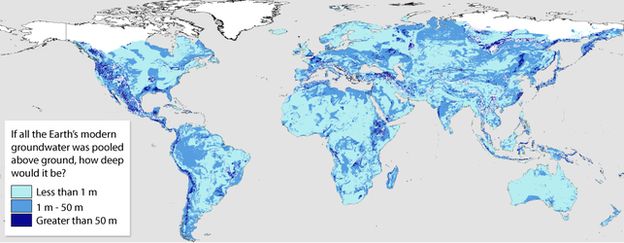
The map above shows the distribution of this modern groundwater around the globe. Dark blue shows where it is very quickly renewed. Light blue shows the older groundwater, which is mostly stagnant and non-renewable.
The total amount of groundwater on the planet, held in rock and soil below our feet, is estimated to be 23 million cubic km. If this volume is hard to visualize, imagine the Earth's entire land surface covered in a layer some 180m deep.
The new calculation comes from a Canadian-led team led by study leader Tom Gleeson from the University of Victoria and is published in the journalNature Geoscience.
To quantify just how much water is stored in the top 2km of the Earth's surface, Dr Gleeson's team had to combine large data sets with an element of modelling. They included information on the permeability of rocks and soil, on their porosity, and all that is known about water table gradients, which tell you about inputs from precipitation.
Data from the Kenyan Energy Regulatory Commission (ERC) shows that consumers used 402.1 million units (kilowatt hours) of geothermal power in October, the highest level ever, accounting for 49 per cent of total units consumed.
This is up from 377.5 million units in August and 388 million units in January—just a month after Kenya completed the injection of additional 280 megawatts of geothermal power to the national grid.
“This is the highest level of geothermal power ever generated and consumed,” said John Mutua, ERC senior manager in charge of economic regulation.
Henry (Bud) Johnston joined the National Renewable Energy Laboratory (NREL) on October 12 as the new Laboratory Program Manager for the Geothermal Technologies Program.
"NREL's geothermal program capabilities include resource assessments, techno-economic modeling, regulatory and permitting processes, and data analysis and visualization," said Johnston. "I'm excited to lead NREL's geothermal program as we continue to advance our capabilities in key areas during the next five years. These opportunities for growth reside in the development and deployment of technologies supporting geothermal exploration and production, desalination and mineral recovery, and direct use and distributed generation."
Previously, Johnston worked with Shell for 30 years, most recently serving as reservoir engineering discipline lead within international unconventional resources at Shell's headquarters in the Netherlands. In that role, he was responsible for technical assurance of reservoir engineering for Shell's international unconventional resource projects.
At Shell, his experience also included a number of broad engineering, systems analysis, technology assessment, and technology management roles, along with focused assignments that allowed him to develop a deep subject matter expertise in reservoir engineering.
The country of Guatemala is considering the issuance of a 200 MW geothermal request for proposals sometime in 2016, US Geothermal President and COO Doug Glaspey said on Nov. 10.
US Geothermal is currently seeking out and meeting with potential purchasers for the output from its planned El Ceibillo geothermal project in Guatemala, according to Glaspey.
With an initial development of 25 MW, the El Ceibillo geothermal project will include a flash steam power plant to be located southwest of Guatemala City.
Enacted nearly 40 years ago, the landmark Public Utility Regulatory Policies Act (PURPA) may be revamped if the chairs of three congressional energy committees and subcommittees get their way.
The lawmakers, all Republicans, have written the Federal Energy Regulatory Commission to urge it to update the legislation, which mandates that electric power utilities purchase energy from small renewable and cogeneration sources.
In their letter, Sen. Lisa Murkowski of Alaska, Rep. Fred Upton of Michigan and Rep. Ed Whitfield of Kentucky told FERC that PURPA is sorely outdated.
"Electricity markets, generation technologies, and investments in the electric grid have changed substantially since PURPA was enacted nearly 40 years ago as part of President Carter's energy plan. Since then, competitive electricity markets and open access policies have emerged and matured, expanding the markets for new generation sources, particularly renewable energy resources," Murkowski and the other chairs wrote in their letter to FERC.
November 9th witnessed the opening of the exhibition 'Geothermals, the Italian energy from from the earth's core', a journey via photos and videos through Enel Green Power (EGP)'s experience in the geothermal field. The exhibition, held at the Javeriana Pontifical University in Bogota, Columbia, is one of the initiatives of the Year of Italy in Latin America promoted by the Italian Ministry of Foreign Affairs.
The Enel Green Power exhibition is based on three pillars: 'seeing, knowing, learning', and aims to both raise awareness of geothermal energy and bring people into contact with the renewable and clean energy source from an early age. In Colombia, despite the country's great potential in this field, geothermal energy, which is generated by the Earth's heat, is not widely known. The exhibition will also be held in Mexico and Peru, supplemented with other activities, notably seminars, workshops and internships in Italy for students. The exhibition will be available to the public from 10 to 21 November.
More geothermal energy generation has helped cut the the fuel cost component in electricity bills to Sh2.51 per kWh in February, from a high of Sh7.22.
(Courtesy CIA.gov)
Electricity generating company KenGen has assured Kenyans that the cost of electricity will drop further in the coming months after an additional 511 megawatts of geothermal power is injected into the national grid in the coming year.
Chairman Joshua Choge said the extra megawatts will lift Kenya’s global ranking from the eighth largest producer of geothermal energy to the top five leading countries. Mr Choge said the country’s installed steam power capacity now stands at 579 MW.
The continued injection of geothermal power had pushed the fuel cost component in electricity bills to an all-time low of Sh2.51 per kWh in February, from a high of Sh7.22 per unit in August last year.
California Governor Jerry Brown has called on the state Energy Commission to expedite repairs to power plants affected by recent wildfires. The largest of which is the Geysers Geothermal Power Generation Facility that was damaged during the Valley Fire in Lake and Sonoma counties.
"The Energy Commission shall expedite the processing of all applications or petitions for amendments to power plant certifications issued by the Energy Commission for the purpose of remediating any wildfire damage and to restore power plant operation by authorizing emergency construction activities including demolition, alteration, replacement, repair or reconstruction necessary for power plant operation.
Title 20, section 1769 of the California Code of Regulations is hereby waived for any such petition, and the Executive Director of the Energy Commission shall approve such petitions as he deems necessary. The Energy Commission shall give timely notice to all relevant local, regional, and state agencies of any petition subject to this directive, and shall post on its website any such petition."
A technical/working-level event for Global Geothermal Alliance (GGA) member countries and partner institutions to present concrete actions towards the accelerated deployment of geothermal energy. The meeting is part of the Conference of Parties (COP) taking place November 30 to December 11 in Paris.
The Geothermal Development Company (GDC) plans to generate more than 3,000 MW of electricity in Baringo County as it continues to tap into the area's rich energy potential.
GDC has identified Silale, Paka, Korossi/Chepchuk and areas around lakes Baringo and Bogoria as potential areas for geothermal development.
Speaking Thursday at the conclusion of the county's investment forum officially titiled Baringo Entrepreneurship Expo Summit (BEES), Ms Ruth Musembi, GDC's Corporate Communications Manager, said that by 2030, the county will have capacity to supply more than 20,000 megawatts of electricity to the national grid.
"Baringo County is endowed with massive energy resources which, if well tapped, can turn around the economy of the area. The county has the capacity to supply energy not only to the country but other countries as well," said Ms Musembi.
The company was in the process of drilling more than 42 geothermal wells and the first phase of the project will start at the Bogoria-Silale Geothermal Block, which is expected to generate more than 200 MW by 2016, she said.
Thanks to projects funded in the first three cycles, more than 56 megawatts of renewable energy capacity will be brought online and roughly 600,000 people and businesses will benefit from increased access to energy and improved livelihoods.
Projects include off-grid, mini-grid and/or on-grid including backup storage and using wind, solar, hydro, geothermal and biomass in Argentina, Cuba, Ecuador, Iran, Maldives, Mali, Mauritania, Samoa and St. Vincent and the Grenadines. The results of the third funding cycle will be announced in January 2016.
Applications for this fourth of seven funding cycles will be accepted until February 15th, 2016 at 17:00 GST.
President Michelle Bachelet was greeted with state honors on Monday as she began a state visit aimed at boosting economic ties across the Pacific Ocean and marking its almost 70-year diplomatic relation with the Philippines.
Bachelet, who will also be attending next week’s Asia-Pacific Economic Cooperation summit, was officially received Monday morning at Malacañang Palace where she also signed two agreements on expanding bilateral trade and cooperating on disaster risk reduction and management.
Aquino said exploration in geothermal energy can benefit of the two countries by contributing to the energy requirements and enhancing the common body of expertise the countries share.
Mexico's Energy Secretariat (SENER) has presented the guidelines for the country's first electricity market auction, the latest step in a process that will include a call for bids next week and the awarding of contracts in March 2016.
On this occasion, 20-year Clean Energy Certificates, or CELs, and 15-year contracts for generation projects of any kind will be awarded to private bidders, Energy Secretary Pedro Joaquin Coldwell said Wednesday.
Mexico is creating a market for tradable CELs as part of the historic 2013 electricity sector restructuring, which ended state-owned power company CFE's monopoly on electricity generation, transmission and distribution activities.
Shane Downey, Chief Financial Officer (CFO) of Toronto-based Polaris Infrastructure Inc. discusses the revitalization of his company’s capital structure, and planned dividend payments in 2016.
"For the time being, we remain focused in Nicaragua and on geothermal. We own rights to an exploration and development property, the Casita project, and the company has invested, historically, $10 million to date on Casita, and we think that the geophysics from that on a preliminary basis have looked very favorable, and so the company is actively in negotiations, discussions right now, with the World Bank for drilling capital to further explore that resource and get it to a commercial stage. And then after that, we’re allowed to proceed and proceed to our satisfaction. At that point, we could then look to build full power plants and raise project level financing at that point."
Guest speaker Josh Nordquist currently serves as director of Business Development for Ormat Nevada Inc., and has been with Ormat since 2008.
In his role, he oversees Ormat’s interests in geothermal and Recovered Energy Generation (REG) projects in the United States and abroad. Specifically, Nordquist has had the opportunity to direct geothermal project development including mergers and acquisitions for Ormat, along with the execution and supervision of supply and Engineering, Procurement and Construction (EPC) contracts, along with O&M service agreements for Ormat’s worldwide clientele.
In addition, Nordquist is closely engaged with state and federal agencies and legislators to support and promote geothermal development in the US through education, legislation, and rule-making.
In the geothermal industry, Nordquist represents Ormat within key organizations including the Geothermal Energy Association, Geothermal Resources Council and the Nevada Geothermal Council. He holds a Masters of Science in Mechanical Engineering from the University of California, Davis and a Bachelor of Science in Mechanical Engineering from Rochester Institute of Technology.
Enel Green Power (EGP) SpA announced today it has turned to a third-quarter (Q3) net loss of EUR 97 million (USD 104.5m) versus a profit of EUR 102 million a year back, mainly due to a EUR-155-million impairment on assets held in Romania.
The Italian renewable power plants developer and operator experienced a 88.7% plunge in earnings before interest and tax (EBIT) to EUR 27 million due to higher depreciation, amortization and impairment losses. The company explained the EUR-155-million impairment on its Romanian assets with the ongoing uncertainties in the regulatory framework and the country’s market conditions.
Geothermal energy provides 8% of EGP's installed capacity, 761 MW of which are located in Italy and 72 MW in the USA. The company has one geothermal energy project under construction - the 38 MW Cerro Pabellon plant in Chile.
SREP funding of $50 million (USD) will help advance geothermal exploration, solar photovoltaic net metering, the building of mini-grids and the development of wind power in the east African country.
The Geothermal Technologies Office (GTO) is very excited to welcome Dr. Susan Hamm as its new acting Office Director. Dr. Hamm will lead the Office's overall strategic, technical, and project oversight of cutting-edge technologies designed to advance geothermal as a key contributor to the U.S. energy portfolio. She partners with industry, academia, and DOE's national laboratories to establish geothermal energy as an economically competitive and widely available component of the U.S. energy supply.
"I am very much looking forward to leading GTO's efforts to continue R&D to address key challenges through new and improved technologies," states Dr. Hamm.
Prior to DOE, Dr. Hamm served as the Directorate Operations Officer for Mathematical and Physical Sciences at the National Science Foundation, worked at the Department of Homeland Security in the Science and Technology Directorate, advocated with professional science societies, and served as a legislative assistant on Capitol Hill. She holds a bachelor’s degree in Geology from Amherst College as well as a Masters in Geophysics and a PhD in Material Sciences from the University of Minnesota.
Exergy has announced the sale of a 24 MWe geothermal plant to Bestepeler Enerji Üretim Ticaret A.s., Project Company of Karizma Enerji. The client, with multiple geothermal licenses in Turkey, is part of the Çevik Group of companies.
The binary plant designed by Exergy will exploit a medium enthalpy geothermal fluid at two pressure levels, each equipped with a high capacity Radial Outflow Turbine, planned to be operational by the end of 2016.
The event will focus on the advantages of utilizing geothermal energy and its benefits. In collaboration with our sponsors, speakers and guests, we want to drill deep into three main topics:
Operability - Feasibility - Practicality.
The objective of the Iceland Geothermal Conference is to increase awareness of geothermal energy, build up new opportunities for our delegates and increase awareness of the value of geothermal.
Early Bird Discount is available until January 26th, 2016
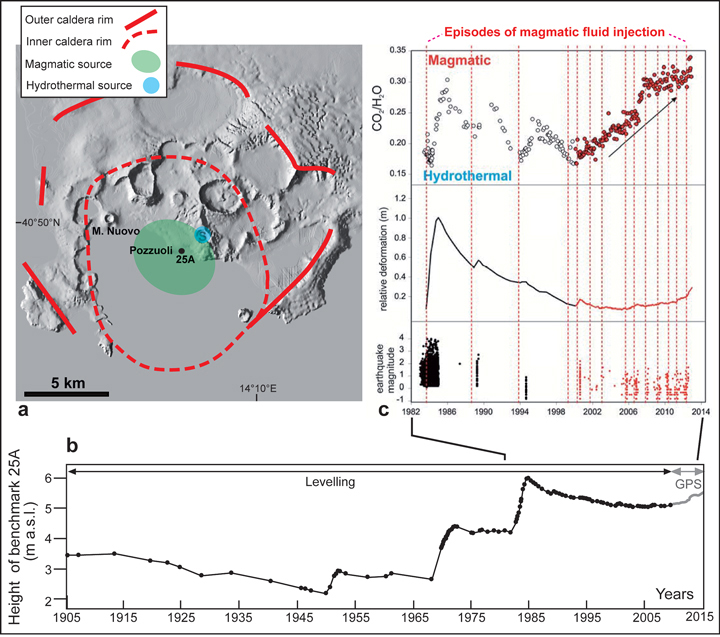
The Eruptive Precursors project in Campi Flegrei, Italy, seeks to understand conditions leading to caldera eruptions.
Calderas are the most hazardous type of volcano. These depressions in the Earth’s surface often form when a magma chamber empties suddenly after an explosive eruption. The hazard arises because of a caldera’s large size, the long-lived magma systems that feed large explosive eruptions, and an overlying hydrothermal system that can either mask or amplify magmatic processes and make it difficult to predict these eruptions.
Periods of unrest, when the volcano undergoes abnormal changes in shape, structure, and chemistry, demonstrate calderas’ complexity. Unrest may culminate in an eruption, or it may merely mark a stage in a more complex dynamic evolution of the volcano. A conceptual model of the unrest may sharpen scientists’ understanding of the dynamics and lead to more reliable forecasts of impending eruptions.
What can we learn about calderas by studying unrest? What should we expect from caldera unrest? What are the associated hazards? These were the central questions of the Eruptive Precursors project. After 2 years, this project has provided constraints on unrest, in the form of deviations from geophysical and geochemical baselines, at the Campi Flegrei caldera in southern Italy.
Dennis Gilles, U.S. Geothermal’s Chief Executive Officer and GRC Board Member commented on updates to various projects:
“During the quarter a number of steps were also completed to advance our growth prospects and increase our MW output. At our WGP Geysers project in California our testing program confirmed a sufficient steam resource to support a 30 MW power plant. We are currently seeking a Power Purchase Agreement (“PPA”) to enable start of plant construction.
Our El Ceibillo project in Guatemala received formal approval of our concession modification in July, which allowed us to restart our drilling and subsequently led to discovery of a commercially viable geothermal reservoir. We are now expanding the area with further drilling prior to seeking a PPA.
We have also signed an agreement to acquire three unconstructed binary power plants for a small fraction of their original cost. This provides us the flexibility to install these plants where required at existing or new projects, lowers our project capital cost, and accelerates the development timelines. We also are continuing to examine a number of synergistic acquisition opportunities.”
County Administrator Bentley Henderson began the meeting by outlining three things that should be changed in the agreement PAGWAPA signed with the Department of Local Affairs (DOLA) when it accepted a $2 million grant for the project.
First, the deadline needs to be extended.
As it stands now, there is approximately $1 million in unspent DOLA funds still available for the project, but that money needs to be spent before May 2016. With the beginning of winter, and the expectation that El Niño will result in an exceptionally severe winter, no further work is planned for the project until at least April.
Second, the scope of the project needs to be changed.
Originally, the plan was to use the DOLA money — in conjunction with a grant from the U.S. Department of Energy (DOE) — to drill a number of shallow, thermal gradient (TG) wells. Data from these wells would then be used to pinpoint the ideal location for a deeper confirmation well that could be flow tested to verify the extent and efficacy of the geothermal resource.
Cheshire East Council is seeking to appoint a joint venture partner before Christmas to enter into a contract to establish a joint venture company (JVC) in order to take advantage of the geology of the area.
The Cheshire basin is one of only six economically suitable sites in the UK for developing deep geothermal energy. Preliminary studies show it holds reserves of more than six times the national heat demand of the UK, with groundwater temperatures of between 75-110 degrees centigrade.
The ultimate aim of the venture is to deliver heating to homes across Cheshire East fueled by a range of renewable energy sources, including but not limited to biomass, solar thermal, solar photo-voltaic and geothermal energy.
The council has already established a knowledge transfer partnership with the University of Keele and has appointed a PhD student to undertake geological mapping of the area.
The joint venture will be formed as a private limited company with equal voting rights between the Council and its partner and an initial tie in period of five years. The appointed partner will not have the exclusive rights to develop renewable projects. The Council will retain the ability to approve new business cases on a project by project basis
Teranov, a French engineering and services company based in Guadeloupe, has started geothermal exploration in St. Kitts. Five geoscientists are on the island conducting feasibility studies in geophysics, geology and geochemistry.
President of Teranov, Jacques Chouraki, says the prospects for geothermal energy on St. Kitts are promising. “The initial results look pretty good but, of course, it’s too early to say what will be valuable…It’s a long process. We have decided to invest a lot of manpower in this project in order to speed up the process so that as quickly as possible the St. Kitts population will be able to know exactly if there are geothermal resources available or not,” Chouraki said.
In September of this year, Minister of Public Infrastructure, Posts, Urban Development and Transport Ian “Patches” Liburd signed a Memorandum of Understanding (MOU) with Teranov, which includes a road map that can possibly see the production of geothermal energy in 2020.
Despite declarations from the executive branch that the Costa Rican government will not pursue geothermal electricity development in national parks, the office of governing Citizen Action Party (PAC) legislator Ottón Solís is working on a bill to allow it in three volcanic protected areas.
The bill would address conservationists’ concerns over exploiting Rincón de la Vieja, Tenorio and Arenal national parks by developing geothermal capacity in the parks in conjunction with the National System of Conservation Areas, or SINAC, in a way that conforms to the conservation goals of the protected areas, said Rodolfo Cordero, an aide to lawmaker Solís.
The bill would require the Costa Rica Electricity Institute, or ICE – which would develop the volcano’s geothermal electricity capacity – to compensate land used for the projects with land outside the parks.
During its regular meeting on Tuesday, the Imperial County board of Supervisors decided to deny the appeal brought forward by the California Unions for Renewable Energy challenging the new expansion project of the Ormat Heber 1 Geothermal Plant.
The proposal is to expand the existing power plant. It will include an additional three-cell cooling towers and an additional iso-pentane storage tank.
The DRECP streamlines permitting and proposes financial incentives for solar, wind, and geothermal developers that build in preferred areas. Projects would still undergo state and federal environmental reviews.
The DRECP area includes known geothermal energy resources around the Salton Sea in Imperial Valley.
U.S. Geothermal Inc. is pleased to announce that it has entered into an agreement to acquire all of the major and long lead equipment for the construction of three binary geothermal power plants at a significant discount. The equipment was part of an order for six power plant units by another geothermal developer, but only three were installed. The components for the three units being purchased are all new and unused, and have been held in storage. Upon closing of the transaction, they will be moved to a Company owned site.
The equipment is from the same manufacturers, and is of a similar size and design, to that installed at the Company's Neal Hot Springs and San Emidio power plants. The design output of the acquired units totals approximately 35 megawatts (MW). Actual output of each unit will be determined by resource conditions found at the sites at which the equipment is ultimately installed. Read More....
Multi-million dollar tests carried out by Icelandic experts indicate promising potential to power the British territory using geothermal energy.
The cheaper, greener electricity would not only slash bills for householders - currently the highest in the Caribbean - but could stimulate external investment by ending decades-old problems of prohibitive utility costs and an unreliable supply.
Hopes are also high that switching to renewable, low-emission energy would increase the number of holidaymakers to the "emerald isle" by cementing its status as an eco-haven. Read More.....
The U.S. Fish and Wildlife Service broke ground Thursday on a first-of-its-kind restoration project at Red Hill Bay, on the southern shore of California's largest lake. Crews plan to cover 420 acres of exposed lakebed with water from the lake and the nearby Alamo River, creating wetland habitat for migratory birds and suppressing toxic dust that would otherwise pollute the air. The wetland project would leave space for energy companies to tap the potent geothermal reservoir beneath the ground, a top priority for local officials.
One of the trickiest parts of designing the project was making sure energy companies would still be able to tap the geothermal resources beneath the lakebed. Government officials worked closely with CalEnergy, the company that leases the below-ground mineral rights from the Imperial Irrigation District, to design "access corridors" where the company will be able to drill beneath the wetlands.
"We got with them, we rolled up our sleeves and we put together a plan that makes both things work," said Randy Keller, director of development for CalEnergy, which owns 10 of the 11 geothermal plants by the Salton Sea.
The Salton Sea is home to one of the world’s most potent geothermal reservoirs, and the Imperial Irrigation District has long seen new development as a source of royalty payments to fund long-term restoration. New geothermal plants would also suppress dust by covering exposed lakebed, not to mention contribute to California’s ambitious clean energy and climate goals.
But new geothermal plants are expensive, and only one has been built by the Salton Sea since 2000. It's unclear whether the 50 percent clean energy mandate signed by Gov. Jerry Brown last month will spark new geothermal development, as some local officials hope.
The annual update of the American Council On Renewable Energy's (ACORE) Renewable Energy in the 50 States: Western Region report was released today at the Renewable Energy Finance Forum-West (REFF-West) in San Francisco. Fully redesigned for 2015, this report examines state energy policies and programs, investment, and market openness in the renewable energy sector in the thirteen western states (AK, AZ, CA, CO, HI, ID, MT, NV, NM, OR, UT, WA, WY).
This year's update to the Western Region Report notes that in 2014, the western renewable energy sector attracted nearly half of the country's combined venture capital, private equity, and asset finance investment and produced roughly one third of the region's total electricity generation -- compared to about 13 percent nationally. In fact, the report notes that half of the nation's total renewable power capacity is located in these states, including 60 percent of all hydro, 70 percent of all solar, and 100 percent of all geothermal power.
Chilean state-owned oil company Empresa Nacional del Petroleo (ENAP) is thinking of reducing its share in the 48 MW Cerro Pabellon geothermal project to maintain focus on its core business.
Cerro Pabellon is controlled by Enel Green Power SpA with a 51% stake, while ENAP holds the remainder.
ENAP's contribution has decreased to 40% since the start of the project in July and could shrink further to a 20% share, Pulso reported on Tuesday, quoting unnamed sources. CEO Marcelo Tokman has confirmed to the newspaper that the company is financing part of the new investments, reducing its participation.
Since the beginning, ENAP has sought to introduce new technology in the country rather than own the asset. Reportedly the company has an agreement with its partner to make minimum contributions and ponder the additional amounts.
After starting construction, which is estimated at nearly USD 320 million (EUR 294.3m), Enel Green Power has said it is funding the project with its own resources. The plant is expected to be completed by the first half of 2017.