Friday, June 10, 2016
Science & Technology: Video on CarbFix Project at Hellisheidi Geothermal Power Plant
Scientists Turn Carbon Dioxide Emissions into Stone (Scientific American)
Turning Carbon Emissions to Stone from Earth Institute on Vimeo.


United Kingdom: Geothermal Heat from Flooded Mines for Homes in a South Wales Valley
How flooded mine shafts could help heat valley homes (WalesOnline)


Heat generated by water which has flooded into old mines could warm almost 1,000 homes in the upper Llynfi Valley in the future.
It is one of two ambitious renewable energy projects being investigated by Bridgend County Borough Council (BCBC), which could cut bills for up to 11,000 homes across the county.
In the upper LlynFfi Valley, the idea is to pump water from the mine workings – which at 10°C to 14°C (50° to 57°F) is a geothermal source of energy – and transport it through a network of pipes to residents’ properties.
There, the heat will be extracted and passed through a heat pump, which will then provide heat for the property using its existing radiator system.
The mine water would not, at any point, enter the homes of residents.
Feasibility studies have begun into both schemes thanks to a £67,000 grant to BCBC from the Department of Energy and Climate Change.
Thursday, June 9, 2016
Turkey: Zorlu Group Applies to Increase Capacity of Kızıldere III Geothermal Project by 70 MW
Decision to include the Kızıldere VI GEPP Project within the scope of the ongoing Kızıldere III GEPP Project (News Release)
Pursuant to our material event disclosures dated 05.05.2016 and 06.05.2016; based on its evaluations, our 100% owned subsidiary, Zorlu Doğal Elektrik Üretimi AŞ (Zorlu Doğal) has decided to realize the Kızıldere VI Geothermal Power Plant (GEPP) Project within the scope of the Kızıldere III GEPP Project which is currently under construction on the same site. Accordingly, Zorlu Doğal withdrew its pre-license application to Energy Market Regulatory Authority (EMRA) for the Kızıldere VI GEPP Project, which was planned to have an installed capacity of 60 MW.
Since the two projects will be merged under the Kızıldere III GEPP Project, an application has been to EMRA to amend the generation license of the Kızıldere III GEPP Project to increase the installed capacity from 95.2 MW to 165 MW with the addition of a second unit with an installed capacity of 69.8 MW.
Read More........
Since the two projects will be merged under the Kızıldere III GEPP Project, an application has been to EMRA to amend the generation license of the Kızıldere III GEPP Project to increase the installed capacity from 95.2 MW to 165 MW with the addition of a second unit with an installed capacity of 69.8 MW.
Read More........
Science & Technology: Radio Program on Turning CO2 to Limestone at Hellisheidi Geothermal Power Plant
Fast Storage of CO2 in Volcanic Rock (BBC)

Atmospheric carbon dioxide injected into volcanic rock as part of a pilot project in Iceland was almost completely mineralized, or converted to carbonate minerals, in less than two years. The results suggest that basaltic rocks may be effective sinks for storing carbon dioxide removed from the atmosphere.
Download the broadcast.........
Atmospheric carbon dioxide injected into volcanic rock as part of a pilot project in Iceland was almost completely mineralized, or converted to carbonate minerals, in less than two years. The results suggest that basaltic rocks may be effective sinks for storing carbon dioxide removed from the atmosphere.
Download the broadcast.........
Iceland: CO2 from Hellisheidi Geothermal Power Plant Turned into Rock
CO2 turned into stone in Iceland in climate change breakthrough (The Guardian)
Radical new technique promises a cheaper and more secure method of burying CO2 emissions underground instead of storing it as a gas
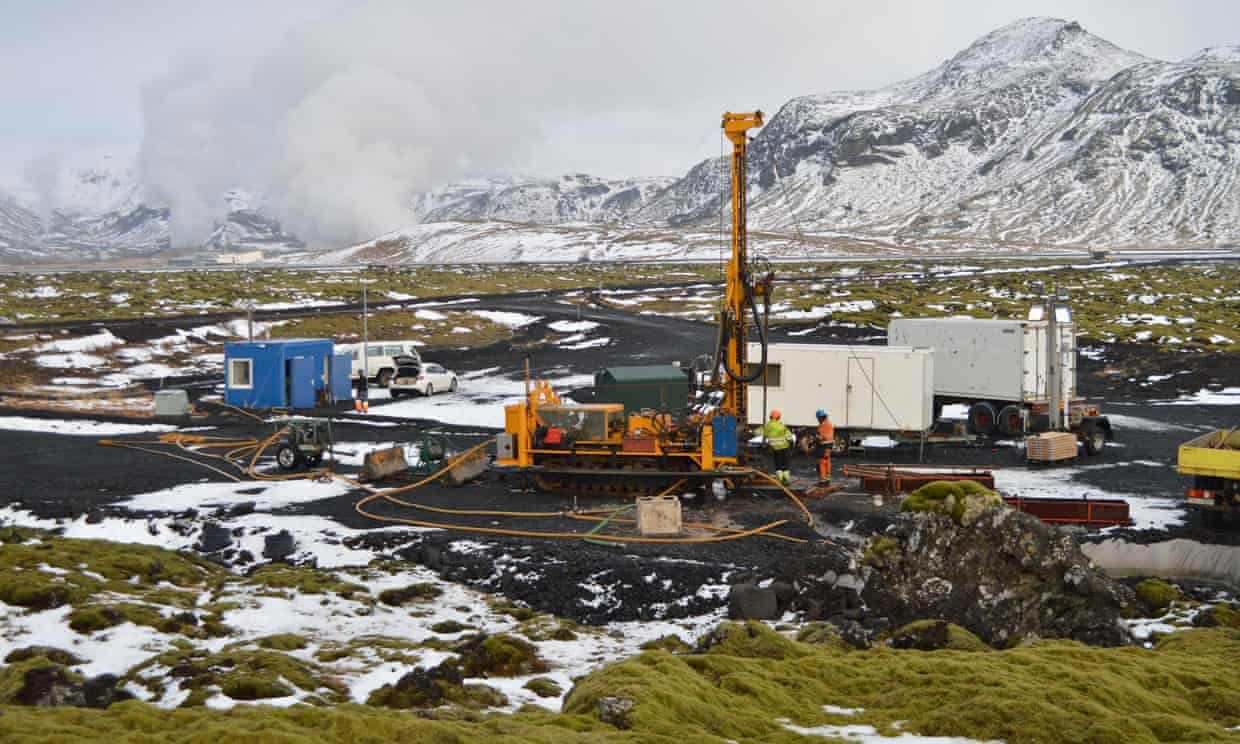 |
| Site close to the Hellisheidi geothermal powerplant, where CO2 was injected into volcanic rock. In two years it was almost completely mineralised. Photograph: Juerg Matter/Science |
Carbon dioxide has been pumped underground and turned rapidly into stone, demonstrating a radical new way to tackle climate change.
The unique project promises a cheaper and more secure way of burying CO2 from fossil fuel burning underground, where it cannot warm the planet. Such carbon capture and storage (CCS) is thought to be essential to halting global warming, but existing projects store the CO2 as a gas and concerns about costs and potential leakage have halted some plans.
The new research pumped CO2 into the volcanic rock under Iceland and sped up a natural process where the basalts react with the gas to form carbonate minerals, which make up limestone. The researchers were amazed by how fast all the gas turned into a solid – just two years, compared to the hundreds or thousands of years that had been predicted.
“We need to deal with rising carbon emissions and this is the ultimate permanent storage – turn them back to stone,” said Juerg Matter, at the University of Southampton in the UK, who led the research published on Thursday in the journal Science.
"In our pilot project in Iceland, called CarbFix, we take CO2 and wastewater from the same geothermal power plant and inject them together. The CO2 dissolves and, like in a bottle of sparkling water, it stays dissolved as long as it's sealed. It then reacts with calcium and magnesium silicates in rocks to form carbonates.
For CarbFix the electricity comes from geothermal power, so the emissions penalty for injecting dissolved CO2 is on the order of 0.2 percent. With electricity from a coal-fired power plant, the penalty would be much higher, over 10 percent of the volume stored."
Science & Technology: Method for Removing Geothermal Scale from Wells
Patent Application: Methods And Systems For Removing Geothermal Scale (US Patent and Trademark Office)
 Geothermal wells frequently form deposits of geothermal scale that can detrimentally affect subterranean operations. These deposits can be very difficult to remove from a surface. Conventional procedures for addressing geothermal scale often provide inadequate scale removal, in addition to creating a number of other issues.
Methods for removing geothermal scale from a wellbore can comprise: introducing a descaling agent comprising an N-(phosphonoalkyl) iminodiacetic acid or any salt thereof into a wellbore of a geothermal well having geothermal scale present therein; contacting the geothermal scale with the descaling agent; and removing at least a portion of the geothermal scale from the geothermal well using the descaling agent.
Read More.........

Methods for removing geothermal scale from a wellbore can comprise: introducing a descaling agent comprising an N-(phosphonoalkyl) iminodiacetic acid or any salt thereof into a wellbore of a geothermal well having geothermal scale present therein; contacting the geothermal scale with the descaling agent; and removing at least a portion of the geothermal scale from the geothermal well using the descaling agent.
Read More.........
USA, Alaska: Pilgrim Hot Springs Geothermal Waters to be Used in Direct Use Project
Unaatuq Breaks Ground on Pilgrim Hot Springs Development (KNOM)
Starting this summer, an abandoned hot springs in the heart of western Alaska will go from a deteriorating historical site to an operational community garden. At least that’s the vision of Unaatuq, LLC, a consortium of seven regional organizations that owns the Pilgrim Hot Springs property.
The Alaska Center for Energy and Power (ACEP) works closely with Unaatuq. It helped secure a “Conservation Innovation” grant through the National Resource Conservation Service to help fund the Pilgrim Project. Research Engineer Chris Pike sees a connection between the grant’s energy focus and growing food.
“One of the things that we really want to do is use that geothermal energy that’s at Pilgrim Hot Springs to grow vegetables,” said Pike. “And then food is a way to export energy. We always think of electricity and heat, but food is just as much of a need.”
ACEP has determined that the Pilgrim Hot Springs resource should be capable of sustainably generating 2 MW of electric power, which could be used locally or delivered to Nome or other nearby loads via the construction of a power line.
Read More.......
 |
| Mountain view at Pilgrim Hot Springs. (Photo: Maddie Winchester, KNOM) |
The Alaska Center for Energy and Power (ACEP) works closely with Unaatuq. It helped secure a “Conservation Innovation” grant through the National Resource Conservation Service to help fund the Pilgrim Project. Research Engineer Chris Pike sees a connection between the grant’s energy focus and growing food.
“One of the things that we really want to do is use that geothermal energy that’s at Pilgrim Hot Springs to grow vegetables,” said Pike. “And then food is a way to export energy. We always think of electricity and heat, but food is just as much of a need.”
ACEP has determined that the Pilgrim Hot Springs resource should be capable of sustainably generating 2 MW of electric power, which could be used locally or delivered to Nome or other nearby loads via the construction of a power line.
Read More.......
USA, California: A New Hope for Lithium from Geothermal Brine Scheme at Salton Sea
Tesla offered $325 million for Salton Sea startup (The Desert Sun)

The letter from Elon Musk left no doubt about his intentions: He wanted Simbol Materials, and he was willing to pay handsomely for it.
Simbol claimed it had developed extraordinary technology for extracting lithium — a key ingredient in the batteries that power Tesla's electric cars — from the mineral-rich brine by the southern shore of the Salton Sea, southeast of Palm Springs, California. Tesla's rock-star co-founder and chief executive was on the hunt for lithium, and Simbol planned to produce huge quantities of the valuable metal. [Simbol Materials' demonstration plant was located next to EnergySource's 49 MW John L. Featherstone geothermal plant near the Salton Sea.]
Musk's preliminary offer for the startup: $325 million, paid in Tesla stock. For reasons that are still unclear, the deal with Tesla fell apart. For all intents and purposes, Simbol is dead.
A new company, Alger Alternative Energy, has risen from the startup's ashes. Founded by Simbol's former vice president of businesses development, Tracy Sizemore, the firm expects to finalize a purchase of Simbol's assets and technology through a court proceeding this week.
Experts say the Salton Sea's mineral-rich brine is one of the world's best lithium resources. But so far, no company has successfully converted geothermal brine to lithium on a large scale, at the Salton Sea or elsewhere.
Read More........

The letter from Elon Musk left no doubt about his intentions: He wanted Simbol Materials, and he was willing to pay handsomely for it.
Simbol claimed it had developed extraordinary technology for extracting lithium — a key ingredient in the batteries that power Tesla's electric cars — from the mineral-rich brine by the southern shore of the Salton Sea, southeast of Palm Springs, California. Tesla's rock-star co-founder and chief executive was on the hunt for lithium, and Simbol planned to produce huge quantities of the valuable metal. [Simbol Materials' demonstration plant was located next to EnergySource's 49 MW John L. Featherstone geothermal plant near the Salton Sea.]
Musk's preliminary offer for the startup: $325 million, paid in Tesla stock. For reasons that are still unclear, the deal with Tesla fell apart. For all intents and purposes, Simbol is dead.
A new company, Alger Alternative Energy, has risen from the startup's ashes. Founded by Simbol's former vice president of businesses development, Tracy Sizemore, the firm expects to finalize a purchase of Simbol's assets and technology through a court proceeding this week.
Experts say the Salton Sea's mineral-rich brine is one of the world's best lithium resources. But so far, no company has successfully converted geothermal brine to lithium on a large scale, at the Salton Sea or elsewhere.
Read More........
Italy: GE Oil & Gas to Help Build Organic Rankine Cycle Geothermal Plant in Tuscany
GE Oil & Gas to deliver geothermal tech to Italy’s Graziella (SeeNews Renewables)

US company GE Oil & Gas said Wednesday it will supply its ORegen technology to Italian renewable energy company Graziella Green Power SpA (GGP) for a plant in the Tuscan geothermal district.
GE’s ORegen technology generates electricity using steam from below the ground without any dispersal or leakage into the environment, as used geothermal fluids can be reinjected underground. Previously, this technology used to be applied in waste heat recovery in hydrocarbon-based plants.
Once up and running in 2018, the plant is expected to be able to generate approximately 40,000 MWh of electricity per year. Its output is estimated to be enough to power some 14,000 local households.
GGP will execute the current scheme as an experimental project in the Italian Ministry of Economic Development’s first program of investments in the geothermal sector with complete reinjection.
Read More........
US company GE Oil & Gas said Wednesday it will supply its ORegen technology to Italian renewable energy company Graziella Green Power SpA (GGP) for a plant in the Tuscan geothermal district.
GE’s ORegen technology generates electricity using steam from below the ground without any dispersal or leakage into the environment, as used geothermal fluids can be reinjected underground. Previously, this technology used to be applied in waste heat recovery in hydrocarbon-based plants.
Once up and running in 2018, the plant is expected to be able to generate approximately 40,000 MWh of electricity per year. Its output is estimated to be enough to power some 14,000 local households.
GGP will execute the current scheme as an experimental project in the Italian Ministry of Economic Development’s first program of investments in the geothermal sector with complete reinjection.
Read More........
USA, Hawaii: Progress Made to Meeting 100% Renewable Energy by 2045
Hawaiian Electric files with state regulators to begin new pursuit of utility-scale renewables (Utility Dive)


The Hawaiian Electric Co. (HECO) asked the Hawaii Public Utilities Commission (HPUC) to open a docket to approve its issuance of a formal Request for Proposals (RFP) for renewable energy projects on Oahu. This is, HECO said, an early step toward meeting the state’s 100% renewables by 2045 mandate.
The RFP would also be an important step toward meeting targets designated in the five-year renewables action plan defined in HECO’s Power Supply Improvement Plan (PSIP) update filed with the PUC in April, the utility added. The commission is reviewing the PSIP. Overall, its preferred plan calls for Hawaii’s 2045 electricity generation mix to be composed of 16.1% distributed solar, 10.2% utility-scale solar, 33.4% onshore and offshore wind energy, 26.9% biofuels, 6.5% geothermal energy, 6.5% waste and biomass, and 0.4% hydropower.
The RFP will stipulate the projects must be on Oahu and must be online by the end of 2020. Once the docket is opened, the PUC will appoint an independent observer to oversee the procurement and to collaborate with HECO on the RFP’s technical, operational, and performance requirements.
Kenya: Menengai Geothermal Project for Electricity Generation and Direct Uses
GDC to go big on direct uses of geothermal energy (The Standard Digital News)
Geothermal Development Company (GDC) will heavily expand its research and innovation on the direct uses of geothermal energy in support of community and national economic sphere, Managing Director (MD) and Chief Executive Officer (CEO) Eng. Johnson P. Ole Nchoe has said.
The MD was speaking at the Menengai Geothermal Project on Wednesday when he took a tour of the facility. “We are forging diverse relationships with development partners such as USAID, African Development Bank and ICEIDA among others to leverage on the abundant geothermal resources in the country,” he said.
Geothermal energy is versatile and prolific. Apart from its uses in the generation of electricity, geothermal has other dozens of uses such as in heating greenhouses, milk pasteurisation, laundry, leisure and recreation, among many other uses. In Menengai, GDC is already running a pilot on four projects for heating fish ponds, heating greenhouses, milk pasteurisation and laundry.
Read More........
 |
| GDC Managing Director and CEO, Eng. Johnson P. Ole Nchoe admires capsicum from the geothermal heated green house at the Menengai Direct Uses pilot project in Nakuru County. |
The MD was speaking at the Menengai Geothermal Project on Wednesday when he took a tour of the facility. “We are forging diverse relationships with development partners such as USAID, African Development Bank and ICEIDA among others to leverage on the abundant geothermal resources in the country,” he said.
Geothermal energy is versatile and prolific. Apart from its uses in the generation of electricity, geothermal has other dozens of uses such as in heating greenhouses, milk pasteurisation, laundry, leisure and recreation, among many other uses. In Menengai, GDC is already running a pilot on four projects for heating fish ponds, heating greenhouses, milk pasteurisation and laundry.
Read More........
Iceland: European Investment Bank Funds 90 MWe Þeistareykir Geothermal Power Station
EIB finances geothermal power plant in Iceland (Mbl.is)
The European Investment Bank (EIB) has signed a EUR 125 million loan agreement with Landsvirkjun, the National Power Company of Iceland, to finance a new geothermal power station and its geothermal wells at Þeistareykir, near Húsavik in north-eastern Iceland.
The financing will be used to support the design, construction and operation of a new 90 MWe geothermal power station and its geothermal wells, operated by the National Power Company of Iceland. The project will be located at Þeistareykir, some 30 km south-east of Húsavik in the northeast of the country, where nine wells with over 50 MWe capacity have already been drilled and tested.
Read More........
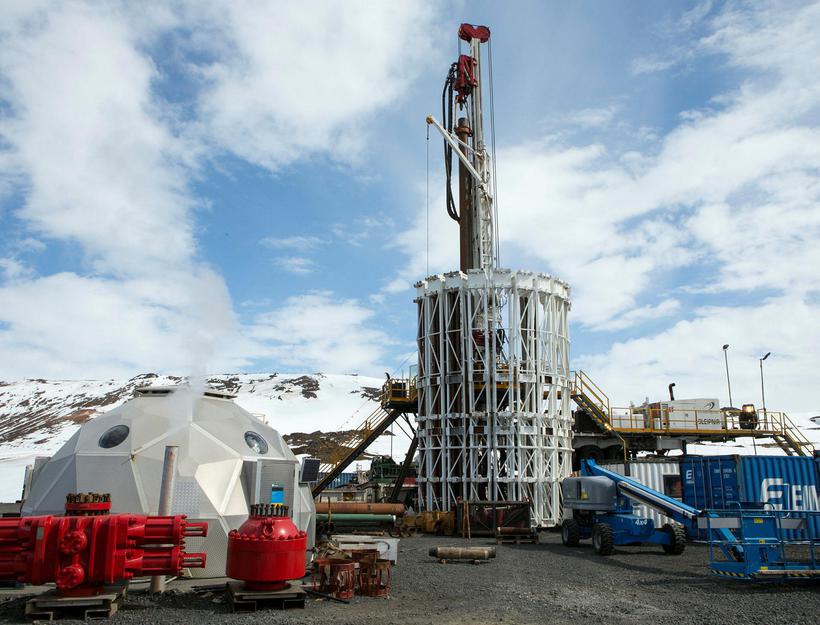 |
| Construction at the Þeistareykjavirkjun power plant. Photo: Mbl.is |
The financing will be used to support the design, construction and operation of a new 90 MWe geothermal power station and its geothermal wells, operated by the National Power Company of Iceland. The project will be located at Þeistareykir, some 30 km south-east of Húsavik in the northeast of the country, where nine wells with over 50 MWe capacity have already been drilled and tested.
Read More........
Wednesday, June 8, 2016
Germany: Looking for a Site for EGS Laboratory in the Southern Black Forest
Criteria and geological setting for the generic geothermal underground research laboratory, GEOLAB (Geothermal Energy)

High flow rate injection and related hydromechanical interaction are the most important factors in reservoir development of Enhanced Geothermal Systems (EGS). GeoLaB, a new generic geothermal underground research laboratory (URL), is proposed for controlled high flow rate experiments (CHFE) to address limited comprehension of coupled processes connected to EGS reservoir flow conditions.
As analogue for typical EGS development, CHFE require specific hydromechanical conditions including a connected fracture network in crystalline basement rock, sufficient hydraulic fracture transmissivities, a strike-slip to normal faulting tectonic regime, controllable hydraulic boundary conditions, and hydrothermal alteration fracture fillings that improve conditions for hydromechanical interaction.
Besides favourable geological, hydraulic, and stress conditions, the vicinity to long-term EGS production favours the southern Black Forest as potential region for GeoLaB. Therefore, an exemplary site assessment has been carried out at “Wilhelminenstollen” in the southern Black Forest (Germany).
Read More........
High flow rate injection and related hydromechanical interaction are the most important factors in reservoir development of Enhanced Geothermal Systems (EGS). GeoLaB, a new generic geothermal underground research laboratory (URL), is proposed for controlled high flow rate experiments (CHFE) to address limited comprehension of coupled processes connected to EGS reservoir flow conditions.
As analogue for typical EGS development, CHFE require specific hydromechanical conditions including a connected fracture network in crystalline basement rock, sufficient hydraulic fracture transmissivities, a strike-slip to normal faulting tectonic regime, controllable hydraulic boundary conditions, and hydrothermal alteration fracture fillings that improve conditions for hydromechanical interaction.
Besides favourable geological, hydraulic, and stress conditions, the vicinity to long-term EGS production favours the southern Black Forest as potential region for GeoLaB. Therefore, an exemplary site assessment has been carried out at “Wilhelminenstollen” in the southern Black Forest (Germany).
Read More........
Turkey: PLUTO will Help Minimize Upfront Risks of Geothermal Exploration
EBRD presents financing scheme for geothermal projects at Izmir conference (EBRD)


The European Bank for Reconstruction and Development (EBRD) has presented its innovative financing scheme in support of geothermal energy projects at a three-day IGC Turkey conference which concluded in Izmir today.
The new US$ 125 million PLUTO initiative provides finance and advice to private developers at exploratory stages in a move to tap Turkey’s significant potential for geothermal energy and help the country meet growing demand for electricity.
Geothermal energy projects face high risks, particularly in their initial stages, including high investment costs and development risks and very limited access to project finance once drilling has confirmed the existence of the resource. PLUTO, named after the ruler of the underworld in classical mythology, helps minimize these risks.
The new US$ 125 million PLUTO initiative provides finance and advice to private developers at exploratory stages in a move to tap Turkey’s significant potential for geothermal energy and help the country meet growing demand for electricity.
Geothermal energy projects face high risks, particularly in their initial stages, including high investment costs and development risks and very limited access to project finance once drilling has confirmed the existence of the resource. PLUTO, named after the ruler of the underworld in classical mythology, helps minimize these risks.
Australia: Baseload Power Generation Gets Short Shrift
Australia could be 100% renewable – with no “baseload” – by 2035 (Renew Economy)

As plans emerge for the development of a massive new “baseload” solar thermal and storage plant to “replace” coal in South Australia, a new report from WWF Australia has questioned the very concept of “baseload”, arguing that this model of power generation is made redundant by a 100% renewable energy grid.
The report, published on Wednesday, argues that Australia could completely and effectively replace the nation’s mostly coal-based “baseload” power generators by harnessing huge volumes of renewable energy – using existing technologies, including battery storage – distributed across the country [there is no mention of geothermal energy in the report].
“The reality is that electricity usage is variable, demand changes throughout the day and night, and Australia doesn’t need baseload power generation,” the report says.
Read More........

As plans emerge for the development of a massive new “baseload” solar thermal and storage plant to “replace” coal in South Australia, a new report from WWF Australia has questioned the very concept of “baseload”, arguing that this model of power generation is made redundant by a 100% renewable energy grid.
The report, published on Wednesday, argues that Australia could completely and effectively replace the nation’s mostly coal-based “baseload” power generators by harnessing huge volumes of renewable energy – using existing technologies, including battery storage – distributed across the country [there is no mention of geothermal energy in the report].
“The reality is that electricity usage is variable, demand changes throughout the day and night, and Australia doesn’t need baseload power generation,” the report says.
Read More........
New Zealand: Drilling Starts at 20 MW Te Ahi O Maui Geothermal Power Project
Te Ahi O Maui drilling is underway (Voxy.co.nz)

Drilling is underway on the first of three wells for the 20 MW Te Ahi O Maui geothermal power project near Kawerau. Following completion of this well, two further wells will be drilled later this year.
Project Manager, Ben Gibson, said that the drilling process will target known sources of geothermal fluid, which could be as hot as 200-300 degrees Celsius. "It’s this high-temperature fluid that will ultimately fuel the geothermal power plant," he advised.
Well pads were constructed on site and the Old Coach Road, near Kawerau, was upgraded in preparation for the drilling rig’s arrival in late April. The drilling rig was commissioned this month following assembly, inspections, and karakia and blessings from local kaumatua.
Mr Gibson advised that the project’s focus for the coming months is ensuring the wells are drilled as safely and efficiently as possible. "We will be able to provide further updates towards the end of 2016, once the three wells are complete."
Saudi Arabia: 54 GW of Electricity from Renewable Energy Sources by 2040 to Include Geothermal
Saudi targets 54 GW power from renewables (Trade Arabia)
Saudi Arabia aims to produce 54 gigawatt (GW) of electricity from renewable energy sources by 2040, a report said.
About 41GW of electricity will be generated from solar energy while geothermal, waste and wind power will provide the remaining 13GW, the Arab News report said, quoting local media, which cited a United Nations report.
Read More........
 |
| (Courtesy CIA.gov) |
About 41GW of electricity will be generated from solar energy while geothermal, waste and wind power will provide the remaining 13GW, the Arab News report said, quoting local media, which cited a United Nations report.
Read More........
India: Government Aims for 10 GW of Geothermal Energy by 2030
India looks to harness 10 GW geothermal power by 2030 (Livemint)
 India proposes to harness 10 GW of geothermal energy by 2030 through active international collaboration with the US, Philippines, Mexico and New Zealand
In its quest to increase its renewable energy portfolio, India proposes to harness 10,000 MW (10 GW) of geothermal energy by 2030 through active international collaboration with countries such as the US, Philippines, Mexico and New Zealand.
The Indian government’s ministry of new and renewable energy (MNRE) on 6 June released a, “draft Indian geothermal energy development framework” seeking comments from all stakeholders by 10 June.
The draft policy also stresses on the role and active participation of states. respective state governments will facilitate land acquisition at prices determined and also decide on the royalty to be paid for the utilization of geothermal resources.
Read More.........
In its quest to increase its renewable energy portfolio, India proposes to harness 10,000 MW (10 GW) of geothermal energy by 2030 through active international collaboration with countries such as the US, Philippines, Mexico and New Zealand.
The Indian government’s ministry of new and renewable energy (MNRE) on 6 June released a, “draft Indian geothermal energy development framework” seeking comments from all stakeholders by 10 June.
The draft policy also stresses on the role and active participation of states. respective state governments will facilitate land acquisition at prices determined and also decide on the royalty to be paid for the utilization of geothermal resources.
Read More.........
Tuesday, June 7, 2016
Science & Technology: Using Supercritical CO2 to Boost Geothermal Energy Production
Boosting geothermal yields (eniday)
 A new study published in the journal Geothermal Energy used a numerical simulation to study the effect of CO2 sequestration into an aquifer in Louisiana, USA. It found that the introduction of supercritical CO2 into the aquifer, as well as reducing atmospheric levels, might also be able to increase the heat yield produced by the aquifer.
This finding further advocates the dual use of CO2 sequestration together with geothermal production. The Gulf States of the USA have huge quantities of geothermal energy that are still untapped, and accordingly this study could pave the way for the wide-scale development of geothermal power generation in this region.
Read More.......
This finding further advocates the dual use of CO2 sequestration together with geothermal production. The Gulf States of the USA have huge quantities of geothermal energy that are still untapped, and accordingly this study could pave the way for the wide-scale development of geothermal power generation in this region.
Read More.......
USA, California: Balancing the Golden State's Electrical Grid
Who's In Charge? Getting Western States To Agree On Sharing Renewable Energy (NPR)
In California, there is so much solar energy that grid operators have to switch off solar farms. One solution of dealing with the additional power generated is to share the renewable wealth across state borders – but in the West, it's sparking some not-so-neighborly opposition.
Nancy Traweek's job is to balance California's electrical grid at the California Independent System Operator (CAISO), keeping the lights on for 30 million people. She relies on huge natural gas power plants that put out a steady stream of electricity.
But lately, Traweek's job has gotten harder because of solar and wind power. If clouds come in, solar power drops off.
"That needs to come from somewhere else immediately," she says.
There will be a GRC Fieldtrip to the headquarters of CAISO from the GRC Annual Meeting & GEA Geothermal Energy Expo, October 23-26, Sacramento, California.
Read More........
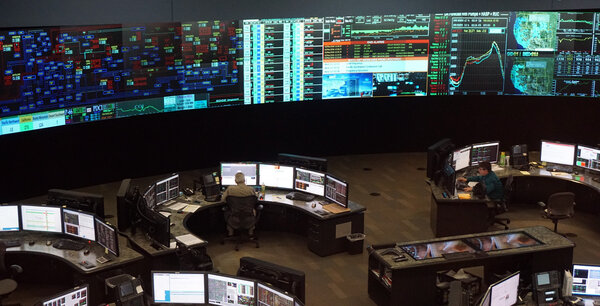 |
| The control room at CAISO headquarters near Sacramento |
Nancy Traweek's job is to balance California's electrical grid at the California Independent System Operator (CAISO), keeping the lights on for 30 million people. She relies on huge natural gas power plants that put out a steady stream of electricity.
But lately, Traweek's job has gotten harder because of solar and wind power. If clouds come in, solar power drops off.
"That needs to come from somewhere else immediately," she says.
There will be a GRC Fieldtrip to the headquarters of CAISO from the GRC Annual Meeting & GEA Geothermal Energy Expo, October 23-26, Sacramento, California.
Read More........
Global: Vote for the New IGA Board
IGA Board Elections 2016-2019
IGA members are invited to vote for up to 30 candidates until 1 July 2016.
 The online voting platform for the IGA Board of Directors election is now available on the IGA website.
Of the 43 candidates 10 are GRC Members:
IGA members are invited to vote for up to 30 candidates until 1 July 2016.
 The online voting platform for the IGA Board of Directors election is now available on the IGA website.
All IGA members are invited to vote for up to 30 Board candidates with their personal login details until Friday, 1 July 2016. All Board candidates including their statements are displayed online.
The new IGA Board of Directors will commence their work in October 2016 and be active until October 2019. Usually, the IGA Board consists of 30 Board members representing many different countries (see current Board members list).
The new IGA Board of Directors will commence their work in October 2016 and be active until October 2019. Usually, the IGA Board consists of 30 Board members representing many different countries (see current Board members list).
All GRC Members are automatically members of the IGA and are therefore eligible to vote in the election.
- Andy Blair (New Zealand)
- Paul Brophy (USA)
- Louis Capuano, Jr (USA)
- Varun Chandrasekhar (India)
- Gustavo Cuellar (El Salvador)
- Paul Moya (Costa Rica)
- Abadi Poernomo (Indonesia)
- Andrew Sabin (USA)
- Toshihiro Uchida (Japan)
- Shigeto Yamada (Japan)
Turkey: Strong Regulatory Support by Government Helps Geothermal Energy Advance
Turkey Is Hottest Geothermal Market In World: EBRD (Anadolu Agency)
Turkey is currently hottest geothermal market in the world, says the Managing Director of the European Bank for Reconstruction and Development (EBRD).
Thanks to private sector investment in the geothermal sector, and with solid support from the government, Turkey is considered the hottest geothermal market in the world, according to Natalia Khanjenkova, the European Bank for Reconstruction and Development (EBRD) managing director for Turkey and Central Asia on Monday.
Izmir is host to the International Geothermal Congress, IGC Turkey 2016, which is running from June 6-8. Speaking at the three-day geothermal congress at the SwissOtel Buyuk Efes Izmir, sponsored by Anadolu Agency, Khanjenkova discussed the geothermal sector’s development in Turkey.
“Turkey right now is a country we would say is the hottest geothermal market in the world. Perhaps it is not due to the temperature of the geothermal resources but it is attributed to the vibrancy of the private sector that we see in Turkey. This is combined with very strong regulatory support that has been put in place by the government,” she said.
Read More........
 |
| Natalia Khanjenkova, the EBRD managing director for Turkey and Central Asia |
Thanks to private sector investment in the geothermal sector, and with solid support from the government, Turkey is considered the hottest geothermal market in the world, according to Natalia Khanjenkova, the European Bank for Reconstruction and Development (EBRD) managing director for Turkey and Central Asia on Monday.
Izmir is host to the International Geothermal Congress, IGC Turkey 2016, which is running from June 6-8. Speaking at the three-day geothermal congress at the SwissOtel Buyuk Efes Izmir, sponsored by Anadolu Agency, Khanjenkova discussed the geothermal sector’s development in Turkey.
“Turkey right now is a country we would say is the hottest geothermal market in the world. Perhaps it is not due to the temperature of the geothermal resources but it is attributed to the vibrancy of the private sector that we see in Turkey. This is combined with very strong regulatory support that has been put in place by the government,” she said.
Read More........
Kenya: World Bank Provides Financial and Technical Assistance for Geothermal Energy Development
World Bank to help Kenya harness geothermal resources (China.org)
 The World Bank said Tuesday it will help Kenya to harness its vast geothermal resources in order to reduce the reliance on fossil-based fuel.
World Bank Kenya Program Leader on Sustainable Development Sector, Meskerem Brhane, told Xinhua in Nairobi that the bank will provide financial and technical assistance for Kenya.
"Part of the World Bank's 840 million U.S. dollar energy portfolio in Kenya is targeted at the geothermal sector," Brhane said during the World Bank Group's Open Day event.
Geothermal power is a clean source of energy that is available 24 hours a day, said Brhane.
"Our goal is to help Kenya wean off expensive sources of energy so that the cost of electricity is brought down," she said.
Read More.......

World Bank Kenya Program Leader on Sustainable Development Sector, Meskerem Brhane, told Xinhua in Nairobi that the bank will provide financial and technical assistance for Kenya.
"Part of the World Bank's 840 million U.S. dollar energy portfolio in Kenya is targeted at the geothermal sector," Brhane said during the World Bank Group's Open Day event.
Geothermal power is a clean source of energy that is available 24 hours a day, said Brhane.
"Our goal is to help Kenya wean off expensive sources of energy so that the cost of electricity is brought down," she said.
Read More.......
Kenya: Climate Change Forcing Shift to More Reliable Geothermal Energy
Hydro-power production drops due to climate change, says ERC official (The Star)
The production of hydro-power in Kenya has dropped from 70% in the 1980s to below 50%, an expert has said. Energy Regulatory Commission director general Engineer Joe Ng’anga said the effects of global warming are being felt and are hurting power generation. He said hydro-power heavily relies on rainfall, whose pattern is no longer predictable.
“A couple of years back, the country heavily relied on hydro-power, but due to global warming this has changed,” Ng’ang’a said. He said the country has shifted to geothermal power generation to address the shortfall.
“Through the use of geothermal power, we have seen the cost of power tariffs drop by 31 per cent among domestic users and 24 per cent in the industrial sector,” Ng’ang’a said.
Read More........
 |
| Energy Regulatory Commission Director general Joe Ng'ang'a |
“A couple of years back, the country heavily relied on hydro-power, but due to global warming this has changed,” Ng’ang’a said. He said the country has shifted to geothermal power generation to address the shortfall.
“Through the use of geothermal power, we have seen the cost of power tariffs drop by 31 per cent among domestic users and 24 per cent in the industrial sector,” Ng’ang’a said.
Read More........
France: 24 MWth Rittershoffen Geothermal Power Plant Inaugurated
Roquette inaugurating the Rittershoffen deep geothermal power plant (News Release)
Électricité de Strasbourg, Roquette and the Caisse des Dépôts inaugurate the first deep geothermal plant for industrial use
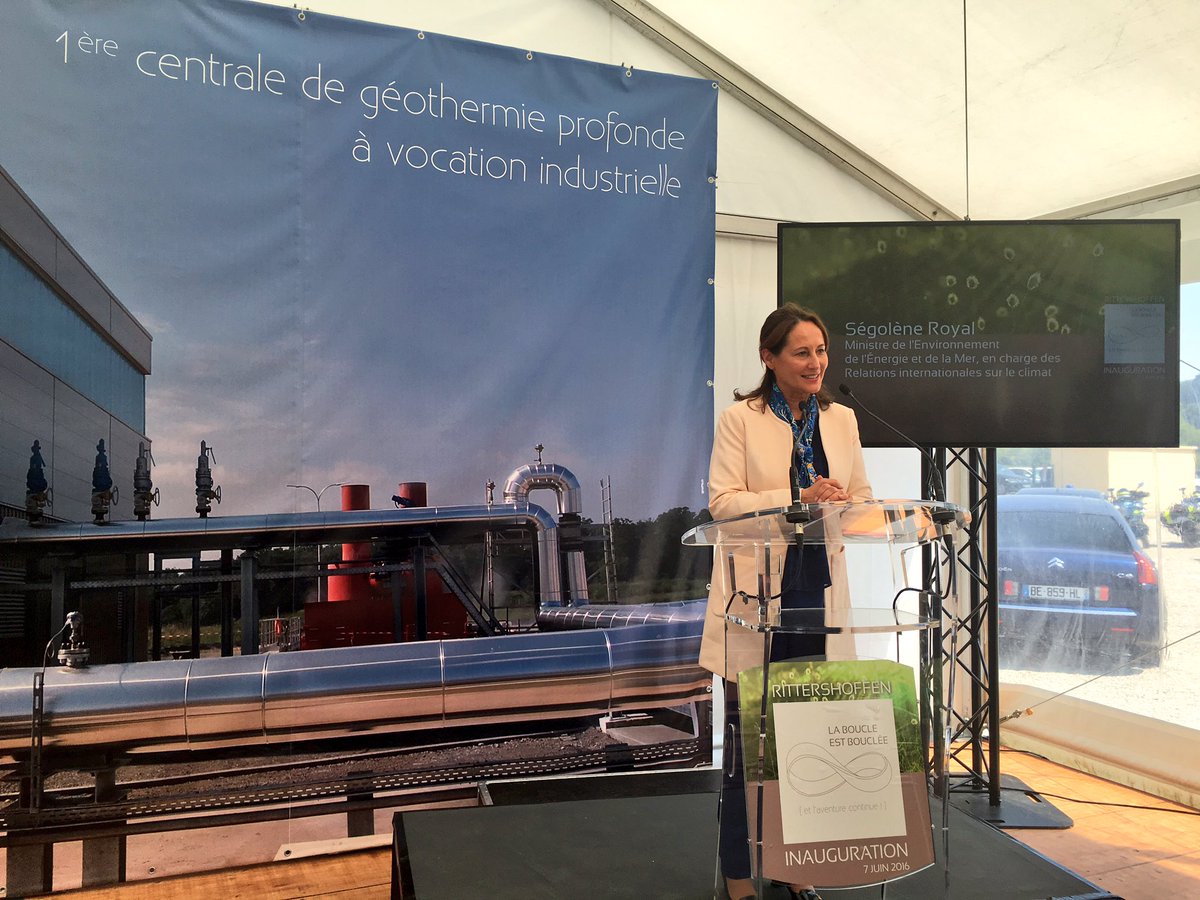
Ségolène Royal, the French Minister of the Environment, Energy and Marine Affairs, responsible for International Climate Relations, has inaugurated the Rittershoffen deep geothermal power plant.
The plant was built by Électricité de Strasbourg, Roquette and the Caisse des Dépôts with the financial backing of the ADEME, the French Environment and Energy Management Agency, represented by its Chairman, Bruno Léchevin, and the Region, represented by Philippe Richert, President of the Regional Council of Alsace Champagne Ardenne Lorraine.
The Rittershoffen deep geothermal power plant is the first of its kind in the world, a model of energy transition and environmental strategy, which opens up important new possibilities for regional and national development. It is the first power plant to use steam from geothermal water to provide energy to an industrial site, in this case the Roquette Group in Beinheim. Water is brought up from a depth of 2,500 m at a temperature of 165°C. The heat is then removed from the water, which is injected back to the same source. The energy is therefore 100% renewable, constant and fully energy-efficient.
Read More........
Électricité de Strasbourg, Roquette and the Caisse des Dépôts inaugurate the first deep geothermal plant for industrial use
Ségolène Royal, the French Minister of the Environment, Energy and Marine Affairs, responsible for International Climate Relations, has inaugurated the Rittershoffen deep geothermal power plant.
The plant was built by Électricité de Strasbourg, Roquette and the Caisse des Dépôts with the financial backing of the ADEME, the French Environment and Energy Management Agency, represented by its Chairman, Bruno Léchevin, and the Region, represented by Philippe Richert, President of the Regional Council of Alsace Champagne Ardenne Lorraine.
The Rittershoffen deep geothermal power plant is the first of its kind in the world, a model of energy transition and environmental strategy, which opens up important new possibilities for regional and national development. It is the first power plant to use steam from geothermal water to provide energy to an industrial site, in this case the Roquette Group in Beinheim. Water is brought up from a depth of 2,500 m at a temperature of 165°C. The heat is then removed from the water, which is injected back to the same source. The energy is therefore 100% renewable, constant and fully energy-efficient.
Read More........
Monday, June 6, 2016
Finance: Economic Competitiveness of Geothermal and Other Electricity Generation Technologies
EIA publishes construction cost information for electric power generators (EIA)

Many factors influence the economic competitiveness of electricity generation technologies; however, two fundamental factors are the cost of constructing generators and the cost of operating them. The U.S. Energy Information Administration (EIA) recently began collecting construction costs for new electric generators at utility-scale power plants. The publication released today covers generators installed in 2013 and includes average costs by technology type or region. EIA expects to publish 2014 construction cost information in August 2016 and 2015 information in October 2016.
Industry reports and other EIA publications have included various estimates of electricity generation technology capital costs, but this is the first time EIA has collected and reported actual construction costs, which include capital and financing costs, for all new generators. Government grants, tax benefits, or other incentives are excluded from these costs. Because the data are business-sensitive and protected, the analysis presents averaged costs for select groupings and excludes certain generation technologies to avoid disclosure of individual company data. The reported costs reflect a snapshot of market prices for generation technologies at the time the projects were developed and built.
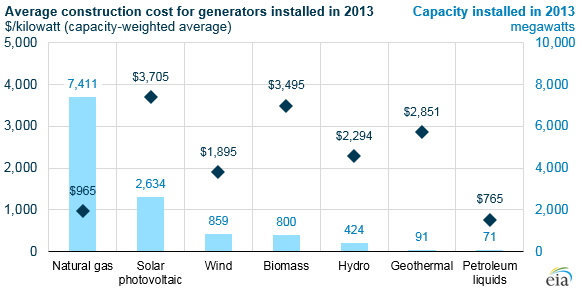
Many factors influence the economic competitiveness of electricity generation technologies; however, two fundamental factors are the cost of constructing generators and the cost of operating them. The U.S. Energy Information Administration (EIA) recently began collecting construction costs for new electric generators at utility-scale power plants. The publication released today covers generators installed in 2013 and includes average costs by technology type or region. EIA expects to publish 2014 construction cost information in August 2016 and 2015 information in October 2016.
Industry reports and other EIA publications have included various estimates of electricity generation technology capital costs, but this is the first time EIA has collected and reported actual construction costs, which include capital and financing costs, for all new generators. Government grants, tax benefits, or other incentives are excluded from these costs. Because the data are business-sensitive and protected, the analysis presents averaged costs for select groupings and excludes certain generation technologies to avoid disclosure of individual company data. The reported costs reflect a snapshot of market prices for generation technologies at the time the projects were developed and built.
Kenya: Olkaria VI 140 MW Geothermal Power Plant Project Gets a Transaction Advisor
K&M Advisors Retained as Transaction Advisor for Olkaria VI 140 MW Geothermal power plant in Kenya (News Release)
 K&M Advisors LLC, a leading financial and technical advisory firm based in Maryland, USA, has announced that it has been awarded a contract by The National Treasury in Kenya and KenGen to serve as the transaction advisor for the Olkaria VI 140 MW geothermal power plant.
K&M’s involvement includes preparing a feasibility study to establish the technical configuration, and bankability of the Olkaria VI project. This will include a grid connection study and advice on the grid capability to accommodate additional power. K&M will also recommend the best Public-Private Partnership (PPP) model and advise KenGen on risk allocation and the contractual structure, as well as prepare all necessary project agreements.
Finally, K&M will prepare the request for qualifications and request for proposals, and advise KenGen through the procurement process and proposal evaluation, as well as provide transaction advisory support through to financial close. This assignment is expected to last approximately 18 months.
Read More.........
K&M’s involvement includes preparing a feasibility study to establish the technical configuration, and bankability of the Olkaria VI project. This will include a grid connection study and advice on the grid capability to accommodate additional power. K&M will also recommend the best Public-Private Partnership (PPP) model and advise KenGen on risk allocation and the contractual structure, as well as prepare all necessary project agreements.
Finally, K&M will prepare the request for qualifications and request for proposals, and advise KenGen through the procurement process and proposal evaluation, as well as provide transaction advisory support through to financial close. This assignment is expected to last approximately 18 months.
Read More.........
Philippines, Iceland: A Filipino Doctor Compares Geothermal Energy in the Two Countries
Opinion: A tale of two geothermal nations (Inquirer.net)


The Icelanders are proud of their geothermal energy. When I visited the Hellisheiði Power Station, the third largest geothermal power station in the world, our guide boasted: “The average Icelandic household only pays $80 a month for water and electricity. We are so blessed!” He proceeded to show how the turbines are able to produce 180 megawatts and to power the entire city of Reykjavik, the world’s northernmost capital.
In the Philippines, such figures will surely be a source of envy. It is very expensive here in Iceland: Even just a bed in a youth hostel costs 8,000 krona (around P3,000) a night. But utilities are cheap, whereas in the Philippines even just a condominium unit can end up costing the $80 in electricity alone.
Read More........
The Icelanders are proud of their geothermal energy. When I visited the Hellisheiði Power Station, the third largest geothermal power station in the world, our guide boasted: “The average Icelandic household only pays $80 a month for water and electricity. We are so blessed!” He proceeded to show how the turbines are able to produce 180 megawatts and to power the entire city of Reykjavik, the world’s northernmost capital.
In the Philippines, such figures will surely be a source of envy. It is very expensive here in Iceland: Even just a bed in a youth hostel costs 8,000 krona (around P3,000) a night. But utilities are cheap, whereas in the Philippines even just a condominium unit can end up costing the $80 in electricity alone.
Read More........
USA, Alaska: GRC Member Talks About his Geothermal Powered Enterprise
Take a trip with Chena Hot Springs Resort owner Bernie Karl (Alaska Dispatch News)
(Video: 2:58 Minutes)
Chena Hot Springs Resort owner Bernie Karl has a lot of ideas intended to create a utopia of environmental sustainability at the end of Chena Hot Springs Road outside Fairbanks. Karl says Chena Hot Springs is in the middle of a 20-year development plan, which already includes a geothermal plant that began operating in 2006. It creates enough electricity to power the entire resort. His latest project is using crushed recycled glass to grow tomatoes.
Chena Hot Springs Resort owner Bernie Karl has a lot of ideas intended to create a utopia of environmental sustainability at the end of Chena Hot Springs Road outside Fairbanks. Karl says Chena Hot Springs is in the middle of a 20-year development plan, which already includes a geothermal plant that began operating in 2006. It creates enough electricity to power the entire resort. His latest project is using crushed recycled glass to grow tomatoes.
New Zealand: Women In Geothermal Creating Opportunities
Abbie Dean's head of steam for geothermal women (Stuff)
Abbie Dean is New Zealand's Ambassador for Women in a male-dominated industry.
Abbie Dean is New Zealand's Ambassador for Women in a male-dominated industry.
 |
| Abbie Dean is a geothermal geochemist at Contact Energy's Wairakei Power Station. |
Scientist Abbie Dean is leading a campaign for women working in the geothermal industry - by recruiting men.
A year ago Dean was appointed New Zealand Ambassador for Women in Geothermal (WING), a global movement aimed at the promotion, education and advancement of women operating in the sector.
Now, Dean has just completed writing WING's five-year vision, and part of that road map includes having 50 per cent male membership, out of a target 1500 members by 2020.
She said: "We truly appreciate and need the support of men. Everyone has daughters, nieces, granddaughters, sisters and that means we need men involved too, to help ensure the next generation of New Zealanders don't encounter the subtle gender biases that are still out there and that create barriers for women."
Indonesia: PT PLN Persero Teams Up With Enel Including Geothermal Projects
Enel and PT PLN Persero to cooperate on sustainable power generation in Indonesia (News Release)
The two companies will jointly evaluate possible opportunities in renewables, conventional technologies and mini-grids
 Enel S.p.A. and the Indonesian power utility PT PLN Persero (PLN) have signed a Memorandum of Understanding to cooperate in sustainable power generation in Indonesia. Enel and PLN will evaluate possible opportunities on projects in electricity generation in the country starting from the joint assessment of the local market for renewables, conventional technologies and mini-grids.
 Under the agreement, Enel and PLN will share useful information and experience both in renewables and conventional generation and will also be scouting for potential opportunities, especially in geothermal, hydropower, wind, solar photovoltaic for renewable energy and CCGT on the conventional front. Enel and PLN will also scout for potential opportunities in mini-grid technologies for the energy supply of remote areas and islands. The two players will implement the agreement through regular meetings, training, seminars, staff exchange, studies and research cooperation among other things.
Read More.......
The two companies will jointly evaluate possible opportunities in renewables, conventional technologies and mini-grids
 Under the agreement, Enel and PLN will share useful information and experience both in renewables and conventional generation and will also be scouting for potential opportunities, especially in geothermal, hydropower, wind, solar photovoltaic for renewable energy and CCGT on the conventional front. Enel and PLN will also scout for potential opportunities in mini-grid technologies for the energy supply of remote areas and islands. The two players will implement the agreement through regular meetings, training, seminars, staff exchange, studies and research cooperation among other things.
Read More.......
Canada: Hundreds of MW of Geothermal Energy Could be Developed in Alberta
Geothermal energy research in Alberta making strides with new technology (CBC News)
Research maps reservoirs of hot water kilometers beneath the earth that could be converted into electricity
 Geothermal-generated electricity could be a piece of the answer to how Alberta can move away from coal-fired electric power in time for the NDP's 2030 deadline.
Jonathan Banks, a research scientist in the department of Earth and Atmospheric Sciences at the University of Alberta, is mapping the potential for geothermal power across the western part of the province, in a partnership with Alberta Innovates and Energy and Environment Solutions. That includes mapping reservoirs of water kilometers beneath our feet, that is hot enough to convert into electricity using a turbine mechanism.
The communities of Grande Prairie County, Hinton, Clearwater County, Rocky Mountain House, the Village of Caroline, the City of Grande Prairie, and the Municipal District of Greenview, are all signed on for exploratory research being done by Banks.
As a conservative estimate, Banks said, by 2030 the province could generate a few hundred megawatts of power in a year to help replace the 6.3 gigawatts of power currently being generated by coal.
Read More........
Research maps reservoirs of hot water kilometers beneath the earth that could be converted into electricity
Jonathan Banks, a research scientist in the department of Earth and Atmospheric Sciences at the University of Alberta, is mapping the potential for geothermal power across the western part of the province, in a partnership with Alberta Innovates and Energy and Environment Solutions. That includes mapping reservoirs of water kilometers beneath our feet, that is hot enough to convert into electricity using a turbine mechanism.
The communities of Grande Prairie County, Hinton, Clearwater County, Rocky Mountain House, the Village of Caroline, the City of Grande Prairie, and the Municipal District of Greenview, are all signed on for exploratory research being done by Banks.
As a conservative estimate, Banks said, by 2030 the province could generate a few hundred megawatts of power in a year to help replace the 6.3 gigawatts of power currently being generated by coal.
Read More........
USA: Geothermal Energy Association Awards Announced
GEA Honors 2016 Recognizes Leaders in Geothermal Technology, Economic and Environmental Advances (News Release)
 The Geothermal Energy Association announced today the winners of their GEA Honors 2016. The winners were selected in categories including Technological Advancement, Economic Development and Environmental Stewardship. GEA will present the Honors at an awards ceremony as part of the Baseload Renewable Energy Summit on June 7 in Reno, Nevada, USA.
This year's award winners are:
Technological Advancement: The University of North Dakota/U.S. Department of Energy.
Economic Development: CalEnergy.
Environmental Stewardship: Enel Green Power's Stillwater Hybrid project in Churchill County, Nevada.
Special Recognition:

This year's award winners are:
Technological Advancement: The University of North Dakota/U.S. Department of Energy.
Economic Development: CalEnergy.
Environmental Stewardship: Enel Green Power's Stillwater Hybrid project in Churchill County, Nevada.
Special Recognition:
- Jay Nathwani of the US Department of Energy for lifetime achievement.
- The Peppermill Resort and Casino for being the only resort in the United States whose heating source is totally provided from geothermal energy produced on the immediate property.
- Ormat Technologies for successfully bringing two U.S. geothermal plant online in 2015-Don A. Campbell and McGinness Hills Complex.
- The National Renewable Energy Laboratory team including Anna Wall, Annika Eberla, and Garvin Heath and the World Bank's Energy Sector Management Assistance Program(ESMAP) for their past and ongoing efforts to understand the carbon emissions from geothermal resources and different power facilities
- Governor John Hickenlooper for advancing geothermal in Colorado.
Saturday, June 4, 2016
GRC Annual Meeting & GEA Geothermal Energy Expo: Geothermal Photo Contest
The Geothermal Resources Council 2016 Amateur Photo Contest
The 37th Amateur Geothermal Photo Contest winners will be announced at the GRC Annual Meeting in Sacramento, California, USA.
The Geothermal Resources Council (GRC) is pleased to announce this year’s Amateur Photo Contest. The purpose of the contest is to showcase quality photography featuring geothermal energy around the world.
The winners will be announced at the GRC Annual Member Meeting and Awards Luncheon, the climax to the 40th GRC Annual Meeting & GEA Geothermal Energy Expo being held in Sacramento, California, USA from October 23-26. The theme for this year’s meeting is “Geothermal Energy, Here and Now: Sustainable, Clean, Flexible”.
The first place winner will receive $150, second place - $100, and third place - $75. Honorable Mention photos will receive certificates. The award checks will be drawn on a US bank.
Photographs on any subject related to geothermal energy can be submitted such as geothermal energy production, EGS, Direct Use and geothermal heat pumps. These can include photos of well testing, drilling, operation of geothermal equipment, newly developed equipment, or plant operation, construction of a geothermal plant or plant site, and geological areas or surface manifestations (holding potential for geothermal exploration or development).
More information on the GRC Amateur Photo Contest, including a submission form, can be found on the GRC website. The deadline for submissions is September 16, 2016.
GRC Photo Contest Submission Form......
The 37th Amateur Geothermal Photo Contest winners will be announced at the GRC Annual Meeting in Sacramento, California, USA.
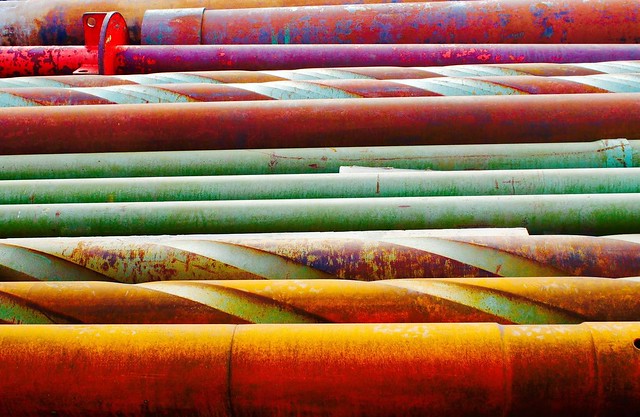 |
| 1st Place 2015: Drill Casings for New Geothermal Well by Cari Covell, Reykjavik University - Iceland School of Energy, Reykjavik, Iceland |
The winners will be announced at the GRC Annual Member Meeting and Awards Luncheon, the climax to the 40th GRC Annual Meeting & GEA Geothermal Energy Expo being held in Sacramento, California, USA from October 23-26. The theme for this year’s meeting is “Geothermal Energy, Here and Now: Sustainable, Clean, Flexible”.
The first place winner will receive $150, second place - $100, and third place - $75. Honorable Mention photos will receive certificates. The award checks will be drawn on a US bank.
Photographs on any subject related to geothermal energy can be submitted such as geothermal energy production, EGS, Direct Use and geothermal heat pumps. These can include photos of well testing, drilling, operation of geothermal equipment, newly developed equipment, or plant operation, construction of a geothermal plant or plant site, and geological areas or surface manifestations (holding potential for geothermal exploration or development).
More information on the GRC Amateur Photo Contest, including a submission form, can be found on the GRC website. The deadline for submissions is September 16, 2016.
GRC Photo Contest Submission Form......
Friday, June 3, 2016
Science & Technology: Market for Geothermal Technology Expected to Reach 18.4 GW by 2021
Geothermal Power Plant Turbines: First Look at the Manufacturing Value Chain (CEMAC)

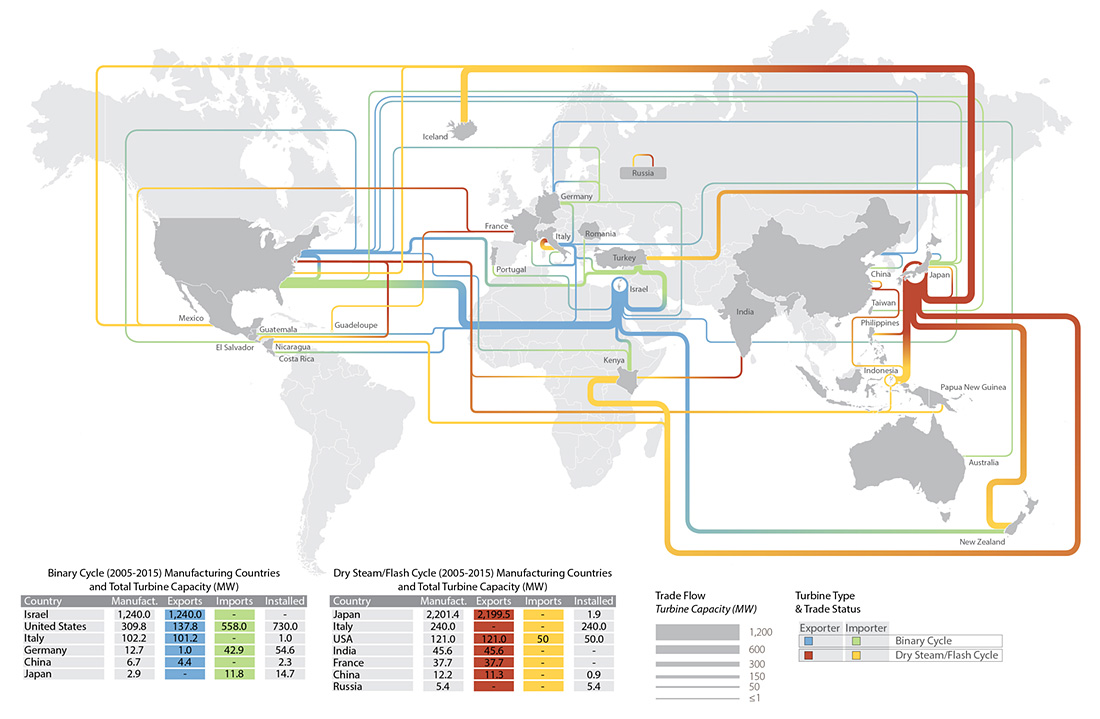
Although the new power plants were mostly binary cycle, the greatest share of new capacity (49.5%) was in flash cycle plants. The capacity share of binary cycle and dry steam turbines was 38.7% and 11.8% respectively.
Binary cycle turbine manufacturing is dominated by Israel followed by the United States, Italy, and Germany. The flash cycle and dry steam turbine manufacturing is dominated by Japan followed by Spain, the United States, France, Italy, Russia, and China. The attached map shows global trade in these two technology types.
The market for geothermal technology is expected to continue growing and reach about 18.4 GW by 2021. Based on developing projects and forecasts, there will be high demand for a diverse mix of geothermal turbine types from Europe and the United States, East Africa, South East Asia and the South Pacific.
The Clean Energy Manufacturing Analysis Center (CEMAC) is operated by the Joint Institute for Strategic Energy Analysis for the U.S. Department of Energy's Clean Energy Manufacturing Initiative.
Read More........
Although the new power plants were mostly binary cycle, the greatest share of new capacity (49.5%) was in flash cycle plants. The capacity share of binary cycle and dry steam turbines was 38.7% and 11.8% respectively.
Binary cycle turbine manufacturing is dominated by Israel followed by the United States, Italy, and Germany. The flash cycle and dry steam turbine manufacturing is dominated by Japan followed by Spain, the United States, France, Italy, Russia, and China. The attached map shows global trade in these two technology types.
The market for geothermal technology is expected to continue growing and reach about 18.4 GW by 2021. Based on developing projects and forecasts, there will be high demand for a diverse mix of geothermal turbine types from Europe and the United States, East Africa, South East Asia and the South Pacific.
The Clean Energy Manufacturing Analysis Center (CEMAC) is operated by the Joint Institute for Strategic Energy Analysis for the U.S. Department of Energy's Clean Energy Manufacturing Initiative.
Read More........
Science & Technology: Plasma Could Power Faster Geothermal Drilling
Plasma power (OEdigital)
Slovakian company GA Drilling hopes to make short shrift of section milling using a plasma-based downhole tool technology.
Standard milling operations currently involve removing the wellhead and the Xmas tree, then pulling the production tubing, before deploying a section milling tool, often requiring a sizeable and costly rig. GA Drilling, based in Bratislava, says its solution, Plasmabit, will be able to mill out sections of tubing or casing, without having to remove wellheads, Xmas trees or production tubing.
The tool, which could be deployed using a light well intervention vessel, uses a non-mechanical rotating electrical arc, with up to 800 revolutions per second, to create a plasma which will fragment steel, cement, rock or other material, in the well.
The plasma arc is created by passing electricity through a plasma forming media, typically water, which is heated to 3000-6000°C. Hydrodynamic and magnetic forces are then used to either radially or axially direct the plasma arc, for either milling or drilling operations, respectively. The impact and speed of disintegration is computer controlled.
After selling their previous company, they looked for a new challenge, setting up GA Drilling in 2008, which initially focused on the geothermal energy sector.
Geothermal energy has had a big impact in places like Iceland and Slovakia. But, because you have to drill very deep to get the temperatures needed, it can be costly. GA assessed various technologies, including laser drilling and water jetting, but chose plasma, opting to build laboratories and testing facilities to develop and commercialize the technology.
Longer term, the firm anticipates the technology will be a solution for geothermal well drilling. But, it has also been looking at options for well stimulation and even temporary wellbore stability enhancement.
Read More.........
Slovakian company GA Drilling hopes to make short shrift of section milling using a plasma-based downhole tool technology.
The tool, which could be deployed using a light well intervention vessel, uses a non-mechanical rotating electrical arc, with up to 800 revolutions per second, to create a plasma which will fragment steel, cement, rock or other material, in the well.
The plasma arc is created by passing electricity through a plasma forming media, typically water, which is heated to 3000-6000°C. Hydrodynamic and magnetic forces are then used to either radially or axially direct the plasma arc, for either milling or drilling operations, respectively. The impact and speed of disintegration is computer controlled.
After selling their previous company, they looked for a new challenge, setting up GA Drilling in 2008, which initially focused on the geothermal energy sector.
Geothermal energy has had a big impact in places like Iceland and Slovakia. But, because you have to drill very deep to get the temperatures needed, it can be costly. GA assessed various technologies, including laser drilling and water jetting, but chose plasma, opting to build laboratories and testing facilities to develop and commercialize the technology.
Longer term, the firm anticipates the technology will be a solution for geothermal well drilling. But, it has also been looking at options for well stimulation and even temporary wellbore stability enhancement.
Read More.........
USA, Wyoming: Geothermal Brine a Source for Rare Earth Elements
UW, INL Researchers Study Pulling Rare Earth Elements from Industrial Waters (University of Wyoming)


University of Wyoming (UW) researchers have joined colleagues from the Idaho National Laboratory (INL) and U.S. Geological Survey (USGS) to study the potential for retrieving rare earth elements from water produced in oil and gas production and geothermal projects.
The U.S. Department of Energy recently announced that the UW/INL/USGS research project is one of four selected to receive up to $4 million to assess the occurrence of rare earth minerals and other critical materials that may be dissolved in high-temperature fluids associated with energy extraction.
Science & Technology: Developing Better Deep Geothermal Pumps
Improving pumps for geothermal energy requirements (IDW-online)
 Geothermal power plants and heating networks use natural water resources from deep water and rock strata. In terms of the efficiency of the plants, the drilling costs and the premature wear and replacement of the feed pumps have previously made a considerable impact on the balance sheet.
The BINE-Projektinfo brochure "Developing robust pumps for geothermal energy" (03/2016) presents modified submersible centrifugal pumps that are specifically adapted to the requirements of deep geothermal energy.
The prototypes for the new pumps are already able to withstand the mineral deposits from the thermal water for longer and provide greater energy efficiency than the previous units.
Read More........
The BINE-Projektinfo brochure "Developing robust pumps for geothermal energy" (03/2016) presents modified submersible centrifugal pumps that are specifically adapted to the requirements of deep geothermal energy.
The prototypes for the new pumps are already able to withstand the mineral deposits from the thermal water for longer and provide greater energy efficiency than the previous units.
Read More........
USA, California: Song to Raise Money for Victims of Devastating Fire in The Geysers Geothermal Field
Community chorus comes together at Calpine (Lake County Record Bee)

Calpine Geothermal Visitor Center will host 40-60 singers to record “Valley Fire” song on Tuesday, with rehearsals Monday.
The dozens of singers will be part of the community chorus for the song inspired by last November’s deadly and destructive fire in The Geysers geothermal field.
The project is a fundraiser, and the strategy is to take the song and make a Youtube music video incorporating some of the horrific fire footage in order to attract potential donors to the website www.valleyfiresong.org, where they can give to groups assisting with recovery efforts.
The GRC will offer three GRC Fieldtrips to The Geysers from the 40th GRC Annual Meeting & GEA Geothermal Energy Expo, October 23-26 in Sacramento, California, USA.
Read More.......

Calpine Geothermal Visitor Center will host 40-60 singers to record “Valley Fire” song on Tuesday, with rehearsals Monday.
The dozens of singers will be part of the community chorus for the song inspired by last November’s deadly and destructive fire in The Geysers geothermal field.
The project is a fundraiser, and the strategy is to take the song and make a Youtube music video incorporating some of the horrific fire footage in order to attract potential donors to the website www.valleyfiresong.org, where they can give to groups assisting with recovery efforts.
The GRC will offer three GRC Fieldtrips to The Geysers from the 40th GRC Annual Meeting & GEA Geothermal Energy Expo, October 23-26 in Sacramento, California, USA.
Read More.......
Mexico: EU Funded GEMex project to Develop Geothermal Energy
EU and Mexico launch the first joint geothermal research project (European Commission)


The three-year project will start in the autumn of 2016. The ultimate objective is to make geothermal energy source cost-effective and affordable both for electricity and heat production.
European and Mexican researchers will work together on tapping into new sources of geothermal energy in the context of GEMex, an international project that was selected in a joint call launched by the European Union and Mexico.
Carlos Moedas, European Commissioner for Research, Science and Innovation, and Pedro Joaquín Coldwell, Mexican Secretary of Energy, announced the result in the margins of the Clean Energy Ministerial Meeting on 2 June in San Francisco.
The EU and Mexico contribute equally to the €20 million project. The EU's share comes from Horizon 2020, its €77 billion research and innovation funding program (2014–2020), and the other from Mexico's Fondo de Sustenibilidad Energética (SENER) - Consejo Nacional de Ciencia y Tecnología (CONACYT).
European and Mexican researchers will work together on tapping into new sources of geothermal energy in the context of GEMex, an international project that was selected in a joint call launched by the European Union and Mexico.
Carlos Moedas, European Commissioner for Research, Science and Innovation, and Pedro Joaquín Coldwell, Mexican Secretary of Energy, announced the result in the margins of the Clean Energy Ministerial Meeting on 2 June in San Francisco.
The EU and Mexico contribute equally to the €20 million project. The EU's share comes from Horizon 2020, its €77 billion research and innovation funding program (2014–2020), and the other from Mexico's Fondo de Sustenibilidad Energética (SENER) - Consejo Nacional de Ciencia y Tecnología (CONACYT).
Caribbean: How to Promote a Geothermal Power Project
Laying a Resilient Foundation for Geothermal in the Caribbean (Renewable Energy Magazine)

Exploratory geothermal drilling is underway in several Caribbean countries, generating new excitement for the potential advances that development in the industry could bring.

Dominica has already confirmed a capacity of approximately 65 MW, while St. Lucia, Grenada and St. Kitts and Nevis are all in various stages of exploration. Moreover, St. Vincent and the Grenadines recently received a $5.7 million grant through a Memorandum of Understanding signed to help defray the costs of drilling.
As suitability for geothermal plants on various islands in the Caribbean is determined, it is important for companies, governments and public-private partnerships to work together to educate communities about both the process and potential benefits, even in the earliest stages, to ensure public support when it comes time to announce plans for the permanent plant.
Mexico: EU to Fund R&D in Geothermal Energy
Mexico to quadruple clean energy R&D investment (Business News Americas)
Centers for innovation in geothermal to be established
Mexico will quadruple investment in clean energy research and development over the next five years to US$310 million, according to an energy ministry statement.
The ramping up of investment is part of the country's obligations assumed at the COP21 climate conference in Paris last year, energy minister Pedro Joaquín Coldwell said during a visit to San Francisco, California, to attend the seventh ministerial clean energy meeting (CEM7).
He said that the US$310 million will be used to develop five centers for innovation, focusing on geothermal, solar, wind, bio-energy and wave power, as well as one for smart grids and another for carbon capture.
Mexico will also sign an agreement with the European Union on cooperation in research and development in geothermal energy over the next three years, to which each party will contribute 10 million euros (US$11.1 million), the ministry said.
Read More........
Centers for innovation in geothermal to be established
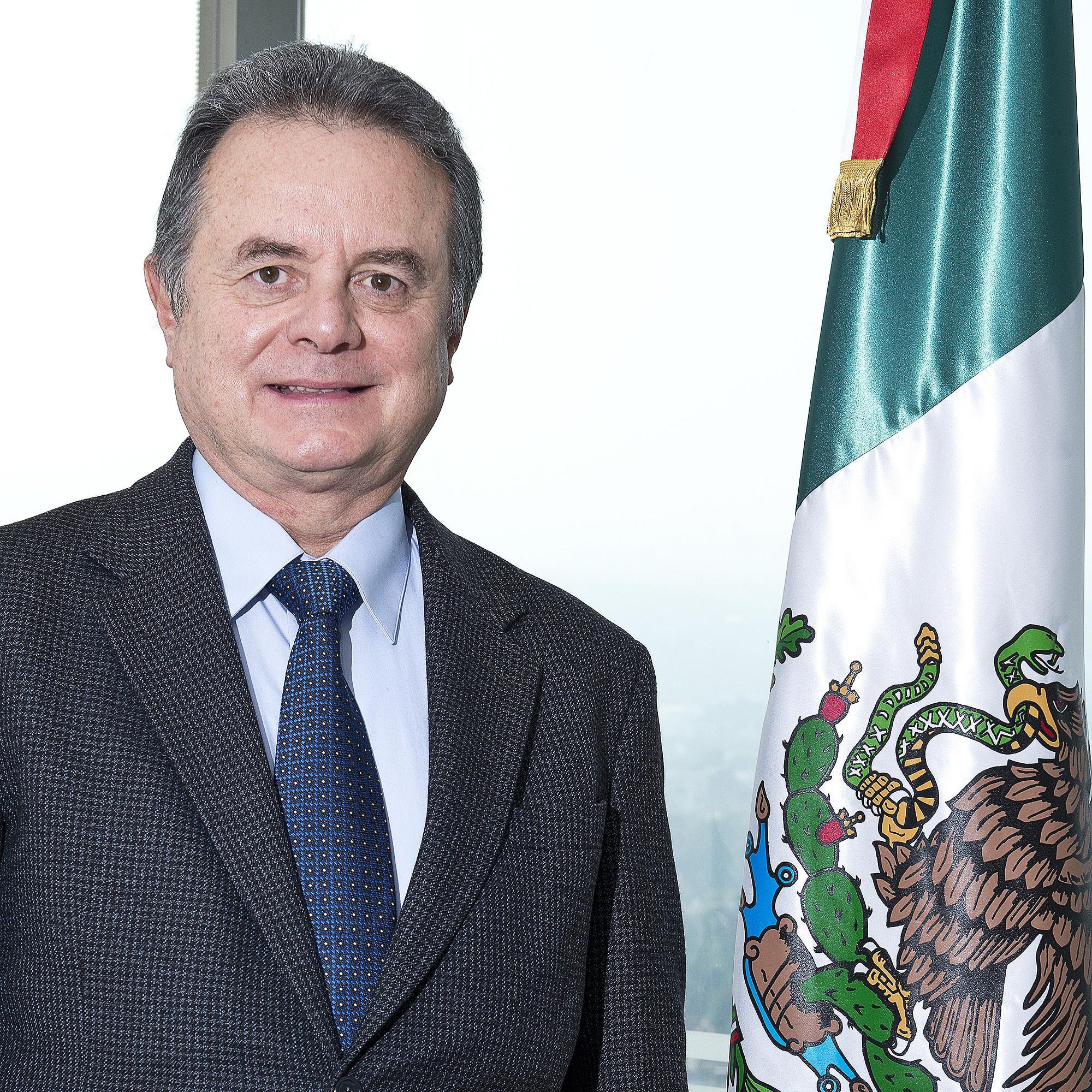 |
| Mexico energy minister Pedro Joaquín Coldwell |
The ramping up of investment is part of the country's obligations assumed at the COP21 climate conference in Paris last year, energy minister Pedro Joaquín Coldwell said during a visit to San Francisco, California, to attend the seventh ministerial clean energy meeting (CEM7).
He said that the US$310 million will be used to develop five centers for innovation, focusing on geothermal, solar, wind, bio-energy and wave power, as well as one for smart grids and another for carbon capture.
Mexico will also sign an agreement with the European Union on cooperation in research and development in geothermal energy over the next three years, to which each party will contribute 10 million euros (US$11.1 million), the ministry said.
Read More........
Commonwealth of Dominica: "Geothermal Project Should Not be Left on Back Burner"
Baroness Sandip Verma Brings Good News On First Visit To Dominica
Plans are for construction of a 7.5- 8 MW geothermal plant
 The advancement of Dominica’s geothermal project took center stage as United Kingdom’s Parliamentary Under Secretary of State for International Development, Baroness Sandip Verma, paid an official visit to Dominica this week.
Baroness Verma expressed to the Dominica leader the UK government’s keen interest in the long term economic development of the island.
She informed Hon Skerrit that more funds were available for the advancement of the geothermal project.
“You obviously have a vision for your country,” she said to the Hon. Prime Minister. “We also have a vision for how we can support your growth agenda. My urge to you is that there is funds available, about $20m. Along with other partners coming together, the geothermal project should not be left on the back burner for a long time.
“You have already done the mapping and the drilling exercises. My urge would be let’s get on with it and let’s get a move on because it’s something that would demonstrate the seriousness of our relationship to get the economic growth story going. Also it allows investors to see the seriousness because then you will have a competitive edge with competitive energy pricing.”
Read More.........
Plans are for construction of a 7.5- 8 MW geothermal plant

Baroness Verma expressed to the Dominica leader the UK government’s keen interest in the long term economic development of the island.
She informed Hon Skerrit that more funds were available for the advancement of the geothermal project.
“You obviously have a vision for your country,” she said to the Hon. Prime Minister. “We also have a vision for how we can support your growth agenda. My urge to you is that there is funds available, about $20m. Along with other partners coming together, the geothermal project should not be left on the back burner for a long time.
“You have already done the mapping and the drilling exercises. My urge would be let’s get on with it and let’s get a move on because it’s something that would demonstrate the seriousness of our relationship to get the economic growth story going. Also it allows investors to see the seriousness because then you will have a competitive edge with competitive energy pricing.”
Read More.........
USA, Hawaii: Project will Study Dispersion of Gases from the Puna Geothermal Power Plant
Puna Geothermal Air Quailty Model Approved (Big Island Video News)
The Windward Planning Commission has approved a Hawaii County Civil Defense request to release funds for an updated air quality model for the area surrounding Puna Geothermal Venture. The project will study the dispersion of hydrogen sulfide and other gases from the Pohoiki power plant.
Past and present civil defense heads presented the request to commissioners during a meeting in Hilo on Thursday. Retired former Civil Defense chief Darryl Oliveira sat beside present and interim Civil Defense administrator Ed Teixeira during the hearing. Both supported the use of the Geothermal Asset Fund for the project, which will total $362,719.
Read More........
The Windward Planning Commission has approved a Hawaii County Civil Defense request to release funds for an updated air quality model for the area surrounding Puna Geothermal Venture. The project will study the dispersion of hydrogen sulfide and other gases from the Pohoiki power plant.
Past and present civil defense heads presented the request to commissioners during a meeting in Hilo on Thursday. Retired former Civil Defense chief Darryl Oliveira sat beside present and interim Civil Defense administrator Ed Teixeira during the hearing. Both supported the use of the Geothermal Asset Fund for the project, which will total $362,719.
Read More........
Thursday, June 2, 2016
Global: Vote for the New IGA Board
IGA Board Elections 2016-2019
IGA members are invited to vote for up to 30 candidates until 1 July 2016.
The online voting platform for the IGA Board of Directors election is now available on the IGA website.
Of the 43 candidates 10 are GRC Members:
IGA members are invited to vote for up to 30 candidates until 1 July 2016.
The online voting platform for the IGA Board of Directors election is now available on the IGA website.
All IGA members are invited to vote for up to 30 Board candidates with their personal login details until Friday, 1 July 2016. All Board candidates including their statements are displayed online.
The new IGA Board of Directors will commence their work in October 2016 and be active until October 2019. Usually, the IGA Board consists of 30 Board members representing many different countries (see current Board members list).
The new IGA Board of Directors will commence their work in October 2016 and be active until October 2019. Usually, the IGA Board consists of 30 Board members representing many different countries (see current Board members list).
All GRC Members are automatically members of the IGA and are therefore eligible to vote in the election.
- Andy Blair (New Zealand)
- Paul Brophy (USA)
- Louis Capuano, Jr (USA)
- Varun Chandrasekhar (India)
- Gustavo Cuellar (El Salvador)
- Paul Moya (Costa Rica)
- Abadi Poernomo (Indonesia)
- Andrew Sabin (USA)
- Toshihiro Uchida (Japan)
- Shigeto Yamada (Japan)
USA: Resource Guide to U.S. Government Programs that Support Development of Clean Energy Projects
Federal Financing Programs For Clean Energy (DOE)
 Federal Financing Programs for Clean Energy is a resource guide to U.S. government programs that support the development of clean energy projects in the U.S. and abroad. Featuring programs from ten agencies, the guide includes summaries and case studies that can benefit private sector partners in finding capital for energy efficiency and clean energy projects.
Now in its third edition, the guide includes financing programs for both domestic and international projects. For every program listed, the guide identifies additional contact information to answer questions and provide additional direction. The guide includes programs from the U.S. Departments of Agriculture, Energy, Housing and Urban Development, State, Transportation and Treasury, along with the Environmental Protection Agency, Overseas Private Investment Corporation, and the Small Business Administration.
Federal Financing Programs for Clean Energy (PDF)
Now in its third edition, the guide includes financing programs for both domestic and international projects. For every program listed, the guide identifies additional contact information to answer questions and provide additional direction. The guide includes programs from the U.S. Departments of Agriculture, Energy, Housing and Urban Development, State, Transportation and Treasury, along with the Environmental Protection Agency, Overseas Private Investment Corporation, and the Small Business Administration.
Federal Financing Programs for Clean Energy (PDF)
USA, California: Community Choice Aggregator to Begin Operations Next Year
Portola Valley council to set baseline of 100% green electricity (The Almanac)
Peninsula Clean Energy launches in April 2017 serving communities in San Mateo County, south of San Francisco
 Portola Valley's Town Council approved a plan on May 25 that will have the greenest baseline possible in effect when a program launches in April 2017 offering residents renewable sources of electricity, including geothermal, as alternatives to the sources used by Pacific Gas & Electric company.
By unanimous vote, the council's action assigns households in Portola Valley to the greenest of two choices -- 100 percent of electricity from renewable sources or 50 percent -- expected to be on offer from the countywide Peninsula Clean Energy program.
Read More........
Peninsula Clean Energy launches in April 2017 serving communities in San Mateo County, south of San Francisco

By unanimous vote, the council's action assigns households in Portola Valley to the greenest of two choices -- 100 percent of electricity from renewable sources or 50 percent -- expected to be on offer from the countywide Peninsula Clean Energy program.
Read More........
Wednesday, June 1, 2016
Kenya: Government to Reimburse KenGen for Drilling Geothermal Wells
KenGen seeks Sh5.8bn refund from State for geothermal wells (Business Daily Africa)
 |
| KenGen managing director and chief executive Albert Mugo |
Electricity producer KenGen is seeking a Sh5.8 billion refund from the government for financing the drilling of geothermal wells with a capacity of 280 megawatts fed to the grid in 2014.
KenGen said that it funded the development of the steam wells at Olkaria in Naivasha on behalf of the Ministry of Energy and Geothermal Development Company — the agency in charge of geothermal energy development.
Ministry of Energy officials said Wednesday that the government would settle the dues owed to KenGen. The government has a 70 per cent majority shareholding in the company.
USA, California: CAISO CEO - “The critical thing is to have the portfolio. It is not solar or wind or geothermal. It is solar and wind and geothermal.”
The head of California's ISO is on a mission to regionalize and decarbonize (Utility Dive)
Steve Berberich wants utilities' help in bridging California’s borders and moving beyond 50% renewables
 California’s system operator is moving ahead with its plans to organize 38 independent power providing systems into a western region grid and market.
Nobody is more passionate about this history-making plan than California Independent System Operator (CAISO) President and CEO Steve Berberich. Just-released preliminary assessments of the regionalization plan to integrate the separate balancing authority areas (BAAs) into a single market give him more reason to push ahead.
Historically, that resource portfolio was composed of coal, natural gas, and nuclear energy. State mandates across the West now require renewables but “the same thing holds true,” he said. “We need wind, we need solar, we need geothermal, and we need a portfolio of resources.”
“The critical thing is to have the portfolio. It is not solar or wind or geothermal. It is solar and wind and geothermal,” Berberich stressed.
There will be a GRC Fieldtrip to the headquarters of CAISO from the GRC Annual Meeting & GEA Geothermal Energy Expo, October 23-26, Sacramento, California.
Read More.........
Steve Berberich wants utilities' help in bridging California’s borders and moving beyond 50% renewables

Nobody is more passionate about this history-making plan than California Independent System Operator (CAISO) President and CEO Steve Berberich. Just-released preliminary assessments of the regionalization plan to integrate the separate balancing authority areas (BAAs) into a single market give him more reason to push ahead.
Historically, that resource portfolio was composed of coal, natural gas, and nuclear energy. State mandates across the West now require renewables but “the same thing holds true,” he said. “We need wind, we need solar, we need geothermal, and we need a portfolio of resources.”
“The critical thing is to have the portfolio. It is not solar or wind or geothermal. It is solar and wind and geothermal,” Berberich stressed.
There will be a GRC Fieldtrip to the headquarters of CAISO from the GRC Annual Meeting & GEA Geothermal Energy Expo, October 23-26, Sacramento, California.
Read More.........
Subscribe to:
Posts (Atom)