Showing posts sorted by date for query Pilgrim Hot Springs. Sort by relevance Show all posts

Monday, July 15, 2019

USA, Alaska: The Potential for Geothermal Energy in The Last Frontier

Geothermal development is heating up in Alaska (KTUU.com)

Volcanoes along the Aleutian chain, hot springs in the interior and the Southeast. these are Alaska's three main geothermal resources. Lisa Murkowski has encouraged Alaskans to develop them. Gwen Holdmann, Director of the Alaska Center for Energy and Power (ACEP) says the main thing stopping development is the distance.

“At the end of the day, if you're looking at economic development of these resources, you need to have some sort of a load within a reasonable distance to make it worth developing or some way to attract industry to that location,” Holdmann says.

The ACEP has looked at ways to get around the distances between heat sources and population centers, and one solution they've found is agriculture.

“That's one of the things that we've worked with Pilgrim Hot Springs out in Western Alaska on is having local food production, and then exporting that food to other parts of the region," Holdmann says.

Thursday, June 9, 2016

USA, Alaska: Pilgrim Hot Springs Geothermal Waters to be Used in Direct Use Project

Unaatuq Breaks Ground on Pilgrim Hot Springs Development (KNOM)

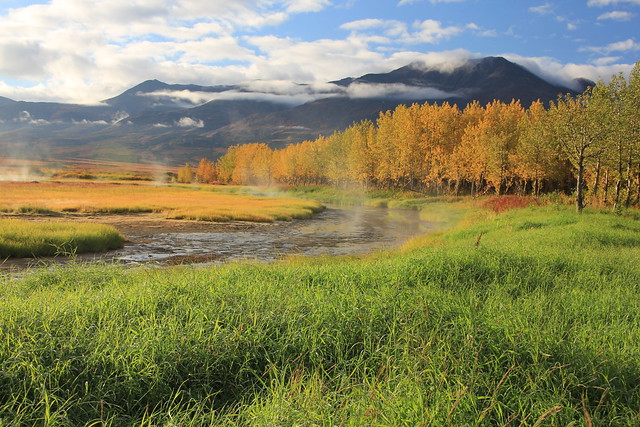
Mountain view at Pilgrim Hot Springs.
(Photo: Maddie Winchester, KNOM)
Starting this summer, an abandoned hot springs in the heart of western Alaska will go from a deteriorating historical site to an operational community garden. At least that’s the vision of Unaatuq, LLC, a consortium of seven regional organizations that owns the Pilgrim Hot Springs property.

The Alaska Center for Energy and Power (ACEP) works closely with Unaatuq. It helped secure a “Conservation Innovation” grant through the National Resource Conservation Service to help fund the Pilgrim Project. Research Engineer Chris Pike sees a connection between the grant’s energy focus and growing food.

“One of the things that we really want to do is use that geothermal energy that’s at Pilgrim Hot Springs to grow vegetables,” said Pike. “And then food is a way to export energy. We always think of electricity and heat, but food is just as much of a need.”

ACEP has determined that the Pilgrim Hot Springs resource should be capable of sustainably generating 2 MW of electric power, which could be used locally or delivered to Nome or other nearby loads via the construction of a power line.

Read More.......

Monday, June 15, 2015

USA, Alaska:


Wednesday, 6/17 @ 9 p.m.


Frontier Scientists presents a new video about Pilgrim Hot Springs, a geothermal resource about 50 miles outside of Nome, Alaska. Nome community partners and scientists describe the potential and exploration of the geothermal hot springs, considered to be the largest identified geothermal resource in the Central Alaska Hot Springs Belt.

Monday, November 24, 2014

USA, Alaska:

Geothermal Energy at Pilgrim Hot Springs Could Help Nome’s Costly Power Problem  (KTVA CBS 11 News Alaska)

Alaska’s oil boom days may be more numbered than we realize. Because of this, a popular hot springs near Nome is hoping to tap into an underground heat source to help solve its rising electricity costs.

The site is located on the outskirts of Nome, about 60 miles away in a valley surrounded by mountains.

“It’s a very unique place,” said Kevin Behnke, a longtime Nome resident. For decades, Alaskans have traveled to this oasis known as Pilgrim Hot Springs. “I grew up in this area, so my whole family has been here since the ’30s,” said Behnke of the hot springs.

It started as a healing place for Eskimos in the surrounding area. Today, however, locals like Behnke want to use the hot springs for more than just a healing soak — they want to harness it for power.

Read More.......

Friday, November 21, 2014

USA, Alaska:

Pilgrim's Progress: An Update on Geothermal Potential in Alaska (EERE/GTO)

"Steaming Pilgrim Lagoon, Fall Colors and Kiqluiak Mountains" - Dick Benoit

A resource in central Alaska is showing promise for geothermal development—the renewable energy that draws on Earth’s natural heat for electricity and other uses. The myriad benefits of this clean, domestic power source make geothermal exploration an attractive proposition for this state, where off-grid demand means that Alaskans often use expensive, polluting diesel power. Today, progress at an Energy Department investment on Native American lands is generating a lot of excitement for geothermal power, turning up enough heat resource to meet the electricity needs of surrounding communities and industries.

At Pilgrim Hot Springs, 50 miles northeast of Nome, the Alaska Center for Energy and Power (ACEP) has found a sufficient geothermal resource from exploration drilling to tap geothermal energy for a spectrum of uses, including on-site power generation. In fact, experts consider the resource at Pilgrim to be the largest identified geothermal resource on the Seward Peninsula. Developments there could also potentially allow the native community to develop the geothermal resource in order to relocate at Pilgrim. To conduct this exploration work, ACEP partnered with the Energy Department’s Geothermal Technologies Office.

Monday, November 3, 2014

USA, Alaska:

Geothermal Source Found for Pilgrim Hot Springs (KNOM)

"Pilgrim Hot Spring and Church in Fall" by Dick Benoit
It’s a project three years, and several wells, in the making. Now, flow testing results from the Alaska Center for Energy and Power (ACEP) indicate that Pilgrim Hot Springs is a viable source of geothermal power — at least on site.

The springs, located 37 miles outside of Nome, have been poked and prodded since last October, as engineers search for the ever elusive “upflow zone”: An optimal combination of high temperatures and water volume needed to produce 2 megawatts of electricity.

Gwen Holdmann, director of ACEP, said the results from a flow test conducted in September at the spring “exceeded expectations.”

Besides confirming a viable power source for the immediate surroundings, the latest data also points to another important piece of the puzzle: The hot springs’ source.

Read More......

Friday, June 27, 2014

USA, Alaska:

Geothermal Exploration at Pilgrim Hot Springs (Frontier Scientists)


(VIDEO 7:28 minutes)

Whereas past scientific explorations at Pilgrim Hot Springs determined developing geothermal energy at Pilgrim Hot Springs would be too difficult, new technologies have opened up new possibilities.

“At that time [30 years ago] the resource was deemed not developable based on the current technology and the current understanding of the resource. However when we looked at the data two years ago we realized there was some potential with improved technology and utilizing the new research findings in developing low temperature sites, such as the power plant at Chena Hot Springs.” ~Gwen Holdman

Read More......

Wednesday, June 25, 2014

USA, Alaska:

Measuring and Modeling Geothermal Resources at Pilgrim Hot Springs (Frontier Scientists)

Pilgrim Hot Springs simulation data points (below ground) / Ronald Daanen
There’s a place where the perennially frozen ground of the Alaskan tundra is interrupted by 2 square miles [~ 5 km² ] of thawed soil. There, cottonwoods and thick brush grow among lazily meandering waterways.

The Pilgrim Hot Springs are a pleasant symptom of the geothermal heat which warms the earth deep beneath Alaska’s Seward Peninsula, not so far south from the Arctic Circle. There, deep below the surface, hot water rises through fractures in the bedrock that comprises the valley floor.

The Alaska Center for Energy & Power (ACEP), supported by the U.S. Department of Energy and the Alaska Energy Authority, undertook scientific testing to determine whether the geothermal resource at Pilgrim Hot Springs could provide the city of Nome, Alaska, with a worthwhile power source. ACEP brought together an interdisciplinary team of skilled scientific professionals to explore the geothermal potential of the area.

Enter two team members: Ronald Daanen, geohydrologist in the Department of Natural Resources, Division of Geological & Geophysical Surveys, and Anupma Prakash, professor in geophysics remote sensing at the University of Alaska Fairbanks Geophysical Institute. They utilize their expertise to gain data about the geothermal characteristics of Pilgrim Hot Springs valley which combine to create a valuable computational model.

Read More......

Wednesday, December 18, 2013

Global:

Best Geothermal Energy Presentations of 2013 Announced

Geothermal Resources Council announces the best presentations showcased at the 37th GRC Annual Meeting in Las Vegas


The audience at the GRC Annual Meeting listen to a speaker

The Geothermal Resources Council (GRC) has announced the outstanding presentations from the global geothermal community for 2013.

The judging was made in each of the technical sessions held in late September/early October at the 37th GRC Annual Meeting in Las Vegas, the world’s largest annual geothermal energy event. The judging criteria included the technical content, the quality of the visual aids and the presenter’s ability to communicate the subject matter.

Over 150 presentations were made totaling over 50 hours. The GRC 2013 Annual Meeting attendees came from 37 different countries around the world highlighting the global interest in the geothermal industry and the worldwide reach of the GRC.

Click below to see the winning presentations.....

Tuesday, November 5, 2013

USA, Alaska:

Will Pilgrim Hot Springs Solve Nome’s Energy Needs? (Alaska Dispatch)

Pilgrim Hot Springs Area (Courtesy ACEP UAF)
After drilling several test holes at a hot springs near Nome, scientists and prospective developers of a planned geothermal electric project still haven’t found the energy they need. But they may be getting close.

A production-size hole -- big enough to be turned into a working geothermal power plant -- was drilled in September. It produced plenty of water, one of the requirements for a planned 2 MWe power plant. But the water wasn’t quite hot enough. Two smaller holes were later drilled into the tundra at Pilgrim Hot Springs, 60 miles northeast of Nome, in mid-October to test for hotter water temperatures, but scientists aren’t sure yet if the site will produce fluid near 190 degrees Fahrenheit. That’s the threshold for a geothermal plant to produce enough energy at the site to make it a worthwhile endeavor.

Read More.....

Friday, November 1, 2013

USA, Alaska:

Profile: Pilgrim Hot Springs Geothermal Project (KNOM Radio)

Since late August, researchers and drillers have been living on site at Pilgrim Hot Springs, working around the clock to answer Nome’s energy question: Can Pilgrim fuel a geothermal power plant? Engineers say yes. And a crew has been collecting data all summer to confirm that answer. Listen to hear an in depth review of the project (AUDIO 15:34 Minutes).

Wednesday, September 4, 2013

USA, Alaska:

Nome Chamber of Commerce Supports Geothermal Research (Alaska Business Monthly)

The Nome Chamber of Commerce has expressed support for geothermal research, committing $5000 to support work that has the potential to generate economic benefits for the region.

University of Alaska Fairbanks (UAF)’s Alaska Center for Energy and Power has spearheaded a resource assessment at Pilgrim Hot Springs in conjunction with the land owner Unataaq (a partnership between seven local native corporations and non-profit organizations), the City of Nome in Northwest Alaska, on the Seward Peninsula, and UAF’s Geophysical Institute.

Preliminary results show that the geothermal resource at Pilgrim Hot Springs has the potential to generate two to four MWe.  If coupled with an existing 2.8 MWe of installed wind power in Nome, it would mean the community could be served by 100% renewable generation at some times of the year. This finding and its future potential for the community has interested a private energy developer, Pilgrim Geothermal LLC, who would like to develop the resource and transmit power to Nome should it be shown capable of generating at least 2 MWe of power.

Read More.....